
Global Full-Funnel Attribution Platform Market Valued at US$6,377 Million in 2026, Projected to Reach US$13,758 Million by 2032 at 13.7% CAGR
Published Date: Friday,23 Oct,2026


 Full-Funnel Attribution Platform
Global Full-Funnel Attribution Platform Market Research Report
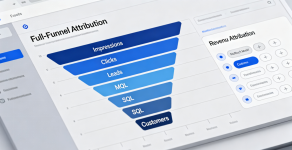
A full-funnel attribution platform is a digital analytics platform used to integrate marketing, sales, customer success and revenue data. It tracks the complete journey of prospects from first touch, content browsing, ad clicks, form submission, sales follow-up and opportunity conversion to final deal closing, repeat purchase and renewal. Through rule-based attribution, algorithmic attribution, multi-touch attribution or data-driven attribution models, it evaluates the contribution of different channels, campaigns, content, sales actions and customer touchpoints to leads, opportunities, revenue and customer lifetime value. The platform is typically connected with CRM, marketing automation systems, advertising platforms, website analytics tools, email systems and customer data platforms. It is widely used in B2B marketing, SaaS companies, enterprise services, e-commerce and high-ticket sales scenarios, helping enterprises optimize marketing budgets, improve sales conversion efficiency, identify high-value channels and manage revenue growth in a measurable way.
Applications of full-funnel attribution platforms in the automotive, financial services, education and training, and healthcare industries mainly revolve around the chain of "multi-touch customer acquisition - sales conversion - revenue outcome". In the automotive industry, the platform is used to analyze the conversion path from advertising exposure, website visits, vehicle browsing and test-drive booking to dealer follow-up and vehicle purchase, helping automakers and dealers identify high-quality lead sources. In financial services, including banking, insurance, securities and consumer finance, it tracks the full process from online advertising, content marketing and customer consultation to advisor follow-up and product purchase or account opening. In education and training, it analyzes the contribution of search ads, feed ads, live classes, trial lessons and sales follow-up to enrollment and tuition payment. In healthcare, it is mainly used by private hospitals, dental clinics, medical aesthetics institutions, physical examination centers and health management providers to evaluate advertising, online inquiries, appointment booking, on-site conversion and repeat engagement.
Looking ahead, full-funnel attribution in the automotive industry will be further integrated with CRM, dealer management systems, test-drive systems and private-domain operation tools, helping companies measure the contribution of online marketing to offline transactions more precisely. In financial services, greater emphasis will be placed on data compliance, customer segmentation and high-value customer conversion analysis, requiring platforms to balance privacy protection with accurate attribution. In education and training, platforms will move beyond measuring advertising effectiveness to full-cycle analysis of trial lessons, community operations, course consultant follow-up and renewal or repurchase. In healthcare, platforms will pay more attention to closed-loop attribution from online acquisition to hospital visits and long-term health management. Overall, the value of full-funnel attribution platforms in these industries will extend from marketing performance assessment to budget optimization, sales efficiency improvement, customer lifecycle management and revenue growth decision support.
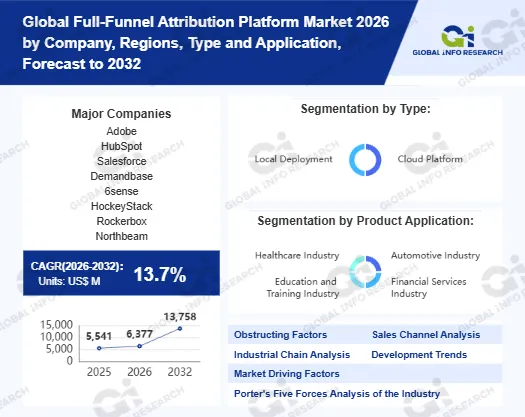
According to the latest research"Global Full-Funnel Attribution Platform Market 2026 by Manufacturers, Regions, Type and Application, Forecast to 2032" by GIR (Global Info Research), the global Full-Funnel Attribution Platform market was valued at USD 5541 million in 2025 and is expected to reach approximately USD 6377 million in 2026. The market is further projected to grow significantly to around USD 13758 million by 2032, registering a CAGR of 13.7% during the forecast period. This growth is driven by increasing market demand, technological advancements, and expanding application areas, highlighting strong growth potential and emerging opportunities for industry participants worldwide.
From the demand side, industry growth is mainly driven by rising customer acquisition costs, fragmented marketing channels, longer sales conversion paths and increasing demand for refined revenue growth management. Industries such as automotive, financial services, education and training, and healthcare increasingly need to connect full-process data from advertising, website visits, customer consultation, sales follow-up, deal conversion, repeat purchase and renewal in order to accurately evaluate the contribution of different channels and customer touchpoints to revenue outcomes. From the supply side, the continued maturity of CRM, marketing automation, advertising platforms, CDP, data warehouses and AI analytics tools has provided full-funnel attribution platforms with stronger data access, attribution modeling, visualization analysis and budget optimization capabilities. Platform vendors are also upgrading from single marketing attribution tools to revenue operations analytics platforms covering marketing, sales and customer success. Overall, full-funnel attribution platforms are becoming important tools for enterprises to improve marketing ROI, optimize sales funnels, reduce customer acquisition costs and achieve measurable revenue growth. The market is expected to maintain relatively fast growth, while data compliance, cross-system integration complexity, attribution model accuracy and customer data quality will remain major challenges.
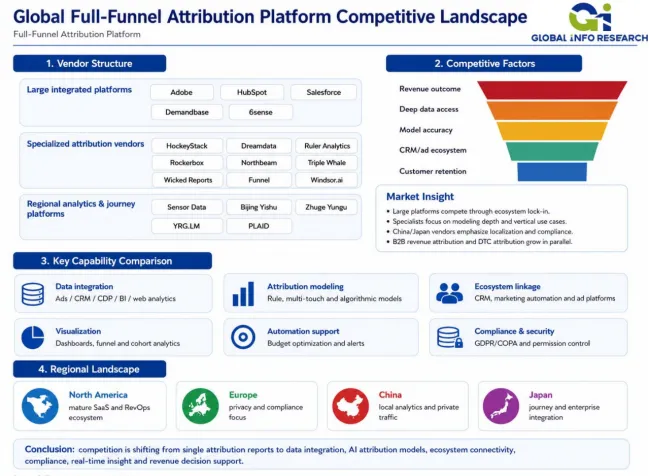
Participants in the global full-funnel attribution platform market include large international marketing technology, CRM and revenue operations platform providers represented by Adobe, HubSpot, Salesforce, Demandbase and 6sense, as well as specialized attribution analytics, advertising measurement and revenue analytics vendors represented by HockeyStack, Dreamdata, Ruler Analytics, Rockerbox, Northbeam, Triple Whale, Wicked Reports, Funnel, Windsor and Fospha. The market also includes regional data analytics and customer journey management platforms such as Sensors Data, Beijing Yishu Technology, Zhuge Yunyou Technology, YRGLM and PLAID. Representative companies include Adobe, HubSpot, Salesforce, Demandbase, 6sense, HockeyStack, Rockerbox, Northbeam, Triple Whale, Wicked Reports, Dreamdata, Ruler Analytics, Funnel, Windsor, Fospha, Sensors Data, Beijing Yishu Technology, Zhuge Yunyou Technology, YRGLM and PLAID. The competitive landscape is characterized by the coexistence of large comprehensive platforms and vertical specialists, strong technology and ecosystem advantages among European and American vendors, accelerating localization by Chinese and Japanese vendors, and parallel development of B2B revenue attribution and e-commerce/DTC advertising attribution. Future competition will gradually shift from single attribution reports and channel ROI analysis to comprehensive competition in multi-source data integration, AI attribution modeling, CRM and advertising ecosystem connectivity, data compliance, real-time insight and revenue growth decision support.
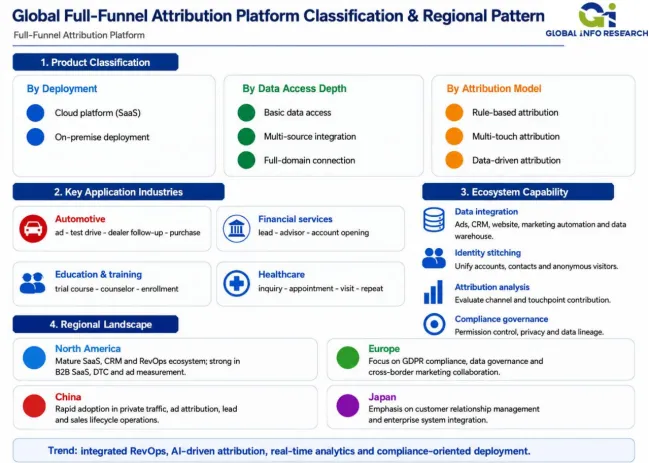
From a product classification perspective, relatively stable dimensions for full-funnel attribution platforms include deployment mode, data access depth and attribution model complexity. By deployment mode, platforms can be divided into cloud platforms and on-premise deployment. Cloud platforms are mainly based on SaaS subscriptions, with shorter deployment cycles and stronger scalability, making them suitable for most enterprises to quickly connect advertising, CRM, website analytics and marketing automation data. On-premise deployment is more suitable for financial services, healthcare, automotive and other industry customers with higher requirements for data security, permission control and private management. By data access depth, platforms can be divided into basic data access, multi-source data integration and full-domain data connection. Basic data access mainly covers advertising, website visits and CRM basic data; multi-source data integration further connects marketing automation, customer data platforms, sales engagement tools and data warehouses; full-domain data connection emphasizes a complete customer journey from acquisition, leads, opportunities and closed deals to renewal and repeat purchase. By attribution model complexity, platforms can be divided into rule-based attribution, multi-touch attribution and data-driven attribution. Rule-based attribution mainly relies on fixed rules such as first-touch, last-touch and linear attribution; multi-touch attribution distributes contribution weights across multiple customer touchpoints; data-driven attribution combines algorithmic models, machine learning and incremental analysis methods to improve the dynamism and accuracy of attribution results.
From a regional perspective, North America is a relatively mature market for full-funnel attribution platforms. Enterprise digital marketing, CRM adoption, the SaaS ecosystem and revenue operations concepts are widely developed, and platform vendors are competitive in B2B SaaS, e-commerce/DTC, enterprise services and advertising measurement scenarios. The European market places greater emphasis on data privacy, compliance governance and cross-border marketing collaboration. When selecting full-funnel attribution platforms, enterprises usually focus more on GDPR compliance, data controllability, localized services and multilingual support, creating opportunities for platforms with strong compliance capabilities and cross-region data integration. The Chinese market is in a stage of rapid penetration. Enterprises have growing digital needs in private-domain operations, advertising, lead management, sales conversion and customer lifecycle management, while local platforms have strong adaptability in data tracking, user behavior analysis, marketing automation and industry-specific customization. The Japanese market places greater emphasis on customer relationship maintenance, refined operations and enterprise system integration. Full-funnel attribution platforms are mainly applied in advertising effectiveness evaluation, customer journey analysis, B2B sales management and brand marketing optimization, and the depth of market application is expected to increase as demand for digital marketing and data-driven decisions grows.
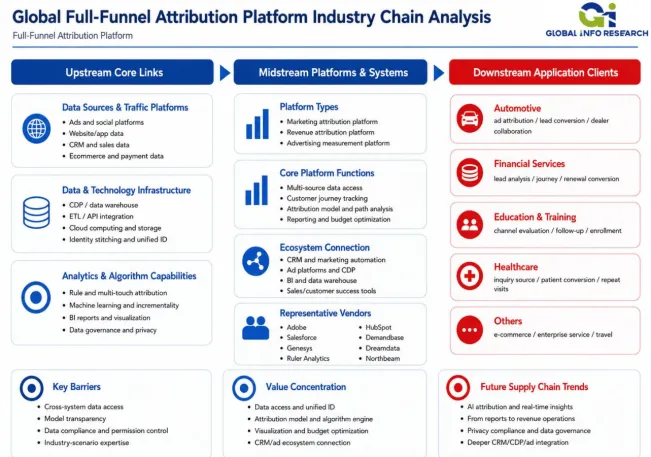
In the future, full-funnel attribution platforms will further develop toward integrated revenue operations. The platform will no longer be only an analytics tool for measuring advertising or marketing campaign effectiveness; instead, it will gradually connect marketing, sales, customer success and financial revenue data, covering the complete chain from traffic acquisition, lead generation and opportunity advancement to deal conversion, renewal and repeat purchase. As customer acquisition costs rise and sales cycles lengthen, customers will pay more attention to the real contribution of each channel, content, campaign and sales action to final revenue.
From a technology perspective, full-funnel attribution platforms will continue to upgrade toward AI-driven, real-time analytics and data-driven attribution. Traditional rule-based models such as first-touch, last-touch and linear attribution will increasingly be combined with machine learning, predictive analytics, incrementality testing and customer journey modeling, helping enterprises more accurately identify high-value touchpoints and potential conversion opportunities. At the same time, platforms will strengthen connections with CRM, advertising platforms, marketing automation systems, CDP, data warehouses and BI tools to enable automatic synchronization of multi-source data, real-time dashboard monitoring and dynamic budget optimization.
From a market application perspective, full-funnel attribution platforms will continue to penetrate industries such as automotive, financial services, education and training, healthcare, B2B SaaS, e-commerce and enterprise services. In the future, enterprises will have higher requirements for data compliance, privacy protection, localized deployment and cross-system integration. Platform vendors need to balance attribution accuracy, data security, industry customization and ease of use. Overall, industry competition will shift from single-function competition to comprehensive competition in data integration, AI model capability, ecosystem connectivity, compliance capability and revenue growth decision support
Full-Funnel Attribution Platform Report Chapter Summary:
Chapter 1: Full-Funnel Attribution Platform Industry Definition and Market Overview
This chapter clearly defines the product definition, characteristics, and industry statistical scope of Full-Funnel Attribution Platform, systematically introduces its mainstream product classifications and key application areas, and presents the overall size and future outlook of the global market.
Chapter 2: In-depth Analysis of Core Full-Funnel Attribution Platform Companies (2021-2025)
This chapter focuses on the main players in the Full-Funnel Attribution Platform market. For each representative company, it not only introduces its basic overview, main business, and product portfolio, but also highlights its core operating data in the Full-Funnel Attribution Platform field, including sales volume, sales revenue, pricing strategies, and the latest development trends of the company from 2021 to 2025.
Chapter 3: Global Competitive Landscape Analysis (2021-2025)
This chapter examines the global Full-Funnel Attribution Platform competitive landscape from a macro perspective. By comparing the Full-Funnel Attribution Platform sales volume, pricing, revenue, and market share of major companies from 2021 to 2025, it quantitatively analyzes market concentration and interprets the competitive strategies and market position evolution of core manufacturers.
Chapter 4: Full-Funnel Attribution Platform Major Regional Market Size and Prospects (2021-2032)
This chapter conducts a regional-level analysis of the global Full-Funnel Attribution Platform core markets. It will present historical data on the Full-Funnel Attribution Platform market size (sales volume and revenue from 2021-2025) in major regions such as North America, Europe, and Asia Pacific, and provide market outlook forecasts for 2026-2032.
Chapter 5: Full-Funnel Attribution Platform Product Type Segmentation Market Forecast (2021-2032)
This chapter delves into the Full-Funnel Attribution Platform product structure. It will segment the Full-Funnel Attribution Platform market by different types (such as Cloud Platform、Local Deployment, etc.), and analyze in detail the historical market size of each segmented product category from 2021 to 2025 and the future growth trends from 2026 to 2032.
Chapter 6: Full-Funnel Attribution Platform Application Field Segmentation Market Forecast (2021-2032)
This chapter delves into the downstream application demand for Full-Funnel Attribution Platform. The market will be segmented by different application areas (such as Automotive Industry、Financial Services Industry、Education and Training Industry、Healthcare Industry, etc.), presenting the historical market size for each area from 2021-2025 and future demand forecasts from 2026-2032.
Chapters 7-11: In-depth Analysis of Global Regional Markets (2021-2032)
This section is the core module of the Full-Funnel Attribution Platform report, providing an in-depth country/regional analysis across five major regions: North America, Europe, Asia Pacific, South America, and the Middle East & Africa. The chapter structure for each region is consistent:
Segmentation by Country/Region: Analysis of the market size and forecasts for major countries within the region from 2021-2032.
Segmentation by Product Type: Presentation of the market structure and development forecasts for different product types within the region from 2021-2032.
Segmentation by Application Area: Analysis of market demand and prospects for different application areas within the region from 2021-2032.
Chapter 12: Global Full-Funnel Attribution Platform Market Dynamics, Challenges, and Trends
This chapter aims to analyze the key internal and external factors affecting the development of the Full-Funnel Attribution Platform market. It systematically reviews the core drivers of Full-Funnel Attribution Platform market growth, the main obstacles and challenges faced, and assesses future product, technology, and market development trends.
Chapter 13: Full-Funnel Attribution Platform Industry Chain Structure Analysis
This chapter analyzes the entire industry chain ecosystem of the Full-Funnel Attribution Platform industry. From upstream raw material supply to midstream production and manufacturing, and then to downstream end-use applications, it analyzes the current status, cost structure, and collaborative relationships of each link.
Chapter 14: Sales Channel Model Research
This chapter focuses on the distribution channels of Full-Funnel Attribution Platform products. It analyzes the market share, advantages and disadvantages, and typical cases of mainstream sales channels, and explores the innovation and development trends of channel models.
Chapter 15: Research Conclusions and Strategic Recommendations
As a summary of the report, this chapter will distill the core findings and conclusions of the entire report and, based on a comprehensive understanding of the Full-Funnel Attribution Platform market, provide actionable strategic development recommendations for industry participants and potential entrants.
For more information, please refer to "Global Full-Funnel Attribution Platform Market 2026 by Manufacturers, Regions, Type and Application, Forecast to 2032". This report analyzes the supply and demand situation, development status, and changes in the industry, focusing on the development status of the industry, how to face the development challenges of the industry, industry development suggestions, industry competitiveness, and industry investment analysis and trend forecasts. The report also summarizes the overall development dynamics of the industry, including the impact of the latest US tariffs on the global supply chain, the supply relationship analysis of the industrial chain, and provides reference suggestions and specific solutions for the industry in terms of products.
Previous News:
Global GNSS Timing Module Market Valued at US$1,157 Million in 2026, Projected to Reach US$1,897 Million by 2032 at 8.6% CAGR
Next News:
Global Hydraulic Pulverizer Attachment Market Valued at US$132 Million in 2026, Projected to Reach US$169 Million by 2032 at 4.1% CAGR
The copyright of this article belongs to Global Info Research. Without the written authorization of our company, no organization or individual may reprint, quote, copy, adapt or use it for commercial purposes in any way. When authorized to use, the original source must be indicated as "Global Info Research" and the complete copyright information must be retained.
- We Provide Professional, Accurate Market Analysis to Help You Stay Ahead of Your Competition.Speak to our analyst >>

Our Clients
What We Can Provide?
With better results and higher quality products,Our professional reports can achieve four things:

Insight into the industry market information

Analyze market development needs

Prospects for future development

Develop industry investment strategy
- Digging deeper into global industry information and providing market strategies.Contact Us >>
- We Provide Professional, Accurate Market Analysis to Help You Stay Ahead of Your Competition.Speak to our analyst >>
Our Clients
What We Can Provide?
With better results and higher quality products,Our professional reports can achieve four things:
Insight into the industry market information
Analyze market development needs
Prospects for future development
Develop industry investment strategy
- Digging deeper into global industry information and providing market strategies.Contact Us >>