
Soybean Oil-based Printing Ink Market 2026: A 6.3% CAGR Points to a USD 476 Million Opportunity as VOC Regulations and Green Packaging Demand Accelerate Adoption
Published Date: Wednesday,11 Nov,2026


 Soybean Oil-based Printing Ink
 Market Summary
Soybean oil-based printing ink is an environmentally friendly ink with soybean oil as its main component, widely used in printing on paper, cardboard, and other substrates. Its main advantage lies in replacing the petroleum-based solvents commonly used in traditional inks with natural vegetable oil, reducing environmental pollution and emissions of volatile organic compounds (VOCs). Soybean oil-based printing ink exhibits good printing performance, including fast drying speed, excellent color reproduction, and strong lightfastness. During its production, soybean oil, as the main solvent, has low viscosity and high fluidity, resulting in more uniform ink application during printing and reducing printing defects and waste. This ink is suitable for various printing methods, including offset and flexographic printing, and is commonly found in food packaging, environmentally friendly products, and other fields. With the advancement of green and environmentally friendly trends, the use of soybean oil-based ink is gradually increasing, becoming one of the important development directions in the printing industry.

The soybean oil-based printing ink market is experiencing rapid growth, primarily driven by increased environmental awareness and global focus on sustainable development. As environmental regulations become increasingly stringent in various countries, particularly in Europe and the United States, requiring reduced volatile organic compound (VOC) emissions and the use of more environmentally friendly materials, soybean oil-based printing inks, with their low VOC emissions and biodegradable properties, have become an ideal alternative to traditional petroleum-based inks. Furthermore, with the growing demand for green packaging and sustainable printing, more and more companies are choosing soybean oil-based inks, especially in food and beverage packaging and publishing printing. These inks not only provide excellent printing results but also help companies achieve their environmental goals and reduce their environmental burden.
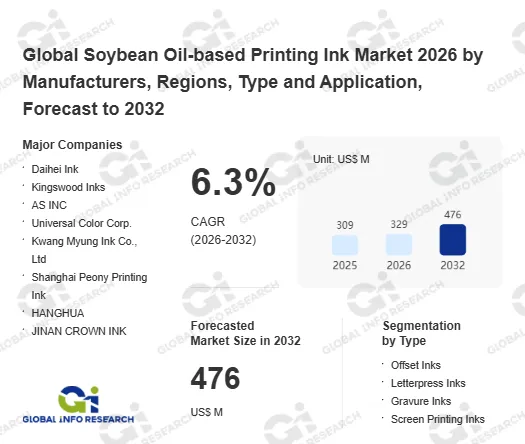
According to the latest report published "Global Soybean Oil-based Printing Ink Market 2026 by Manufacturers, Regions, Type and Application, Forecast to 2032" by GIR (Global Info Research), the global Soybean Oil-based Printing Ink market was valued at approximately USD 309 million and is projected to reach USD 476 million in the coming years, expanding at a CAGR of 6.3%. This growth reflects sustained market momentum and increasing opportunities driven by evolving industry demand and emerging application scenarios.
Additionally, with the gradual stabilization of the soybean oil supply chain and technological advancements, the cost of producing soybean oil-based printing inks is gradually decreasing, making these inks more competitive in the market. As the market penetration of soybean oil-based printing inks increases, manufacturers are continuously improving their performance, such as enhancing color vibrancy, lightfastness, and printability, leading to wider market applications. In the future, with the packaging industry's transformation towards green and environmentally friendly practices and the continuous strengthening of environmental regulations, the market for soybean oil-based printing inks will continue to expand, especially driven by the low-carbon and circular economy, offering even richer business opportunities.
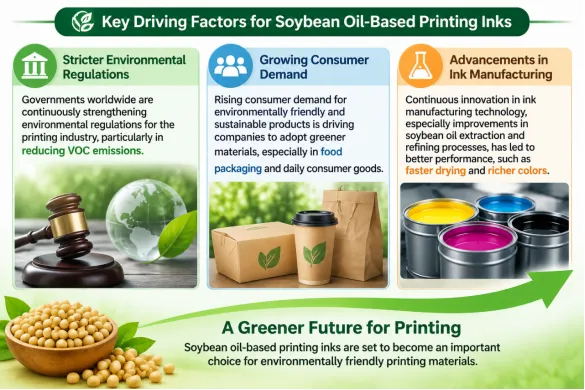
The driving factors for the development of soybean oil-based printing inks mainly include increasingly stringent environmental regulations, increased consumer demand for environmentally friendly products, and advancements in ink manufacturing technology.
Firstly, with the increasing global awareness of environmental protection, governments worldwide are continuously strengthening environmental regulations for the printing industry, particularly in reducing volatile organic compound (VOC) emissions. This provides strong policy support for the promotion of soybean oil-based inks.
Secondly, rising consumer demand for environmentally friendly and sustainable products is driving companies to adopt greener production processes and materials, especially in industries such as food packaging and daily consumer goods, where eco-friendly products are becoming increasingly popular.
Furthermore, continuous innovation in ink manufacturing technology, especially improvements in soybean oil extraction and refining processes, has led to continuous optimization of the performance of soybean oil-based inks, such as improved drying speed and enhanced color saturation, making them more competitive in the market.
These factors combined have driven the rapid development of soybean oil-based printing inks, which are expected to continue to be an important choice for environmentally friendly printing materials in the future.
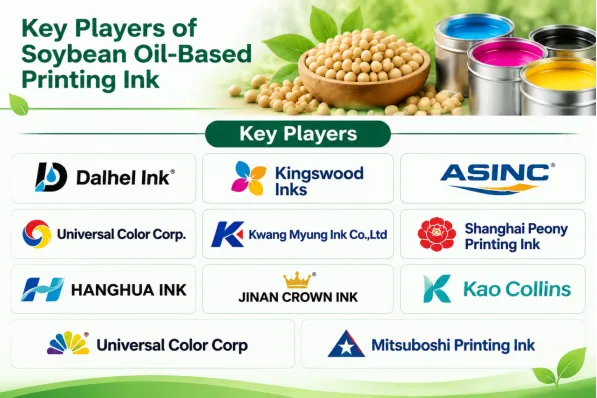 This report profiles key players of Soybean Oil-based Printing Ink such as Dalhel Ink、Kingswood Inks、ASINC、Universal Color Corp.、Kwang Myung Ink Co.,Ltd、Shanghai Peony Printing Ink、HANGHUA INK、JINAN CROWN INK、Kao Collins、Universal Color Corp、Mitsuboshi Printing Ink.
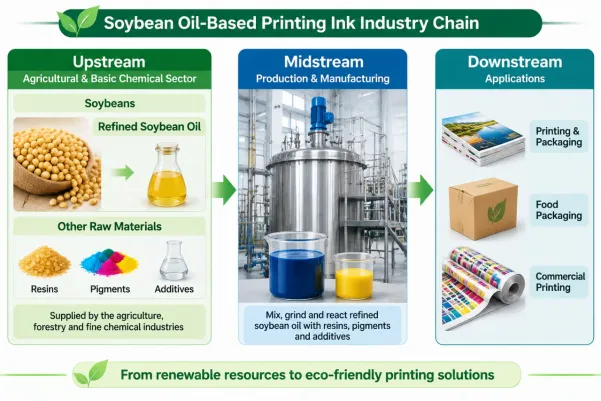
The soybean oil-based printing ink industry chain mainly consists of the following parts: The soybean oil-based printing ink industry chain begins in the upstream agricultural and basic chemical sectors.
Its core raw material is natural soybeans, which are processed through pressing and refining to obtain refined soybean oil, serving as an environmentally friendly alternative to traditional petroleum-based solvents. Simultaneously, the industry chain also requires auxiliary raw materials such as resins (e.g., rosin-modified phenolic resins), pigments, and additives, which come from the forestry and fine chemical industries, respectively. The supply stability of the upstream sector is closely related to soybean production, international oil prices, and fluctuations in the prices of related chemical products.
Entering the midstream production and manufacturing stage, companies mix, grind, and react refined soybean oil with resins, pigments, and additives according to specific formulas.
This process requires controlling key performance indicators such as ink viscosity, drying speed, and color strength. Because soybean oil-based inks possess environmentally friendly characteristics such as being renewable, low in toxicity, and having low volatile organic compound (VOC) emissions, their production equipment and process management must also meet corresponding safety and environmental standards. Currently, this segment is primarily dominated by specialized ink manufacturers, with products subdivided into series of inks for different printing methods such as offset, flexographic, and gravure printing.
Downstream is the printing and application segment.
Soybean oil-based inks are widely used in food packaging, commercial printing, newspapers, children's toys, and books—fields with high environmental and safety requirements. When printing companies use these inks in production, they can improve air quality in their workshops and reduce the difficulty of subsequent recycling and deinking of printed materials. Ultimately, packaging or printed materials printed with soybean oil-based inks enter the consumer goods market, and their waste, due to the plant-based nature of the inks, is more conducive to the recycling of paper or paperboard, thus forming part of a green cycle.
The competitive landscape of the soybean oil-based printing ink market is mainly composed of several factors, including the number of market participants, technological innovation capabilities, production cost control, and environmental certifications.
Major players in the market include globally renowned ink manufacturers and small, innovative companies focused on green and environmentally friendly products. The advantage of soybean oil-based inks lies in their environmentally friendly characteristics, making them an ideal choice to meet increasingly stringent environmental regulations and consumer demands. In this market, leading companies typically possess strong R&D capabilities, enabling them to launch products with optimized performance and better environmental performance, and maintain their market leadership through continuous technological innovation.
Currently, the major players in the soybean oil-based printing ink market include some of the world's leading ink manufacturers. These large companies typically have established extensive production and sales networks globally, leveraging economies of scale and resource advantages to capture a significant market share. Simultaneously, these companies are continuously innovating technologically, enhancing their market competitiveness by developing more efficient, higher-performance, and environmentally friendly ink products. They also expand their market coverage and strengthen brand influence through strategic mergers and acquisitions and partnerships. On the other hand, some smaller businesses and innovative companies are also offering differentiated products, particularly in niche markets, such as inks focused on specific printing methods (e.g., flexographic printing) or specific application areas (e.g., food packaging).
Overall, the soybean oil-based printing ink market is in a stage of continuous development, with competition primarily focused on technological innovation, product differentiation, and environmental compliance. Large ink manufacturers dominate the market due to their strong financial resources, R&D capabilities, and globalized production systems. However, with increasing awareness of green environmental protection and growing demand for customization, smaller innovative companies are gradually becoming an important force in the market. Looking ahead, as environmental regulations become increasingly stringent, competition for green certification will intensify, and technological innovation will continue to be key to success for businesses. Furthermore, the growing trend towards market segmentation necessitates that companies focus more on meeting the needs of specific sectors to increase market share and competitiveness.
Soybean Oil-based Printing Ink Report Chapter Summary:
Chapter 1: Soybean Oil-based Printing Ink Industry Definition and Market Overview
This chapter clearly defines the product definition, characteristics, and industry statistical scope of Soybean Oil-based Printing Ink, systematically introduces its mainstream product classifications and key application areas, and presents the overall size and future outlook of the global market.
Chapter 2: In-depth Analysis of Core Soybean Oil-based Printing Ink Companies (2021-2025)
This chapter focuses on the main players in the Soybean Oil-based Printing Ink market. For each representative company, it not only introduces its basic overview, main business, and product portfolio, but also highlights its core operating data in the Soybean Oil-based Printing Ink field, including sales volume, sales revenue, pricing strategies, and the latest development trends of the company from 2021 to 2025.
Chapter 3: Global Competitive Landscape Analysis (2021-2025)
This chapter examines the global Soybean Oil-based Printing Ink competitive landscape from a macro perspective. By comparing the Soybean Oil-based Printing Ink sales volume, pricing, revenue, and market share of major companies from 2021 to 2025, it quantitatively analyzes market concentration and interprets the competitive strategies and market position evolution of core manufacturers.
Chapter 4: Soybean Oil-based Printing Ink Major Regional Market Size and Prospects (2021-2032)
This chapter conducts a regional-level analysis of the global Soybean Oil-based Printing Ink core markets. It will present historical data on the Soybean Oil-based Printing Ink market size (sales volume and revenue from 2021-2025) in major regions such as North America, Europe, and Asia Pacific, and provide market outlook forecasts for 2026-2032.
Chapter 5: Soybean Oil-based Printing Ink Product Type Segmentation Market Forecast (2021-2032)
This chapter delves into the Soybean Oil-based Printing Ink product structure. It will segment the Soybean Oil-based Printing Ink market by different types (such as Offset Inks、Letterpress Inks、Gravure Inks、Screen Printing Inks, etc.), and analyze in detail the historical market size of each segmented product category from 2021 to 2025 and the future growth trends from 2026 to 2032.
Chapter 6: Soybean Oil-based Printing Ink Application Field Segmentation Market Forecast (2021-2032)
This chapter delves into the downstream application demand for Soybean Oil-based Printing Ink. The market will be segmented by different application areas (such as Commercial Printing、Packaging Printing、Others, etc.), presenting the historical market size for each area from 2021-2025 and future demand forecasts from 2026-2032.
Chapters 7-11: In-depth Analysis of Global Regional Markets (2021-2032)
This section is the core module of the Soybean Oil-based Printing Ink report, providing an in-depth country/regional analysis across five major regions: North America, Europe, Asia Pacific, South America, and the Middle East & Africa. The chapter structure for each region is consistent:
Segmentation by Country/Region: Analysis of the market size and forecasts for major countries within the region from 2021-2032.
Segmentation by Product Type: Presentation of the market structure and development forecasts for different product types within the region from 2021-2032.
Segmentation by Application Area: Analysis of market demand and prospects for different application areas within the region from 2021-2032.
Chapter 12: Global Soybean Oil-based Printing Ink Market Dynamics, Challenges, and Trends
This chapter aims to analyze the key internal and external factors affecting the development of the Soybean Oil-based Printing Ink market. It systematically reviews the core drivers of Soybean Oil-based Printing Ink market growth, the main obstacles and challenges faced, and assesses future product, technology, and market development trends.
Chapter 13: Soybean Oil-based Printing Ink Industry Chain Structure Analysis
This chapter analyzes the entire industry chain ecosystem of the Soybean Oil-based Printing Ink industry. From upstream raw material supply to midstream production and manufacturing, and then to downstream end-use applications, it analyzes the current status, cost structure, and collaborative relationships of each link.
Chapter 14: Sales Channel Model Research
This chapter focuses on the distribution channels of Soybean Oil-based Printing Ink products. It analyzes the market share, advantages and disadvantages, and typical cases of mainstream sales channels, and explores the innovation and development trends of channel models.
Chapter 15: Research Conclusions and Strategic Recommendations
As a summary of the report, this chapter will distill the core findings and conclusions of the entire report and, based on a comprehensive understanding of the Soybean Oil-based Printing Ink market, provide actionable strategic development recommendations for industry participants and potential entrants.
For more information, please refer to "Global Soybean Oil-based Printing Ink Market 2026 by Manufacturers, Regions, Type and Application, Forecast to 2032". This report analyzes the supply and demand situation, development status, and changes in the industry, focusing on the development status of the industry, how to face the development challenges of the industry, industry development suggestions, industry competitiveness, and industry investment analysis and trend forecasts. The report also summarizes the overall development dynamics of the industry, including the impact of the latest US tariffs on the global supply chain, the supply relationship analysis of the industrial chain, and provides reference suggestions and specific solutions for the industry in terms of products.
Previous News:
2026 Three Platen Electric Injection Molding Machine Outlook: 7.0% CAGR Forecast as All-Electric Drives, Multi-Gate Mold Layouts and Precision Clean Molding Push the Market Toward USD 1,541 Million by 2032
Next News:
2026 Resin for Plant Extraction Outlook: 5.5% CAGR Forecast as High-Capacity Reusable Resins, Green Extraction and Continuous Processing Push the Market Toward USD 2,350 Million by 2032
The copyright of this article belongs to Global Info Research. Without the written authorization of our company, no organization or individual may reprint, quote, copy, adapt or use it for commercial purposes in any way. When authorized to use, the original source must be indicated as "Global Info Research" and the complete copyright information must be retained.
- We Provide Professional, Accurate Market Analysis to Help You Stay Ahead of Your Competition.Speak to our analyst >>

Our Clients
What We Can Provide?
With better results and higher quality products,Our professional reports can achieve four things:

Insight into the industry market information

Analyze market development needs

Prospects for future development

Develop industry investment strategy
- Digging deeper into global industry information and providing market strategies.Contact Us >>
- We Provide Professional, Accurate Market Analysis to Help You Stay Ahead of Your Competition.Speak to our analyst >>
Our Clients
What We Can Provide?
With better results and higher quality products,Our professional reports can achieve four things:
Insight into the industry market information
Analyze market development needs
Prospects for future development
Develop industry investment strategy
- Digging deeper into global industry information and providing market strategies.Contact Us >>