
2026 Restaurant Food Delivery Robot Outlook: 6.6% CAGR Forecast as LiDAR SLAM, Generative AI Voice Interaction and Cloud Multi-Robot Dispatching Push the Market Toward USD 276 Million by 2032
Published Date: Wednesday,11 Nov,2026


 Restaurant Food Delivery Robot
 Market Summary
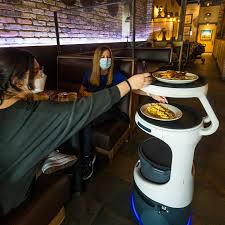
Restaurant Food Delivery Robot is a commercial service robot that is engaged in food delivery, tray return and reception, and belongs to the category of public service robots. It uses artificial intelligence, machine vision, SLAM (simultaneous localization and mapping) and other technologies, and has functions such as automatic driving, voice interaction, and intelligent obstacle avoidance. It can independently complete the task of food delivery and meet the carrying requirements of heavy food and tableware. Its core goal is to improve the efficiency of catering services through automation technology, reduce labor costs, and provide customers with a novel and convenient dining experience. Its core value lies in shifting repetitive, low-skill delivery tasks from human labor to automated equipment, thereby reducing restaurant labor costs, increasing table turnover rates, and enhancing customer experience. Unlike traditional human delivery, Restaurant Food Delivery Robots utilize LiDAR, depth cameras, inertial navigation units, and multi-sensor fusion algorithms to achieve autonomous path planning, dynamic obstacle avoidance, precise docking, and natural language interaction in complex restaurant environments. They can also seamlessly interface with restaurant ordering systems, kitchen display systems (KDS), and call systems, forming an automated delivery closed loop from "kitchen to table."
The global market presents a pattern of "China leading in manufacturing, Europe and the US driving technology, and emerging markets rapidly following." China, as the world's largest manufacturer and application market for catering robots, complete supply chains, rich application scenarios, and intense local competition, a dominant position in manufacturing and large-scale deployment. Europe and the US maintain technological leadership in core algorithms, human-robot interaction design, and high-end catering scenario applications. Emerging markets such as Southeast Asia and the Middle East, driven by tourism catering and large commercial complexes, are becoming important growth regions for Restaurant Food Delivery Robot demand.
Global Restaurant Food Delivery Robot Market Size (US$ Million), 2026-2032
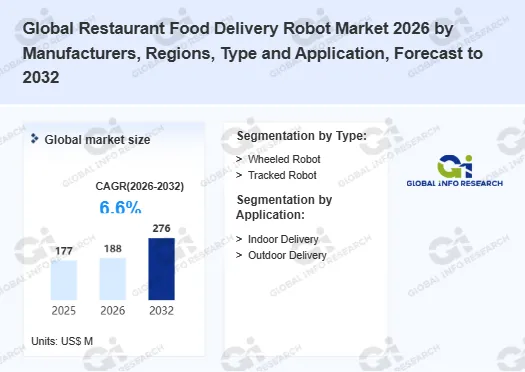
According to the latest report "Global Restaurant Food Delivery Robot Market 2026 by Manufacturers, Regions, Type and Application, Forecast to 2032" published by GIR (Global Info Research), the global Restaurant Food Delivery Robot market was valued at approximately USD 177 million in 2025 and is projected to reach USD 188 million in 2026. With a CAGR of 6.6% during the forecast period from 2026 to 2032, the market is expected to further expand to approximately USD 276 million by 2032. This growth is driven by increasing market demand, evolving industry trends, and expanding application opportunities worldwide.
Technology Characteristics & Product Classification
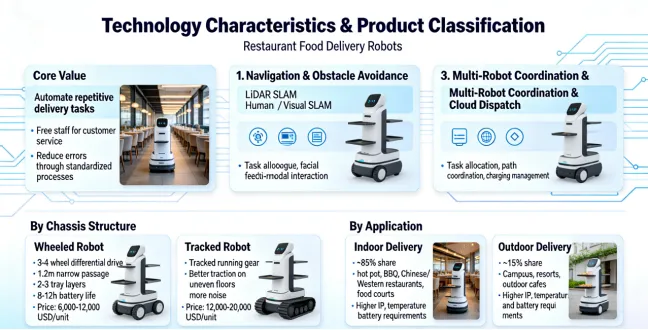
The core technological value of Restaurant Food Delivery Robots lies in automating repetitive, high-frequency delivery tasks, freeing up restaurant staff to focus on customer service and food quality, while reducing human errors through standardized delivery processes.
Key technological trends include: 1. Continuously Enhancing Navigation and Obstacle Avoidance Capabilities, evolving from early magnetic strip navigation and QR code navigation to LiDAR SLAM and visual SLAM, enabling robot deployment without restaurant environment modifications and ensuring stable movement in dynamic scenarios with dense tables, moving people, and temporary obstacles; 2. Naturalized and Intelligent Human-Robot Interaction, evolving from simple screen selection to voice dialogue, facial expression feedback, and multi-modal interaction, allowing robots to introduce dishes, remind customers to pick up orders, and play animations or advertisements while waiting; 3. Mature Multi-Robot Coordination and Cloud Dispatching Systems, achieving task allocation, path coordination, and charging management among multiple robots in the same restaurant through cloud dispatch platforms, avoiding congestion and collisions, while enabling remote status monitoring and software updates.
By Chassis Structure:
Wheeled Robot: Uses three-wheel or four-wheel differential drive structures with rubber or polyurethane wheels. Offers high efficiency, low noise, and cost controllability on flat ground, making it the absolute mainstream form of Restaurant Food Delivery Robot. Wheeled robots are capable of navigating through narrow passages of 1.2 meters or wider, and require no restaurant floor modifications. Mainstream products typically feature 2 to 3 tray layers, can deliver 2 to 4 tables per trip, have a battery life of approximately 8 to 12 hours, and charging time of about 2 to 4 hours. Estimated average price: 6,000−12,000 USD per unit.
Tracked Robot: Uses tracked running gear. By increasing the ground contact area, it reduces ground pressure, providing better traction on uneven surfaces such as carpets, thresholds, and ramps. However, due to higher cost, greater motion noise, and more significant floor wear, tracked robots are less common in ordinary restaurant scenarios and are mainly used for outdoor delivery, large event mobile food carts, and themed restaurants with floor environments. Estimated average price: 12,000−20,000 USD per unit.
By Application:
Indoor Delivery: The largest and most penetrated application segment for Restaurant Food Delivery Robots, accounting for approximately 85%, covering hot pot restaurants, BBQ restaurants, Chinese restaurants, Western fast food, shopping mall food courts, and other conventional catering scenarios.
Outdoor Delivery: Approximately 15%, including campus restaurants, university canteens, resort restaurants, and outdoor cafes requiring short-distance outdoor delivery, with higher requirements for water and dust resistance (IP rating), temperature adaptability, and battery life.
Market Participant Competitive Landscape Analysis
Upstream Core: Focuses on LiDAR, depth cameras, drive motors, battery management systems, SLAM algorithm modules, and cloud dispatch platforms. Among these, automotive-grade LiDAR and high-performance SLAM algorithms have the highest technological barriers, with global supply concentrated among a few technology-leading companies, though an increasing number of Chinese supply chain companies are entering this field, driving continuous cost reduction of core components.
Midstream Market: Presents a pattern of "Chinese leading enterprises excelling + European/American technological differentiation + local brands regions." Global leaders include Pudu Robotics (leading global shipments of restaurant delivery robots, covering wheeled and tracked, indoor and outdoor scenarios, rapidly expanding overseas), Starship Technologies (USA, focusing on outdoor delivery robots with deep in campus and scenarios), Serve Robotics (USA, focusing on sidewalk outdoor delivery, deeply cooperating with platforms like Uber Eats), Kiwibot (USA/Colombia, focusing on campus and community outdoor delivery), UBTECH Robotics (China, extending from education robots to commercial service robots), DUCO Robots (China, focusing on commercial service robots). Additionally, GreenCo, Guangzhou AOBO, Reeman Robot, Shanghai Micity Industrial, Metadolce Technologies, Miso Robotics (USA, focusing on kitchen automation including delivery and cooking robots), Avride, Cartken, ASBIS Group, and G Robotics also participate in specific regions or specific scenarios.
Downstream end demand is primarily composed of chain restaurant groups (Haidilao, McDonald's, Starbucks, etc.), independent restaurants, commercial complex dining areas, corporate canteens, and campus service providers. Among these, hot pot and BBQ establishments with high sensitivity to delivery frequency and table turnover rates constitute the core demand driver, while fast food and beverage shops contribute to incremental market expansion. Unlike industrial robot markets, the end demand for Restaurant Food Delivery Robots exhibits "experience-driven + word-of-mouth-driven + cost-sensitive" characteristics. Equipment procurement decisions heavily depend on restaurant owners' ROI calculations, peer demonstration effects, and robot exposure on social media.
Leaders: BD, B. Braun, Teleflex, Smiths Medical, ICU Medical. These five companies are the absolute leaders in global vascular access and critical care, possessing complete product lines (from peripheral venous catheters to central venous catheters and infusion ports) and extensive clinical distribution networks. They have built extremely high market entry barriers through strong brands, mature education and training systems, and long-term supply relationships with hospitals.
Technology Roadmap & Innovation Directions
2023: Starship Technologies announced that its outdoor delivery robots had completed over 6 million commercial deliveries, primarily serving European and American university campuses and scenarios, validating the business model feasibility of outdoor delivery robots in closed or semi-closed environments.
2024: Serve Robotics deepened its partnership with Uber Eats, deploying sidewalk delivery robots in cities such as Los Angeles, USA, exploring a "robot + human rider" hybrid delivery model where robots handle the last few hundred meters of short-distance delivery and human riders focus on long-distance and complex routes.
2025: Pudu Robotics launched a new generation cloud dispatch system at an industry exhibition, incorporating generative AI capabilities, allowing restaurant managers to view robot operational data via natural language conversation (e.g., "Which three table numbers were delivered to most frequently in Zone A today?") and remotely adjust robot voice styles and standby animations. Meanwhile, several Chinese manufacturers began reinforced robots adapted for dish return scenarios in dishwashing areas, increasing tray payload, enhancing waterproof ratings, and adding automatic dumping mechanisms, enabling robots to undertake composite tasks of "delivery + tray return."
The above industry developments indicate that Restaurant Food Delivery Robot technology iteration is concentrated in three major directions: navigation and obstacle avoidance moving toward higher robustness and low environmental dependence (pure vision/LiDAR solutions requiring no restaurant modifications), human-robot interaction evolving from functional to emotional and marketing-oriented (generative AI voice, dynamic expressions, customized advertising), and dispatch systems converging from platforms to universal catering digital mid-platforms (integration with ordering, inventory, and membership systems) , driving delivery robots from "novelty gadgets" toward "standard restaurant tools."
Future Development Outlook
In the future, Restaurant Food Delivery Robots will continue to evolve around the three core demands of the catering industry: cost reduction, efficiency enhancement, and experience upgrading. Under the triple drivers of technological maturity, cost decline, and business model innovation, they will achieve wider market coverage.
In the indoor delivery field, as LiDAR and depth camera costs continue to decline, entry-level delivery robots priced at 3,000−5,000 will accelerate penetration into price-sensitive customers such as small and medium-sized restaurants, milk tea shops, and bakeries. Meanwhile, the functional boundaries of Restaurant Food Delivery Robots will extend from "delivery" to "greeting, guiding, tray return, cleaning" and other tasks, forming "multi-purpose" service robot platforms.
In the outdoor delivery field, as local governments explore and open policies on outdoor robot road rights (e.g., low-speed autonomous vehicle road permits), outdoor delivery robots in university campuses, large industrial parks, resorts, and gated communities will see growth. Outdoor robots need to address technical challenges such as water/dust resistance, high/low temperature adaptation, long battery life, and complex terrain (ramps, speed bumps, standing water).
In overseas markets, Chinese Restaurant Food Delivery Robot companies will face challenges of standard certification, localized service, and brand recognition, while also encountering strategic opportunities from the global catering industry automation wave. Partnering with overseas local agents, restaurant groups through joint ventures, or authorized OEM will become mainstream models.
Overall, the Restaurant Food Delivery Robot industry remains in a phase of technological maturation coexisting with market education. With the catering industry's sustained pursuit of "standardized service" and "labor cost optimization," further decline in core component costs, and continuous improvement in AI interaction experiences, the long-term growth certainty of the industry is strong. Restaurant Food Delivery Robots are expected to upgrade from "optional restaurant equipment" to "catering infrastructure."
Restaurant Food Delivery Robot Report Chapter Summary:
Chapter 1: Restaurant Food Delivery Robot Industry Definition and Market Overview
This chapter clearly defines the product definition, characteristics, and industry statistical scope of Restaurant Food Delivery Robot, systematically introduces its mainstream product classifications and key application areas, and presents the overall size and future outlook of the global market.
Chapter 2: In-depth Analysis of Core Restaurant Food Delivery Robot Companies (2021-2025)
This chapter focuses on the main players in the Restaurant Food Delivery Robot market. For each representative company, it not only introduces its basic overview, main business, and product portfolio, but also highlights its core operating data in the Restaurant Food Delivery Robot field, including sales volume, sales revenue, pricing strategies, and the latest development trends of the company from 2021 to 2025.
Chapter 3: Global Competitive Landscape Analysis (2021-2025)
This chapter examines the global Restaurant Food Delivery Robot competitive landscape from a macro perspective. By comparing the Restaurant Food Delivery Robot sales volume, pricing, revenue, and market share of major companies from 2021 to 2025, it quantitatively analyzes market concentration and interprets the competitive strategies and market position evolution of core manufacturers.
Chapter 4: Restaurant Food Delivery Robot Major Regional Market Size and Prospects (2021-2032)
This chapter conducts a regional-level analysis of the global Restaurant Food Delivery Robot core markets. It will present historical data on the Restaurant Food Delivery Robot market size (sales volume and revenue from 2021-2025) in major regions such as North America, Europe, and Asia Pacific, and provide market outlook forecasts for 2026-2032.
Chapter 5: Restaurant Food Delivery Robot Product Type Segmentation Market Forecast (2021-2032)
This chapter delves into the Restaurant Food Delivery Robot product structure. It will segment the Restaurant Food Delivery Robot market by different types (such as Wheeled Robot、Tracked Robot, etc.), and analyze in detail the historical market size of each segmented product category from 2021 to 2025 and the future growth trends from 2026 to 2032.
Chapter 6: Restaurant Food Delivery Robot Application Field Segmentation Market Forecast (2021-2032)
This chapter delves into the downstream application demand for Restaurant Food Delivery Robot. The market will be segmented by different application areas (such as Indoor Delivery、Outdoor Delivery, etc.), presenting the historical market size for each area from 2021-2025 and future demand forecasts from 2026-2032.
Chapters 7-11: In-depth Analysis of Global Regional Markets (2021-2032)
This section is the core module of the Restaurant Food Delivery Robot report, providing an in-depth country/regional analysis across five major regions: North America, Europe, Asia Pacific, South America, and the Middle East & Africa. The chapter structure for each region is consistent:
Segmentation by Country/Region: Analysis of the market size and forecasts for major countries within the region from 2021-2032.
Segmentation by Product Type: Presentation of the market structure and development forecasts for different product types within the region from 2021-2032.
Segmentation by Application Area: Analysis of market demand and prospects for different application areas within the region from 2021-2032.
Chapter 12: Global Restaurant Food Delivery Robot Market Dynamics, Challenges, and Trends
This chapter aims to analyze the key internal and external factors affecting the development of the Restaurant Food Delivery Robot market. It systematically reviews the core drivers of Restaurant Food Delivery Robot market growth, the main obstacles and challenges faced, and assesses future product, technology, and market development trends.
Chapter 13: Restaurant Food Delivery Robot Industry Chain Structure Analysis
This chapter analyzes the entire industry chain ecosystem of the Restaurant Food Delivery Robot industry. From upstream raw material supply to midstream production and manufacturing, and then to downstream end-use applications, it analyzes the current status, cost structure, and collaborative relationships of each link.
Chapter 14: Sales Channel Model Research
This chapter focuses on the distribution channels of Restaurant Food Delivery Robot products. It analyzes the market share, advantages and disadvantages, and typical cases of mainstream sales channels, and explores the innovation and development trends of channel models.
Chapter 15: Research Conclusions and Strategic Recommendations
As a summary of the report, this chapter will distill the core findings and conclusions of the entire report and, based on a comprehensive understanding of the Restaurant Food Delivery Robot market, provide actionable strategic development recommendations for industry participants and potential entrants.
For more information, please refer to "Global Restaurant Food Delivery Robot Market 2026 by Manufacturers, Regions, Type and Application, Forecast to 2032". This report analyzes the supply and demand situation, development status, and changes in the industry, focusing on the development status of the industry, how to face the development challenges of the industry, industry development suggestions, industry competitiveness, and industry investment analysis and trend forecasts. The report also summarizes the overall development dynamics of the industry, including the impact of the latest US tariffs on the global supply chain, the supply relationship analysis of the industrial chain, and provides reference suggestions and specific solutions for the industry in terms of products.
Previous News:
2026 Resin for Plant Extraction Outlook: 5.5% CAGR Forecast as High-Capacity Reusable Resins, Green Extraction and Continuous Processing Push the Market Toward USD 2,350 Million by 2032
Next News:
Large Data Center Battery Cooling System Market 2026: A 10.5% CAGR Points to a USD 1,956 Million Opportunity by 2032 as AI Computing and Lithium-Ion UPS Adoption Accelerate
The copyright of this article belongs to Global Info Research. Without the written authorization of our company, no organization or individual may reprint, quote, copy, adapt or use it for commercial purposes in any way. When authorized to use, the original source must be indicated as "Global Info Research" and the complete copyright information must be retained.
- We Provide Professional, Accurate Market Analysis to Help You Stay Ahead of Your Competition.Speak to our analyst >>

Our Clients
What We Can Provide?
With better results and higher quality products,Our professional reports can achieve four things:

Insight into the industry market information

Analyze market development needs

Prospects for future development

Develop industry investment strategy
- Digging deeper into global industry information and providing market strategies.Contact Us >>
- We Provide Professional, Accurate Market Analysis to Help You Stay Ahead of Your Competition.Speak to our analyst >>
Our Clients
What We Can Provide?
With better results and higher quality products,Our professional reports can achieve four things:
Insight into the industry market information
Analyze market development needs
Prospects for future development
Develop industry investment strategy
- Digging deeper into global industry information and providing market strategies.Contact Us >>