
Smart Soil Sensor Market 2026: A 6.0% CAGR Points to a USD 782 Million Opportunity by 2032 as Precision Agriculture and Water-Saving Irrigation Demand Accelerate
Published Date: Thursday,12 Nov,2026


Smart Soil Sensor: Precision Agriculture and Water-Saving Irrigation Drive the Smart Soil Monitoring Market
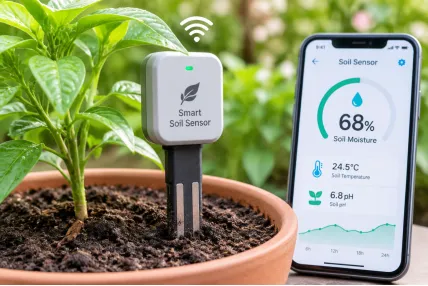
A smart soil sensor is a device that uses physical, chemical, and biological principles to collect real - time environmental parameters of soil, such as moisture, nutrients, temperature, and pH value. It usually consists of a sensing element, a signal conditioning circuit, a data acquisition module, and a wireless communication module. The sensing element is the core part for detecting soil parameters. The signal conditioning circuit is used to amplify, filter, and convert the weak electrical signals output by the sensing element to make them meet the requirements of the data acquisition module. The data acquisition module collects and digitizes the conditioned signals. The wireless communication module is responsible for transmitting the data to a remote server or terminal for users to view and analyze. In addition, the sensor housing is made of materials with good corrosion resistance, weather resistance, and mechanical strength to ensure stable long - term operation.
Market Size and Growth Trend
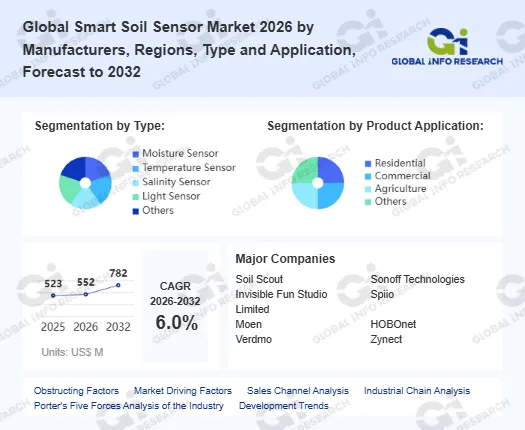
According to the latest report "Global Smart Soil Sensor Market 2026 by Manufacturers, Regions, Type and Application, Forecast to 2032"published by GIR (Global Info Research), the global Smart Soil Sensor market was valued at approximately USD 523 million in 2025 and is projected to reach USD 552 million in 2026. With a CAGR of 6.0% during the forecast period from 2026 to 2032, the market is expected to further expand to approximately USD 782 million by 2032. This growth is driven by increasing market demand, evolving industry trends, and expanding application opportunities worldwide.
Competitive Landscape and Leading Players
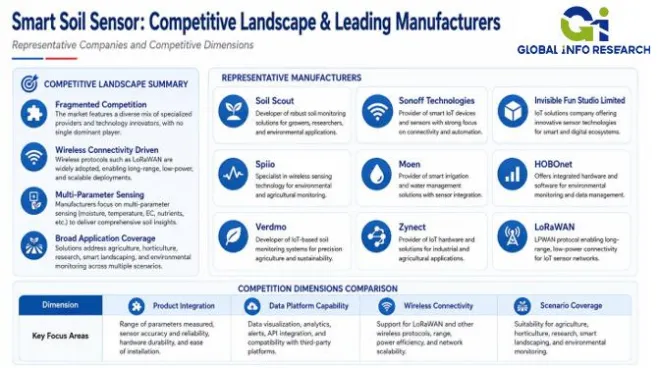
The global Smart Soil Sensor market is moderately fragmented, with soil measurement companies, agricultural IoT providers, irrigation equipment suppliers, environmental monitoring brands and precision farming platforms competing together. Representative companies include METER Group, Campbell Scientific, The Toro Company, Stevens Water Monitoring Systems, Sentek Technologies, Delta-T Devices, Spectrum Technologies, Acclima, Irrometer, Vegetronix, Sensoterra, CropX, AquaCheck, Eijkelkamp and John Deere. Leading players differentiate themselves through accuracy, calibration stability, multi-parameter capability, wireless range, low power consumption, field durability, dashboard functions and compatibility with irrigation and farm management systems. Competition is moving toward data interpretation, agronomic recommendations, automatic irrigation control and platform ecosystem capability.
Product Classification and Application Structure
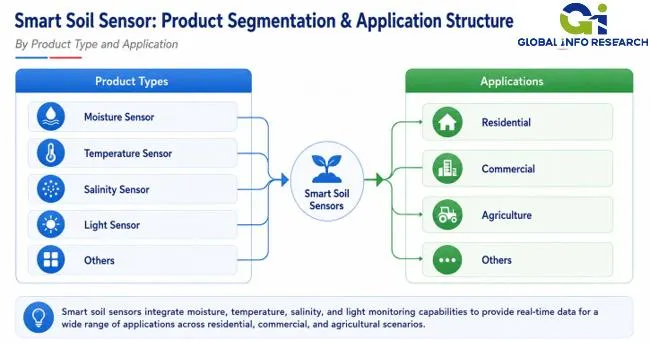
By sensing parameter, smart soil sensors mainly include soil moisture sensors, soil temperature sensors, EC or salinity sensors, pH sensors, nutrient or NPK sensors and multi-parameter integrated sensors. Moisture sensors support irrigation scheduling and drought stress management; temperature sensors support seed germination and greenhouse control; EC and salinity sensors monitor fertilizer concentration and salt accumulation; pH and nutrient sensors support soil fertility assessment and precision fertilization; multi-parameter probes provide comprehensive diagnostics for high-value crops and research. By connectivity, products include wired systems, short-range wireless devices, cellular/NB-IoT sensors, LoRa/LoRaWAN networks and gateway-based farm sensor systems. Major applications include open-field crops, orchards, greenhouses, nurseries, turf, landscaping, forestry, research stations and smart city greening projects.
Regional Landscape and Market Opportunities
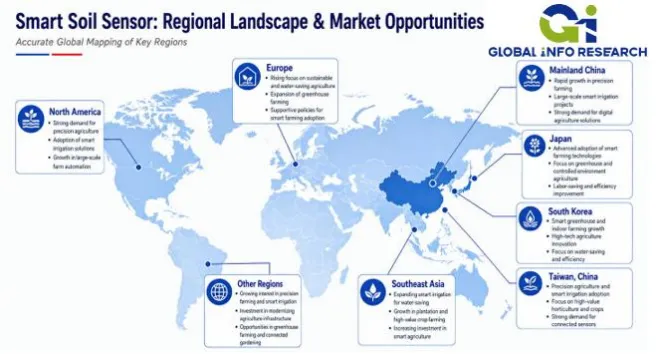
North America and Europe are relatively mature markets for smart soil sensors, supported by large-scale mechanized agriculture, high labor costs, advanced irrigation infrastructure, environmental regulation and precision farming service ecosystems. The United States has strong demand in row crops, orchards, turf and water-saving irrigation, while Europe emphasizes sustainable agriculture, fertilizer reduction, digital farm management and water-resource governance. China, India, Southeast Asia and the Middle East are faster-growing regions, where food security, farmland modernization, greenhouse construction, smart irrigation projects and water scarcity are accelerating adoption. Japan and South Korea focus on high-value horticulture, greenhouse automation and compact precision farming systems. Emerging market opportunities are concentrated in cost-effective wireless sensors, low-power networks, localized agronomic models and packaged solutions combining devices, cloud platforms and irrigation control.
Industry Chain Analysis
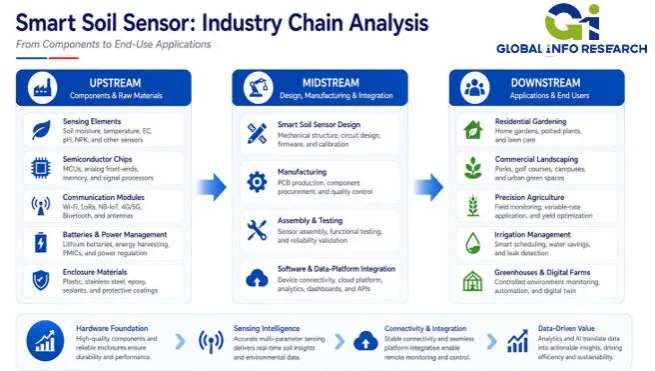
The upstream supply chain includes sensing chips, electrodes, probe materials, temperature and EC modules, pH electrodes, NPK detection elements, MCUs, wireless communication modules, batteries, solar panels, waterproof housings, cables, connectors, data loggers and packaging materials. The midstream focuses on probe design, calibration algorithms, PCB assembly, firmware development, wireless networking, gateway integration, cloud data processing, dashboard software, agronomic models, irrigation-control interfaces, reliability testing and field installation services. Downstream applications include farms, orchards, greenhouses, irrigation districts, cooperatives, seed companies, fertilizer service providers, turf managers, landscaping companies, research institutions and environmental monitoring agencies. Higher value-added links are concentrated in calibration accuracy, field durability, data analytics, agronomic decision support, irrigation automation and long-term service contracts, while future development will move toward multi-parameter sensing, lower power consumption, AI-based irrigation recommendations and broader farm data platform integration.
Smart Soil Sensor Report Chapter Summary:
Chapter 1: Smart Soil Sensor Industry Definition and Market Overview
This chapter clearly defines the product definition, characteristics, and industry statistical scope of Smart Soil Sensor, systematically introduces its mainstream product classifications and key application areas, and presents the overall size and future outlook of the global market.
Chapter 2: In-depth Analysis of Core Smart Soil Sensor Companies (2021-2025)
This chapter focuses on the main players in the Smart Soil Sensor market. For each representative company, it not only introduces its basic overview, main business, and product portfolio, but also highlights its core operating data in the Smart Soil Sensor field, including sales volume, sales revenue, pricing strategies, and the latest development trends of the company from 2021 to 2025.
Chapter 3: Global Competitive Landscape Analysis (2021-2025)
This chapter examines the global Smart Soil Sensor competitive landscape from a macro perspective. By comparing the Smart Soil Sensor sales volume, pricing, revenue, and market share of major companies from 2021 to 2025, it quantitatively analyzes market concentration and interprets the competitive strategies and market position evolution of core manufacturers.
Chapter 4: Smart Soil Sensor Major Regional Market Size and Prospects (2021-2032)
This chapter conducts a regional-level analysis of the global Smart Soil Sensor core markets. It will present historical data on the Smart Soil Sensor market size (sales volume and revenue from 2021-2025) in major regions such as North America, Europe, and Asia Pacific, and provide market outlook forecasts for 2026-2032.
Chapter 5: Smart Soil Sensor Product Type Segmentation Market Forecast (2021-2032)
This chapter delves into the Smart Soil Sensor product structure. It will segment the Smart Soil Sensor market by different types (such as Moisture Sensor、Temperature Sensor、Salinity Sensor、Light Sensor、Others, etc.), and analyze in detail the historical market size of each segmented product category from 2021 to 2025 and the future growth trends from 2026 to 2032.
Chapter 6: Smart Soil Sensor Application Field Segmentation Market Forecast (2021-2032)
This chapter delves into the downstream application demand for Smart Soil Sensor. The market will be segmented by different application areas (such as Residential、Commercial、Agriculture、Others, etc.), presenting the historical market size for each area from 2021-2025 and future demand forecasts from 2026-2032.
Chapters 7-11: In-depth Analysis of Global Regional Markets (2021-2032)
This section is the core module of the Smart Soil Sensor report, providing an in-depth country/regional analysis across five major regions: North America, Europe, Asia Pacific, South America, and the Middle East & Africa. The chapter structure for each region is consistent:
Segmentation by Country/Region: Analysis of the market size and forecasts for major countries within the region from 2021-2032.
Segmentation by Product Type: Presentation of the market structure and development forecasts for different product types within the region from 2021-2032.
Segmentation by Application Area: Analysis of market demand and prospects for different application areas within the region from 2021-2032.
Chapter 12: Global Smart Soil Sensor Market Dynamics, Challenges, and Trends
This chapter aims to analyze the key internal and external factors affecting the development of the Smart Soil Sensor market. It systematically reviews the core drivers of Smart Soil Sensor market growth, the main obstacles and challenges faced, and assesses future product, technology, and market development trends.
Chapter 13: Smart Soil Sensor Industry Chain Structure Analysis
This chapter analyzes the entire industry chain ecosystem of the Smart Soil Sensor industry. From upstream raw material supply to midstream production and manufacturing, and then to downstream end-use applications, it analyzes the current status, cost structure, and collaborative relationships of each link.
Chapter 14: Sales Channel Model Research
This chapter focuses on the distribution channels of Smart Soil Sensor products. It analyzes the market share, advantages and disadvantages, and typical cases of mainstream sales channels, and explores the innovation and development trends of channel models.
Chapter 15: Research Conclusions and Strategic Recommendations
As a summary of the report, this chapter will distill the core findings and conclusions of the entire report and, based on a comprehensive understanding of the Smart Soil Sensor market, provide actionable strategic development recommendations for industry participants and potential entrants.
For more information, please refer to "Global Smart Soil Sensor Market 2026 by Manufacturers, Regions, Type and Application, Forecast to 2032". This report analyzes the supply and demand situation, development status, and changes in the industry, focusing on the development status of the industry, how to face the development challenges of the industry, industry development suggestions, industry competitiveness, and industry investment analysis and trend forecasts. The report also summarizes the overall development dynamics of the industry, including the impact of the latest US tariffs on the global supply chain, the supply relationship analysis of the industrial chain, and provides reference suggestions and specific solutions for the industry in terms of products.
Previous News:
2026 Secondary Tickets Outlook: 8.3% CAGR Forecast as Digital Wallet Transfers, Official Barcode Verification and Dynamic Pricing Push the Market Toward USD 4,170 Million by 2032
Next News:
The copyright of this article belongs to Global Info Research. Without the written authorization of our company, no organization or individual may reprint, quote, copy, adapt or use it for commercial purposes in any way. When authorized to use, the original source must be indicated as "Global Info Research" and the complete copyright information must be retained.
- We Provide Professional, Accurate Market Analysis to Help You Stay Ahead of Your Competition.Speak to our analyst >>

Our Clients
What We Can Provide?
With better results and higher quality products,Our professional reports can achieve four things:

Insight into the industry market information

Analyze market development needs

Prospects for future development

Develop industry investment strategy
- Digging deeper into global industry information and providing market strategies.Contact Us >>
- We Provide Professional, Accurate Market Analysis to Help You Stay Ahead of Your Competition.Speak to our analyst >>
Our Clients
What We Can Provide?
With better results and higher quality products,Our professional reports can achieve four things:
Insight into the industry market information
Analyze market development needs
Prospects for future development
Develop industry investment strategy
- Digging deeper into global industry information and providing market strategies.Contact Us >>