
L2 Ethernet Switches Market 2026: A 5.0% CAGR Points to a USD 2,962 Million Opportunity by 2032 as Industrial Automation and PoE Access Demand Accelerate
Published Date: Friday,13 Nov,2026


L2 Ethernet Switches Market Summary
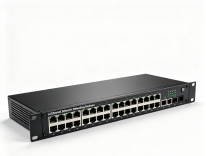
A L2 Ethernet Switch is a network device operating at Layer 2 of the OSI model, designed to forward, filter, and control broadcast traffic within an Ethernet-based LAN. It utilizes MAC address tables for intelligent packet forwarding, without involving Layer 3 routing logic. L2 switches are widely deployed in enterprise networks, campuses, and industrial environments to ensure reliable communication among connected devices. Compared to L3 switches, L2 switches are simpler, more cost-effective, and offer lower latency—ideal for network access or aggregation layers. Advanced models support VLAN segmentation, Quality of Service (QoS), loop detection, and Power over Ethernet (PoE). With the rapid expansion of IoT, edge computing, and surveillance networks, L2 Ethernet Switches continue to see robust demand across smart infrastructure and automation sectors.
Figure1. Global L2 Ethernet Switches Market Size (US$ Million), 2020-2031
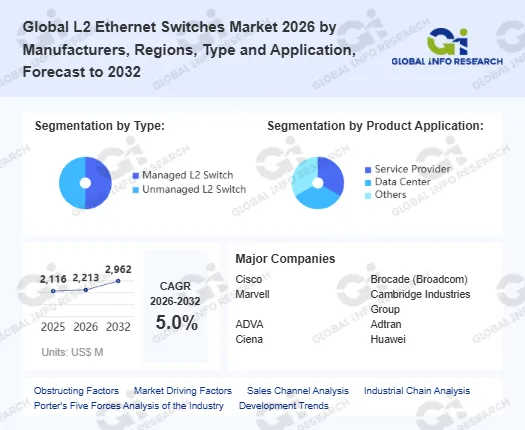
According to the latest report "Global L2 Ethernet Switches Market 2026 by Manufacturers, Regions, Type and Application, Forecast to 2032"published by GIR (Global Info Research), the global L2 Ethernet Switches market was valued at approximately USD 2116 million in 2025 and is projected to reach USD 2213 million in 2026. With a CAGR of 5.0% during the forecast period from 2026 to 2032, the market is expected to further expand to approximately USD 2962 million by 2032. This growth is driven by increasing market demand, evolving industry trends, and expanding application opportunities worldwide.
Figure2. Global L2 Ethernet Switches Top 14 Players Ranking and Market Share (Ranking is based on the revenue of 2024, continually updated)
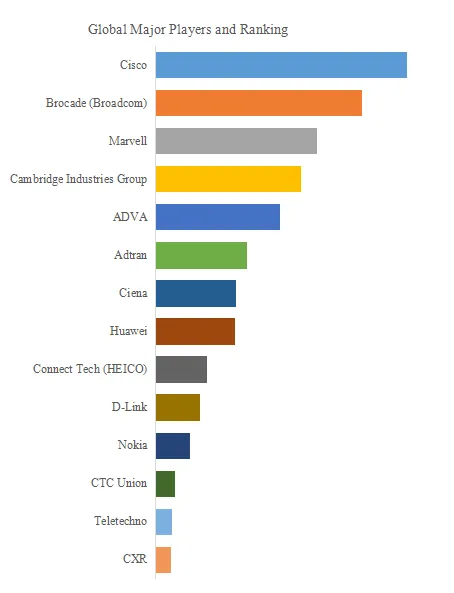
According to Global Info Research Top Players Research Center, the global key manufacturers of L2 Ethernet Switches include Cisco, Brocade (Broadcom), Marvell, Cambridge Industries Group, ADVA, etc. In 2024, the global top five players had a share approximately 56.0% in terms of revenue.
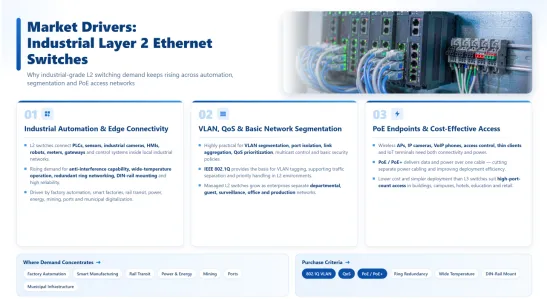
Market Drivers:
Growth in industrial automation, smart manufacturing, and edge connectivity: In industrial environments, L2 Ethernet switches connect PLCs, sensors, industrial cameras, HMIs, robots, meters, gateways, and control systems within local networks. They are an important component of industrial Ethernet infrastructure. With the expansion of factory automation, smart factories, rail transit, power, energy, mining, ports, and municipal infrastructure digitization, demand for industrial-grade L2 switches with anti-interference capability, wide-temperature operation, redundant ring networking, DIN-rail installation, and high reliability continues to rise.
Increasing demand for VLAN, QoS, and basic network segmentation: Although L2 switches do not perform advanced Layer 3 routing, they are highly practical for VLAN segmentation, port isolation, link aggregation, QoS prioritization, multicast control, and basic security policies. IEEE 802.1Q provides the basis for VLAN tagging in Ethernet networks, supporting traffic separation and priority handling in Layer 2 switching environments. As enterprises increasingly need to separate departmental networks, guest access, surveillance systems, office networks, and production networks, demand for managed L2 switches with VLAN and basic management functions continues to grow.
Expansion of PoE endpoints and cost-effective access networks: A large number of wireless APs, IP cameras, VoIP phones, access control devices, thin clients, and IoT terminals require both Ethernet connectivity and power delivery. PoE/PoE+ L2 switches can provide data transmission and power supply simultaneously, reducing separate power cabling and improving deployment efficiency. This is especially useful in building networks, surveillance systems, hotels, campuses, education, and retail environments. Compared with Layer 3 switches, L2 switches are lower-cost and easier to deploy, making them attractive for high-port-count access scenarios.
Restraint:
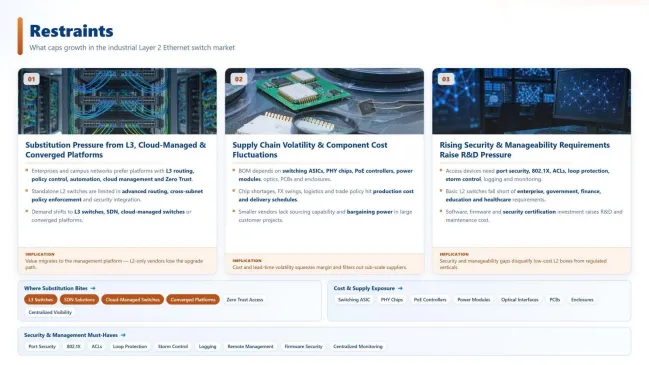
Substitution pressure from Layer 3 switches, cloud-managed switches, and integrated networking platforms: In medium and large enterprises, data centers, and complex campus networks, customers increasingly prefer switching platforms with Layer 3 routing, policy control, automated operations, cloud management, Zero Trust access, and centralized visibility. Standalone L2 switches have limitations in advanced routing, cross-subnet policy enforcement, security integration, and automation. Some demand may therefore shift toward L3 switches, SDN solutions, cloud-managed switches, or converged networking platforms.
Supply chain volatility and component cost fluctuations: L2 switches rely on switching ASICs, PHY chips, PoE controllers, power modules, optical interfaces, PCBs, and metal enclosures. Tight chip supply, exchange-rate volatility, rising logistics costs, or changes in regional trade policies can affect production costs and delivery schedules. Smaller vendors often lack long-term component sourcing capability and supply-chain bargaining power, which weakens their competitiveness in large customer projects.
Rising security and manageability requirements increase R&D pressure: Customers now expect access-layer devices to support port security, 802.1X authentication, ACLs, loop protection, storm control, logging, remote management, firmware security, and centralized monitoring. Basic L2 switches without sufficient security and management capabilities may fail to meet enterprise, government, finance, education, healthcare, and industrial network requirements. Vendors need continuous investment in software, firmware, management platforms, and security certifications, increasing R&D and maintenance costs.
Opportunity:
PoE, 2.5G/10G uplinks, and high-density access drive product upgrades: Traditional Fast Ethernet and basic Gigabit L2 switches are gradually upgrading toward Gigabit access, 2.5G access, 10G uplinks, higher PoE power budgets, and higher port density. Wi-Fi 6/6E/7 APs, HD cameras, edge gateways, and multimedia terminals require higher bandwidth and power delivery, driving replacement of legacy switches. For vendors, L2 switches with PoE management, energy-saving control, link aggregation, and uplink expansion can achieve higher ASPs and better project opportunities.
Cloud management and lightweight intelligent operations become differentiation drivers: In SMBs, chain stores, schools, hotels, and branch offices, users want to reduce local IT maintenance work and improve remote configuration, batch deployment, fault diagnosis, and device lifecycle management. Cloud-managed L2 switches can support unified monitoring, configuration delivery, alert management, port status visibility, and firmware updates. This enables vendors to move beyond hardware sales toward a “hardware + software subscription + managed service” model.
Emerging-market network infrastructure expansion creates incremental demand: Southeast Asia, India, the Middle East, Latin America, and Africa are still expanding enterprise digitalization, education informatization, smart cities, video surveillance, broadband access, and SMB network infrastructure. L2 switches are suitable for large-scale basic network deployment because they are easy to deploy, cost-effective, and relatively simple to maintain. Vendors with cost control, channel coverage, local certification, and stable supply capabilities can capture growth opportunities in these emerging markets.
L2 Ethernet Switches Report Chapter Summary:
Chapter 1: L2 Ethernet Switches Industry Definition and Market Overview
This chapter clearly defines the product definition, characteristics, and industry statistical scope of L2 Ethernet Switches, systematically introduces its mainstream product classifications and key application areas, and presents the overall size and future outlook of the global market.
Chapter 2: In-depth Analysis of Core L2 Ethernet Switches Companies (2021-2025)
This chapter focuses on the main players in the L2 Ethernet Switches market. For each representative company, it not only introduces its basic overview, main business, and product portfolio, but also highlights its core operating data in the L2 Ethernet Switches field, including sales volume, sales revenue, pricing strategies, and the latest development trends of the company from 2021 to 2025.
Chapter 3: Global Competitive Landscape Analysis (2021-2025)
This chapter examines the global L2 Ethernet Switches competitive landscape from a macro perspective. By comparing the L2 Ethernet Switches sales volume, pricing, revenue, and market share of major companies from 2021 to 2025, it quantitatively analyzes market concentration and interprets the competitive strategies and market position evolution of core manufacturers.
Chapter 4: L2 Ethernet Switches Major Regional Market Size and Prospects (2021-2032)
This chapter conducts a regional-level analysis of the global L2 Ethernet Switches core markets. It will present historical data on the L2 Ethernet Switches market size (sales volume and revenue from 2021-2025) in major regions such as North America, Europe, and Asia Pacific, and provide market outlook forecasts for 2026-2032.
Chapter 5: L2 Ethernet Switches Product Type Segmentation Market Forecast (2021-2032)
This chapter delves into the L2 Ethernet Switches product structure. It will segment the L2 Ethernet Switches market by different types (such as Managed L2 Switch、Unmanaged L2 Switch, etc.), and analyze in detail the historical market size of each segmented product category from 2021 to 2025 and the future growth trends from 2026 to 2032.
Chapter 6: L2 Ethernet Switches Application Field Segmentation Market Forecast (2021-2032)
This chapter delves into the downstream application demand for L2 Ethernet Switches. The market will be segmented by different application areas (such as Service Provider、Data Center、Others, etc.), presenting the historical market size for each area from 2021-2025 and future demand forecasts from 2026-2032.
Chapters 7-11: In-depth Analysis of Global Regional Markets (2021-2032)
This section is the core module of the L2 Ethernet Switches report, providing an in-depth country/regional analysis across five major regions: North America, Europe, Asia Pacific, South America, and the Middle East & Africa. The chapter structure for each region is consistent:
Segmentation by Country/Region: Analysis of the market size and forecasts for major countries within the region from 2021-2032.
Segmentation by Product Type: Presentation of the market structure and development forecasts for different product types within the region from 2021-2032.
Segmentation by Application Area: Analysis of market demand and prospects for different application areas within the region from 2021-2032.
Chapter 12: Global L2 Ethernet Switches Market Dynamics, Challenges, and Trends
This chapter aims to analyze the key internal and external factors affecting the development of the L2 Ethernet Switches market. It systematically reviews the core drivers of L2 Ethernet Switches market growth, the main obstacles and challenges faced, and assesses future product, technology, and market development trends.
Chapter 13: L2 Ethernet Switches Industry Chain Structure Analysis
This chapter analyzes the entire industry chain ecosystem of the L2 Ethernet Switches industry. From upstream raw material supply to midstream production and manufacturing, and then to downstream end-use applications, it analyzes the current status, cost structure, and collaborative relationships of each link.
Chapter 14: Sales Channel Model Research
This chapter focuses on the distribution channels of L2 Ethernet Switches products. It analyzes the market share, advantages and disadvantages, and typical cases of mainstream sales channels, and explores the innovation and development trends of channel models.
Chapter 15: Research Conclusions and Strategic Recommendations
As a summary of the report, this chapter will distill the core findings and conclusions of the entire report and, based on a comprehensive understanding of the L2 Ethernet Switches market, provide actionable strategic development recommendations for industry participants and potential entrants.
For more information, please refer to "Global L2 Ethernet Switches Market 2026 by Manufacturers, Regions, Type and Application, Forecast to 2032". This report analyzes the supply and demand situation, development status, and changes in the industry, focusing on the development status of the industry, how to face the development challenges of the industry, industry development suggestions, industry competitiveness, and industry investment analysis and trend forecasts. The report also summarizes the overall development dynamics of the industry, including the impact of the latest US tariffs on the global supply chain, the supply relationship analysis of the industrial chain, and provides reference suggestions and specific solutions for the industry in terms of products.
Previous News:
Refurbished HDD Market 2026: A 4.6% CAGR Points to a USD 3,557 Million Opportunity by 2032 as Data Center Refresh Cycles and ESG Circular Economy Goals Drive Supply
Next News:
The copyright of this article belongs to Global Info Research. Without the written authorization of our company, no organization or individual may reprint, quote, copy, adapt or use it for commercial purposes in any way. When authorized to use, the original source must be indicated as "Global Info Research" and the complete copyright information must be retained.
- We Provide Professional, Accurate Market Analysis to Help You Stay Ahead of Your Competition.Speak to our analyst >>

Our Clients
What We Can Provide?
With better results and higher quality products,Our professional reports can achieve four things:

Insight into the industry market information

Analyze market development needs

Prospects for future development

Develop industry investment strategy
- Digging deeper into global industry information and providing market strategies.Contact Us >>
- We Provide Professional, Accurate Market Analysis to Help You Stay Ahead of Your Competition.Speak to our analyst >>
Our Clients
What We Can Provide?
With better results and higher quality products,Our professional reports can achieve four things:
Insight into the industry market information
Analyze market development needs
Prospects for future development
Develop industry investment strategy
- Digging deeper into global industry information and providing market strategies.Contact Us >>