
2026 Medical Superconducting Magnet Outlook: 4.7% CAGR Forecast as Zero-Boil-Off Designs, 5.0T/7.0T Research Systems and Domestic Substitution Push the Market Toward USD 1,677 Million by 2032
Published Date: Monday,16 Nov,2026


 Medical Superconducting Magnet
 Market Summary
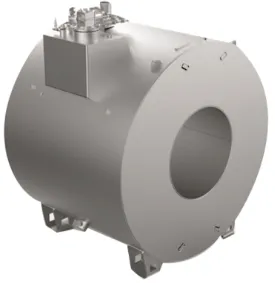
Medical superconducting magnets are core main-field components used in medical magnetic resonance imaging systems. They typically consist of superconducting coils, cryogenic cooling systems, vacuum cryostats, magnetic shielding structures, shimming components, mechanical supports, and monitoring or control units. These magnets generate highly uniform and stable static magnetic fields for clinical diagnosis and medical research. The market mainly covers 1.5T and 3.0T whole-body MRI magnets, selected 0.5T–1.2T open or low-field superconducting systems, and emerging 5.0T and 7.0T ultra-high-field medical research systems. Key performance parameters include field strength, bore size, homogeneity, temporal stability, helium consumption, cooling architecture, weight, fringe-field control, and installation requirements.
Figure1. Global Medical Superconducting Magnet Market Size (US$ Million), 2021-2032
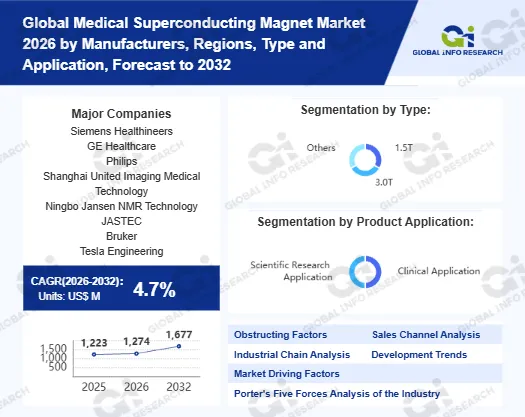
According to the latest report "Global Medical Superconducting Magnet Market 2026 by Manufacturers, Regions, Type and Application, Forecast to 2032" published by GIR (Global Info Research), the global Medical Superconducting Magnet market was valued at approximately USD 1223 million in 2025 and is projected to reach USD 1274 million in 2026. With a CAGR of 4.7% during the forecast period from 2026 to 2032, the market is expected to further expand to approximately USD 1677 million by 2032. This growth is driven by increasing market demand, evolving industry trends, and expanding application opportunities worldwide.
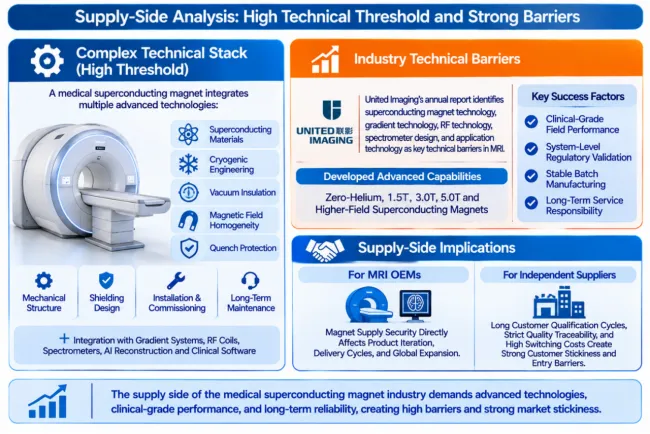
On the supply side, the technical threshold of this industry is far higher than that of general medical device components. A medical superconducting magnet integrates superconducting materials, cryogenic engineering, vacuum insulation, magnetic field homogeneity, quench protection, mechanical structure, shielding design, installation, commissioning, and long-term maintenance. It must also be optimized together with gradient systems, RF coils, spectrometers, AI reconstruction, and clinical software. United Imaging’s annual report identifies superconducting magnet technology, gradient technology, RF technology, spectrometer design, and application technology as key technical barriers in MRI, and states that the company has developed zero-liquid-helium, 1.5T, 3.0T, 5.0T, and higher-field superconducting magnet capabilities. Therefore, suppliers with real industrial value are not those that can merely produce magnet housings or cryogenic parts. They are companies capable of delivering clinical-grade field performance, passing system-level regulatory validation, achieving stable batch manufacturing, and assuming long-term service responsibility. For MRI OEMs, magnet supply security directly affects product iteration, delivery cycles, and global expansion. For independent magnet suppliers, long customer qualification cycles, strict quality traceability, and high switching costs create strong customer stickiness and entry barriers.
Technologically, the industry is moving from a simple pursuit of higher field strength toward integrated competition in high field strength, low helium usage, lower energy consumption, wider bore design, and intelligent system collaboration. 1.5T remains the clinical installed-base foundation worldwide, 3.0T is the main upgrade path for advanced clinical and research applications, while 5.0T and higher-field systems represent the technological frontier and future translational potential. At the same time, helium supply risk and operating cost are reshaping hospital procurement decisions.
In terms of competition, the medical superconducting magnet industry is shaped by a hybrid structure: vertical integration by major MRI OEMs, specialized core component suppliers, and regional localization. Global MRI leaders usually control magnet design, system integration, and customer access, enabling magnet upgrades through complete MRI platforms. Independent magnet manufacturers compete through engineering execution, manufacturing yield, cost control, and customer certification, often gaining positions in specific field-strength ranges, platforms, or regional supply chains. China is an especially important market to watch. High-end medical imaging equipment is still constrained by regulatory approval, clinical validation, brand credibility, and service networks. However, policy support, hospital replacement demand, breakthroughs by domestic MRI OEMs, and the maturing local core component supply chain are pushing superconducting magnets from import-dependent components toward scalable domestic strategic parts. NMPA rules emphasize safety, effectiveness, quality control, and lifecycle responsibility for medical devices, which means competition will increasingly depend on quality systems, batch stability, and clinical traceability rather than price alone.
Figure00002. Global Medical Superconducting Magnet Top 9 Players Ranking and Market Share (Ranking is based on the revenue of 2025, by revenue, continually updated)
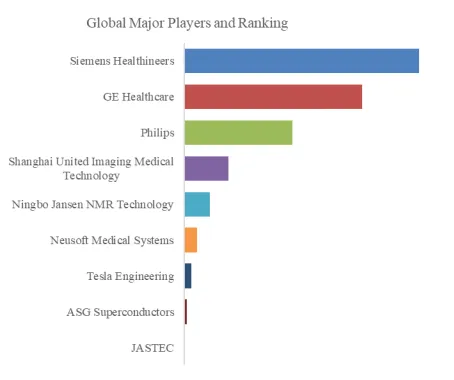
According to Global Info Research Top Players Research Center, the global key manufacturers of Medical Superconducting Magnet include Siemens Healthineers, GE Healthcare, Philips, Shanghai United Imaging Medical Technology, Ningbo Jansen NMR Technology, etc. In 2025, the global top five players had a share approximately 93.0% in terms of revenue.
Major Players Profiles:
Siemens Healthineers

Siemens Healthineers is a global medical technology leader with a long heritage in diagnostic imaging and clinical engineering. Its businesses cover imaging, diagnostics, interventional solutions, cancer therapy, and digital healthcare. The company has strong capabilities in MRI, CT, X-ray, ultrasound, molecular imaging, and radiotherapy, while using AI and data-driven solutions to improve clinical efficiency. In MRI, Siemens Healthineers is recognized for high-end system platforms and innovation in low-helium and virtually helium-free magnet technologies.
GE Healthcare

GE HealthCare is a U.S.-based medical technology company that became an independent public company after its spin-off from General Electric. Its business is organized around Imaging, Advanced Visualization Solutions, Patient Care Solutions, and Pharmaceutical Diagnostics. The company provides MRI, CT, ultrasound, molecular imaging, monitoring systems, contrast media, and AI-enabled clinical tools. GE HealthCare positions itself around precise, personal, and connected care, serving hospitals and healthcare systems worldwide.
Philips

Philips is a Netherlands-based health technology company focused on improving people’s health and well-being through meaningful innovation. Its healthcare portfolio includes Diagnosis & Treatment, Connected Care, and Personal Health. Key products and solutions cover image-guided therapy, patient monitoring, ultrasound, MRI, CT, diagnostic informatics, and clinical software. Philips emphasizes integrated, sustainable, and AI-enabled healthcare solutions designed to improve workflow, diagnostic confidence, and care delivery.
Shanghai United Imaging Medical Technology

United Imaging Healthcare is a Chinese high-end medical equipment company providing self-developed medical imaging, radiotherapy, life science instruments, and digital healthcare solutions. Its portfolio covers MR, CT, PET/CT, PET/MR, DR, angiography, radiotherapy systems, and imaging software. The company serves clinical diagnosis, cancer treatment, translational research, and regional healthcare capacity building. Its competitiveness lies in high-end system platforms, self-developed core technologies, and expanding global regulatory and commercial reach.
Ningbo Jansen NMR Technology

Ningbo Jansen Superconducting Technologies Co., Ltd. is a Chinese supplier of core MRI components. The company focuses on the R&D, manufacturing, and sales of key parts for medical MRI systems, including superconducting magnets, permanent magnets, and gradient coils. These components are central to MRI system performance and cost structure. Jansen’s product development focuses on 1.5T, 3.0T, zero-boil-off, and liquid-helium-free magnet technologies, supporting MRI OEM customers in China and overseas.
Figure00003. Production Process Flowchart for Medical Superconducting Magnet
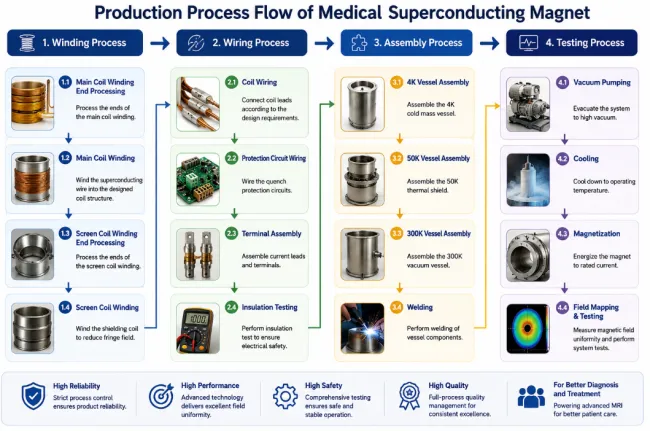
The production process of a medical superconducting magnet generally consists of four key stages: winding, wiring, assembly, and testing. The process begins with the winding stage, where the main coil is insulated and wound according to the required magnetic field design. The shielding coil is then insulated and wound to reduce stray magnetic fields and improve system safety and field control. The quality of coil winding has a direct impact on magnetic field uniformity, operational stability, and long-term reliability, making it one of the most critical steps in the entire manufacturing process.
The wiring stage includes coil lead connection, protection circuit wiring, terminal or joint fabrication, and insulation testing. This stage affects both current transmission efficiency and quench protection safety. In the assembly stage, the 4K cold mass vessel, 50K thermal shield, and 300K vacuum vessel are assembled in sequence, followed by welding of key structural components to form the cryogenic and thermal insulation system. The final testing stage includes vacuum pumping, cooling, magnet energization, field shimming, and comprehensive performance testing. These procedures verify vacuum integrity, cryogenic stability, magnetic field strength, field uniformity, and overall safety. Only magnets that pass strict testing can proceed to MRI system integration and clinical use.
Figure00004. Medical Superconducting Magnet Industry Chain
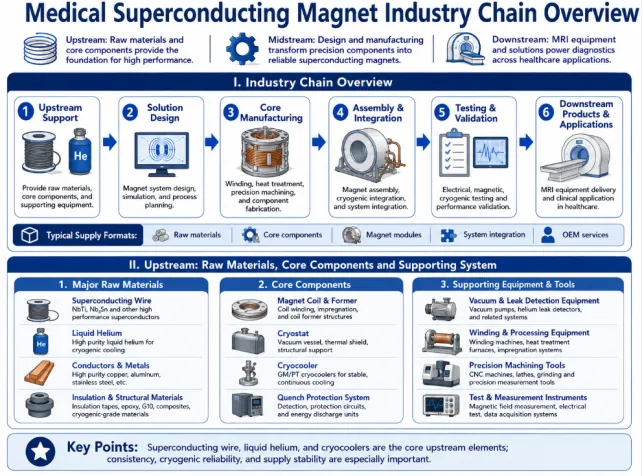
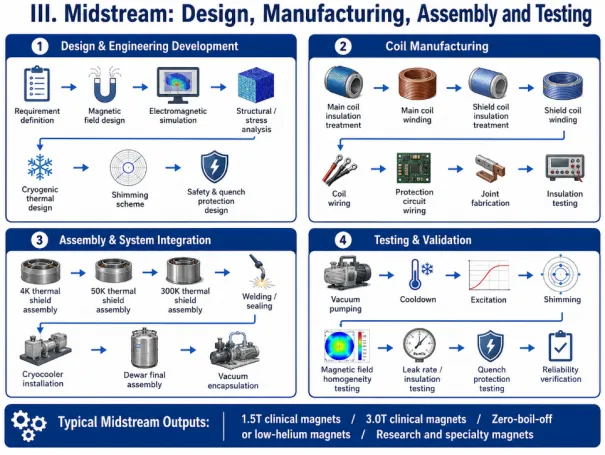
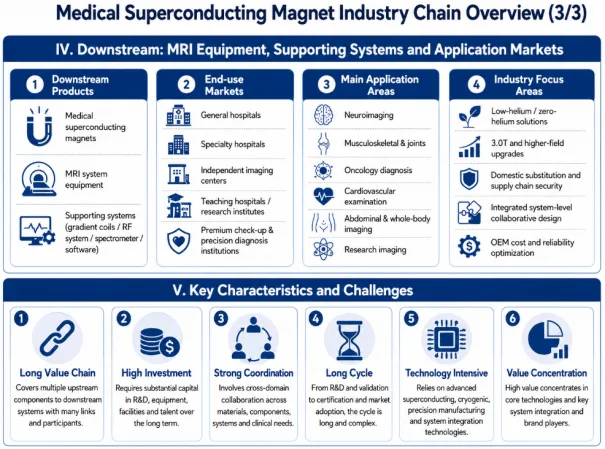
The medical superconducting magnet industry chain can be divided into three major segments: upstream raw materials and core components, midstream magnet design and manufacturing, and downstream MRI systems and end-use applications. The upstream segment mainly includes superconducting wire, liquid helium, cryocoolers, cryogenic insulation materials, electrical insulation materials, structural parts, dewars, cold shields, current leads, vacuum components, sensors, power supply systems, and quench protection systems. Among these, superconducting wire, liquid helium, and cryocoolers are the key factors affecting magnet performance, operating cost, and supply stability. The midstream segment is the core of the value chain, covering magnetic field design, electromagnetic simulation, structural design, cryogenic thermal design, coil winding, insulation treatment, wiring, cold shield assembly, dewar integration, vacuum sealing, welding, cooling, excitation, shimming, and reliability testing. These processes require high manufacturing precision, strong cryogenic engineering capability, strict quality control, and system integration expertise. Downstream, MRI equipment manufacturers integrate superconducting magnets with gradient systems, RF systems, spectrometers, software, and clinical platforms to produce 1.5T, 3.0T, and higher-field MRI systems. These systems are mainly used in general hospitals, specialty hospitals, imaging centers, research institutions, and high-end health examination facilities. Overall, the industry chain is long, technology-intensive, and characterized by lengthy validation cycles, with core competitiveness concentrated in cryogenic superconducting technology, magnetic field homogeneity control, low-helium or helium-free solutions, quench protection, stable mass production, and system-level integration.
Overall, the medical superconducting magnet market is not a purely high-speed, homogeneous expansion market. It is a structural upgrade market. Primary and county-level healthcare demand supports broader access to 1.5T systems; tertiary hospitals and specialty centers drive replacement toward 3.0T and higher-end platforms; and research institutions and advanced clinical centers create demand for ultra-high-field, animal research, and multimodal imaging systems. A credible industry report should therefore go beyond MRI shipment volume. It should analyze field-strength mix, magnet technology routes, helium consumption models, OEM self-supply versus external procurement, customer structures of independent suppliers, regional regulatory barriers, service models, and total lifecycle operating cost. Only by connecting the magnet, MRI system, hospital, clinical use case, and operating economics in one analytical framework can the true growth drivers, competitive barriers, and localization opportunities of this industry be accurately assessed.
Medical Superconducting Magnet Report Chapter Summary:
Chapter 1: Medical Superconducting Magnet Industry Definition and Market Overview
This chapter clearly defines the product definition, characteristics, and industry statistical scope of Medical Superconducting Magnet, systematically introduces its mainstream product classifications and key application areas, and presents the overall size and future outlook of the global market.
Chapter 2: In-depth Analysis of Core Medical Superconducting Magnet Companies (2021-2025)
This chapter focuses on the main players in the Medical Superconducting Magnet market. For each representative company, it not only introduces its basic overview, main business, and product portfolio, but also highlights its core operating data in the Medical Superconducting Magnet field, including sales volume, sales revenue, pricing strategies, and the latest development trends of the company from 2021 to 2025.
Chapter 3: Global Competitive Landscape Analysis (2021-2025)
This chapter examines the global Medical Superconducting Magnet competitive landscape from a macro perspective. By comparing the Medical Superconducting Magnet sales volume, pricing, revenue, and market share of major companies from 2021 to 2025, it quantitatively analyzes market concentration and interprets the competitive strategies and market position evolution of core manufacturers.
Chapter 4: Medical Superconducting Magnet Major Regional Market Size and Prospects (2021-2032)
This chapter conducts a regional-level analysis of the global Medical Superconducting Magnet core markets. It will present historical data on the Medical Superconducting Magnet market size (sales volume and revenue from 2021-2025) in major regions such as North America, Europe, and Asia Pacific, and provide market outlook forecasts for 2026-2032.
Chapter 5: Medical Superconducting Magnet Product Type Segmentation Market Forecast (2021-2032)
This chapter delves into the Medical Superconducting Magnet product structure. It will segment the Medical Superconducting Magnet market by different types (such as 1.5T、3.0T、Others, etc.), and analyze in detail the historical market size of each segmented product category from 2021 to 2025 and the future growth trends from 2026 to 2032.
Chapter 6: Medical Superconducting Magnet Application Field Segmentation Market Forecast (2021-2032)
This chapter delves into the downstream application demand for Medical Superconducting Magnet. The market will be segmented by different application areas (such as Clinical Application、Scientific Research Application, etc.), presenting the historical market size for each area from 2021-2025 and future demand forecasts from 2026-2032.
Chapters 7-11: In-depth Analysis of Global Regional Markets (2021-2032)
This section is the core module of the Medical Superconducting Magnet report, providing an in-depth country/regional analysis across five major regions: North America, Europe, Asia Pacific, South America, and the Middle East & Africa. The chapter structure for each region is consistent:
Segmentation by Country/Region: Analysis of the market size and forecasts for major countries within the region from 2021-2032.
Segmentation by Product Type: Presentation of the market structure and development forecasts for different product types within the region from 2021-2032.
Segmentation by Application Area: Analysis of market demand and prospects for different application areas within the region from 2021-2032.
Chapter 12: Global Medical Superconducting Magnet Market Dynamics, Challenges, and Trends
This chapter aims to analyze the key internal and external factors affecting the development of the Medical Superconducting Magnet market. It systematically reviews the core drivers of Medical Superconducting Magnet market growth, the main obstacles and challenges faced, and assesses future product, technology, and market development trends.
Chapter 13: Medical Superconducting Magnet Industry Chain Structure Analysis
This chapter analyzes the entire industry chain ecosystem of the Medical Superconducting Magnet industry. From upstream raw material supply to midstream production and manufacturing, and then to downstream end-use applications, it analyzes the current status, cost structure, and collaborative relationships of each link.
Chapter 14: Sales Channel Model Research
This chapter focuses on the distribution channels of Medical Superconducting Magnet products. It analyzes the market share, advantages and disadvantages, and typical cases of mainstream sales channels, and explores the innovation and development trends of channel models.
Chapter 15: Research Conclusions and Strategic Recommendations
As a summary of the report, this chapter will distill the core findings and conclusions of the entire report and, based on a comprehensive understanding of the Medical Superconducting Magnet market, provide actionable strategic development recommendations for industry participants and potential entrants.
For more information, please refer to "Global Medical Superconducting Magnet Market 2026 by Manufacturers, Regions, Type and Application, Forecast to 2032". This report analyzes the supply and demand situation, development status, and changes in the industry, focusing on the development status of the industry, how to face the development challenges of the industry, industry development suggestions, industry competitiveness, and industry investment analysis and trend forecasts. The report also summarizes the overall development dynamics of the industry, including the impact of the latest US tariffs on the global supply chain, the supply relationship analysis of the industrial chain, and provides reference suggestions and specific solutions for the industry in terms of products.
Previous News:
Drum Floor Sander Rental Market 2026: A 2.9% CAGR Points to a USD 547 Million Opportunity by 2032 as Aging Building Stock and Hardwood Refinishing Demand Sustain Rental Adoption
Next News:
RFID Label Converting Machine Market 2026: A 5.2% CAGR Points to a USD 2,052 Million Opportunity by 2032 as RAIN RFID Item-Level Tagging and Digital Product Passports Accelerate Demand
The copyright of this article belongs to Global Info Research. Without the written authorization of our company, no organization or individual may reprint, quote, copy, adapt or use it for commercial purposes in any way. When authorized to use, the original source must be indicated as "Global Info Research" and the complete copyright information must be retained.
- We Provide Professional, Accurate Market Analysis to Help You Stay Ahead of Your Competition.Speak to our analyst >>

Our Clients
What We Can Provide?
With better results and higher quality products,Our professional reports can achieve four things:

Insight into the industry market information

Analyze market development needs

Prospects for future development

Develop industry investment strategy
- Digging deeper into global industry information and providing market strategies.Contact Us >>
- We Provide Professional, Accurate Market Analysis to Help You Stay Ahead of Your Competition.Speak to our analyst >>
Our Clients
What We Can Provide?
With better results and higher quality products,Our professional reports can achieve four things:
Insight into the industry market information
Analyze market development needs
Prospects for future development
Develop industry investment strategy
- Digging deeper into global industry information and providing market strategies.Contact Us >>