
Visual Single Piece Separation System Market 2026: A 5.1% CAGR Points to a USD 557 Million Opportunity by 2032 as Express Volume Growth and Warehouse Labor Costs Drive Automation
Published Date: Monday,16 Nov,2026


 Visual Single Piece Separation System
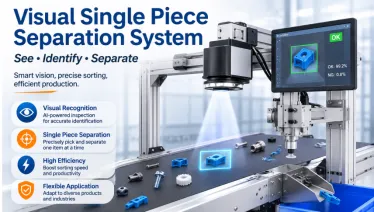
The visual single piece separation system is an automated device based on machine vision technology used in the field of logistics parcel sorting. It uses a visual camera to capture the location, shape, size and other information of the parcel in real time, and combines intelligent algorithms and control systems to separate piled and disordered parcels one by one and arrange them according to the set spacing and order, so that subsequent automated sorting equipment can process each parcel efficiently and accurately. The system integrates mechanical, optoelectronic and visual technologies to achieve automatic parcel alignment, separation and intelligent queuing, and convert batches of parcels in staggered, overlapped and stacked states into single-column output.
Global Visual Single Piece Separation System Market Size (US$ Million), 2026-2032
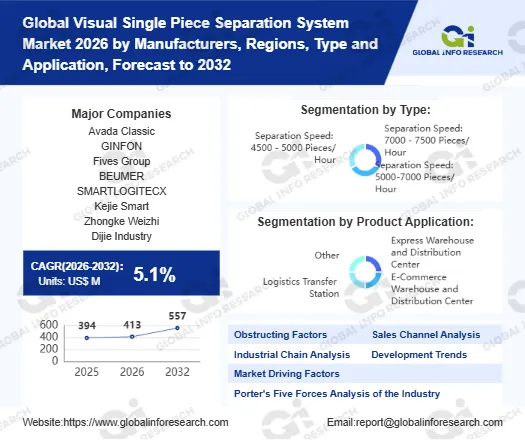
According to the latest report "Global Visual Single Piece Separation System Market 2026 by Manufacturers, Regions, Type and Application, Forecast to 2032" published by GIR (Global Info Research), the global Visual Single Piece Separation System market was valued at approximately USD 394 million in 2025 and is projected to reach USD 413 million in 2026. With a CAGR of 5.1% during the forecast period from 2026 to 2032, the market is expected to further expand to approximately USD 557 million by 2032. This growth is driven by increasing market demand, evolving industry trends, and expanding application opportunities worldwide.
This growth is underpinned by three core factors: the efficiency pressure caused by consistently high annual growth rates in global express delivery volumes, rising labor costs in warehousing and logistics driving automation equipment penetration, and the maturation of computer vision and motion control technologies enabling intelligent upgrades of single piece separation equipment. However, the impact of global trade landscape changes on logistics equipment supply chains, coupled with differentiated requirements for separation speed and accuracy across different scenarios, is profoundly shaping the product structure and competitive landscape of the global Visual Single Piece Separation System market. This report analyzes product performance classification, competitive dynamics, and industry application characteristics, providing data-driven insights for strategic decision-making.
Technical Characteristics and Product Classification
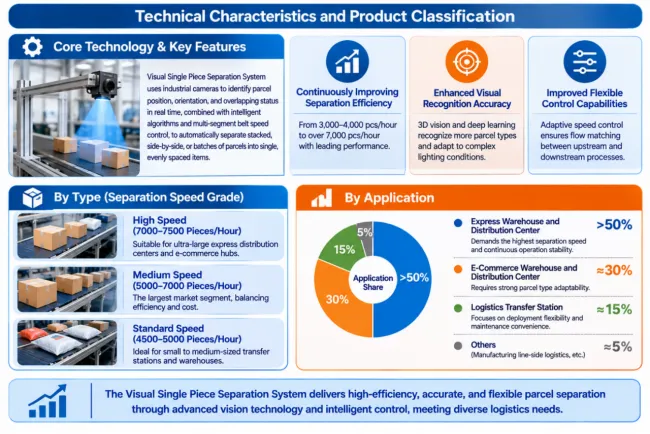
The core value of Visual Single Piece Separation System lies in using industrial cameras to identify parcel position, orientation, and overlapping status in real time, combined with intelligent algorithms and multi-segment belt speed control, to automatically separate stacked, side-by-side, or batches of parcels into single, evenly spaced items, providing a stable singulated input stream for downstream automatic barcode scanning, weighing, and sorting processes. Key technological trends include: 1. Continuously Improving Separation Efficiency, advancing from early 3,000-4,000 pieces/hour toward higher speed grades, with leading companies achieving stable separation capabilities above 7,000 pieces/hour; 2. Enhanced Visual Recognition Accuracy, with 3D vision and deep learning algorithms enabling systems to recognize more parcel types (soft packs, irregular items, film-wrapped items) and adapt to complex lighting conditions; 3. Improved Flexible Control Capabilities, using adaptive speed control algorithms to automatically adjust separation rhythm based on incoming flow rates, achieving flow matching between upstream parcel feeding and downstream sorting.
By Type (Separation Speed Grade)
High Speed (7000-7500 Pieces/Hour): Suitable for ultra-large express distribution centers and e-commerce hubs, demanding the highest system stability and algorithm response speed.
Medium Speed (5000-7000 Pieces/Hour): The largest market segment by share, balancing efficiency and cost, widely used in regional distribution centers.
Standard Speed (4500-5000 Pieces/Hour): Suitable for small to medium-sized transfer stations and warehouse distribution centers, with higher sensitivity to equipment investment costs.
By Application:
Express Warehouse and Distribution Center: The largest application segment (>50%), demanding the highest separation speed and continuous operation stability.
E-Commerce Warehouse and Distribution Center: Approximately 30%, with higher requirements for parcel type adaptability (soft packs, irregular items) and flexible control capabilities.
Logistics Transfer Station: Approximately 15%, serving as connection nodes between line-haul transportation and last-mile delivery, with greater focus on deployment flexibility and maintenance convenience.
Others (manufacturing line-side logistics, postal processing centers, etc.): Approximately 5%.
Global Visual Single Piece Separation System Top 14 players Ranking and Market Share (Ranking is based on the revenue of 2025, continually updated)
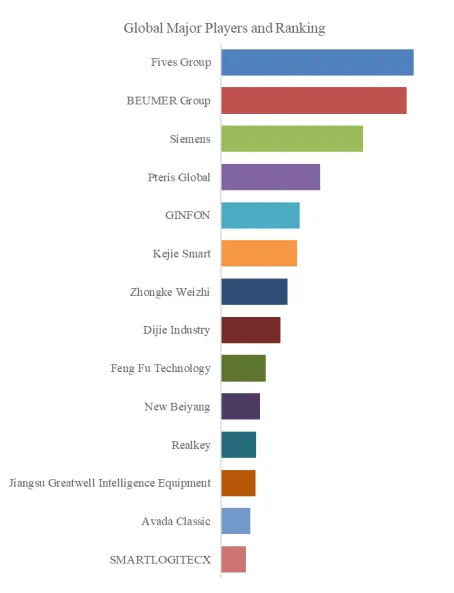
According to Global Info Research Top Players Research Center, the global key manufacturers of Visual Single Piece Separation System include Fives Group, BEUMER Group, Siemens, Pteris Global, GINFON, etc. In 2025, the global top five players had a share approximately 38.4% in terms of revenue.
Market Competition Landscape Analysis
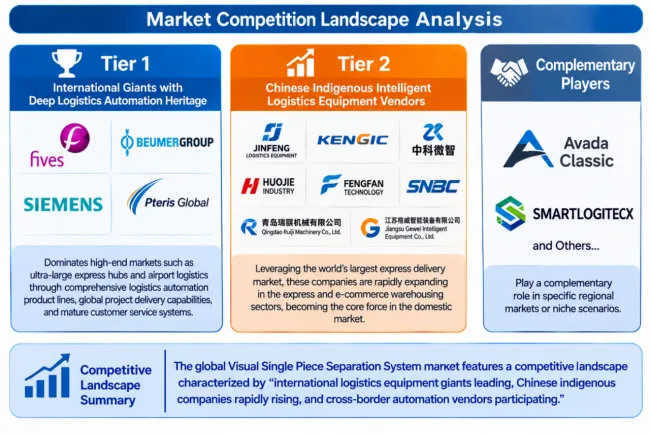
The global Visual Single Piece Separation System market features a competitive landscape characterized by "international logistics equipment giants leading, Chinese indigenous companies rapidly rising, and cross-border automation vendors participating."
Tier 1 (International Giants with Deep Logistics Automation Heritage): This group includes Fives Group (global leader in intelligent logistics solutions), BEUMER Group (airport and logistics sorting system specialist), Siemens (industrial automation and logistics solutions), and Pteris Global (airport logistics system supplier). These companies dominate high-end markets such as ultra-large express hubs and airport logistics through comprehensive logistics automation product lines, global project delivery capabilities, and mature customer service systems.
Tier 2 (Chinese Indigenous Intelligent Logistics Equipment Vendors): Represented by Jinfeng Logistics Equipment, KENGIC Intelligent, Zhongke Weizhi, Huojie Industry, Fengfan Technology, SNBC, Qingdao Ruiji Machinery Co., Ltd. , and Jiangsu Gewei Intelligent Equipment Co., Ltd. Leveraging the world's largest express delivery market application scenarios, rapid-response localized services, and continuously iterating product capabilities, these companies are rapidly expanding in the express and e-commerce warehousing sectors, becoming the core force in the domestic Visual Single Piece Separation System market. Among them, companies such as Zhongke Weizhi and KENGIC Intelligent have established significant advantages in the medium-to-high-speed single piece separation equipment market through deep cooperation with leading express delivery enterprises.
Additionally, Avada Classic, SMARTLOGITECX, and others play complementary roles in specific regional markets or niche scenarios.
Tariff Policy and Supply Chain Restructuring
Changes in the global trade landscape in 2025 are having structural impacts on the Visual Single Piece Separation System market:
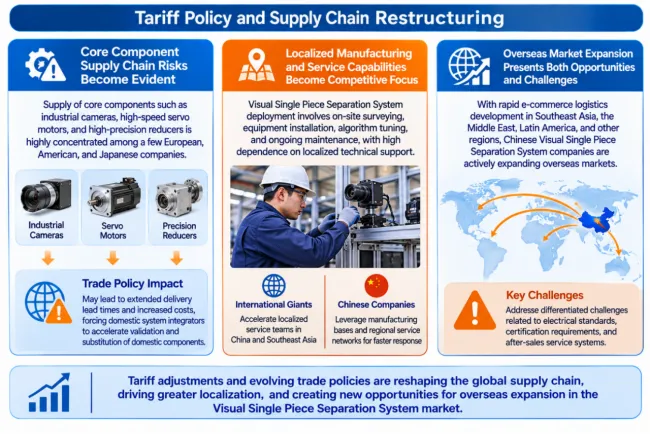
Core Component Supply Chain Risks Become Evident. Supply of core components such as industrial cameras, high-speed servo motors, and high-precision reducers is highly concentrated among a few European, American, and Japanese companies. Trade policy fluctuations may lead to extended delivery lead times and increased costs, forcing domestic system integrators to accelerate validation and substitution of domestic components.
Localized Manufacturing and Service Capabilities Become Competitive Focus. Visual Single Piece Separation System deployment involves on-site surveying, equipment installation, algorithm tuning, and ongoing maintenance, with high dependence on localized technical support. International giants are accelerating the establishment of localized service teams in China and Southeast Asia, while Chinese indigenous companies leverage manufacturing bases and regional service networks to build response speed advantages.
Overseas Market Expansion Presents Both Opportunities and Challenges. With rapid e-commerce logistics development in Southeast Asia, the Middle East, Latin America, and other regions, Chinese Visual Single Piece Separation System companies are actively expanding overseas markets. However, they must address differentiated challenges related to electrical standards, certification requirements, and after-sales service systems across different countries.
Typical Cases and Technological Breakthroughs
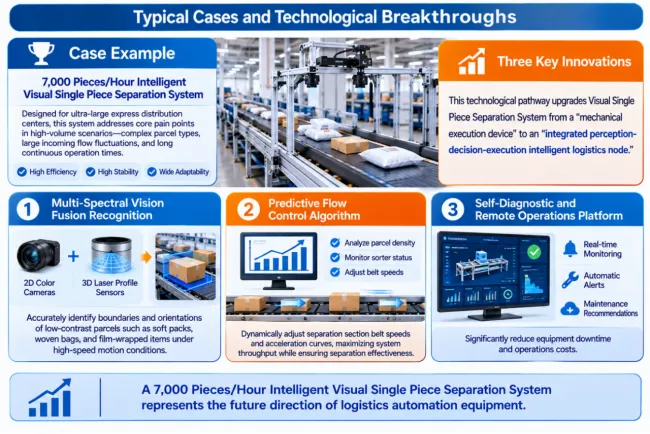
The industry's focus is shifting decisively from single "separation speed improvement" to deep evolution in "full-category adaptability and system stability." A prime example is a 7,000 pieces/hour intelligent Visual Single Piece Separation System developed for ultra-large express distribution centers.
Targeting core pain points in high-volume scenarios—complex parcel types, large incoming flow fluctuations, and long continuous operation times—this system achieves three key innovations:
Multi-Spectral Vision Fusion Recognition: Integrates 2D color cameras with 3D laser profile sensors to accurately identify boundaries and orientations of low-contrast parcels such as soft packs, woven bags, and film-wrapped items under high-speed motion conditions.
Predictive Flow Control Algorithm: Analyzes upstream parcel density and downstream sorter real-time status to dynamically adjust separation section belt speeds and acceleration curves, maximizing system throughput while ensuring separation effectiveness.
Self-Diagnostic and Remote Operations Platform: Real-time monitoring of key component status, automatic alerts for anomalies with maintenance recommendations, significantly reducing equipment downtime and operations costs.
This technological pathway upgrades Visual Single Piece Separation System from a "mechanical execution device" to an "integrated perception-decision-execution intelligent logistics node," representing the future direction of logistics automation equipment.
Future Trends & Core Challenges
Future Trends:
Deep Integration of Deep Learning and Separation Algorithms: Training on massive parcel image datasets to enable systems to adaptively handle special parcel types such as irregular items and damaged parcels.
Inter-Equipment Coordination: Achieving data interoperability and coordinated scheduling between single piece separation systems, upstream feeding systems, and downstream sorting systems to build end-to-end intelligent sorting solutions.
Modular and Standardized Design: Reducing deployment cycles and maintenance complexity, enabling flexible configuration for different site conditions and flow requirements.
Core Challenges:
Accuracy vs. Stability Balance at Ultra-High Separation Speeds: At speeds exceeding 7,000 pieces/hour, parcel recognition and separation accuracy cannot reach 100%. Mis-separation or missed separation may cause downstream equipment jams or sorting errors.
Extreme Parcel Type Diversity Challenge: The differences in parcel size, weight, material, and packaging form in e-commerce and express delivery present continuous challenges for visual recognition algorithms and mechanical structure adaptability.
Price Competition and Cost Pressure: With increasing market participants, medium-to-low-speed products face downward price pressure. Companies must maintain reasonable profit margins through technological innovation and economies of scale.
Visual Single Piece Separation System Report Chapter Summary:
Chapter 1: Visual Single Piece Separation System Industry Definition and Market Overview
This chapter clearly defines the product definition, characteristics, and industry statistical scope of Visual Single Piece Separation System, systematically introduces its mainstream product classifications and key application areas, and presents the overall size and future outlook of the global market.
Chapter 2: In-depth Analysis of Core Visual Single Piece Separation System Companies (2021-2025)
This chapter focuses on the main players in the Visual Single Piece Separation System market. For each representative company, it not only introduces its basic overview, main business, and product portfolio, but also highlights its core operating data in the Visual Single Piece Separation System field, including sales volume, sales revenue, pricing strategies, and the latest development trends of the company from 2021 to 2025.
Chapter 3: Global Competitive Landscape Analysis (2021-2025)
This chapter examines the global Visual Single Piece Separation System competitive landscape from a macro perspective. By comparing the Visual Single Piece Separation System sales volume, pricing, revenue, and market share of major companies from 2021 to 2025, it quantitatively analyzes market concentration and interprets the competitive strategies and market position evolution of core manufacturers.
Chapter 4: Visual Single Piece Separation System Major Regional Market Size and Prospects (2021-2032)
This chapter conducts a regional-level analysis of the global Visual Single Piece Separation System core markets. It will present historical data on the Visual Single Piece Separation System market size (sales volume and revenue from 2021-2025) in major regions such as North America, Europe, and Asia Pacific, and provide market outlook forecasts for 2026-2032.
Chapter 5: Visual Single Piece Separation System Product Type Segmentation Market Forecast (2021-2032)
This chapter delves into the Visual Single Piece Separation System product structure. It will segment the Visual Single Piece Separation System market by different types (such as Separation Speed: 7000 - 7500 Pieces/Hour、Separation Speed: 5000-7000 Pieces/Hour、Separation Speed: 4500 - 5000 Pieces/Hour, etc.), and analyze in detail the historical market size of each segmented product category from 2021 to 2025 and the future growth trends from 2026 to 2032.
Chapter 6: Visual Single Piece Separation System Application Field Segmentation Market Forecast (2021-2032)
This chapter delves into the downstream application demand for Visual Single Piece Separation System. The market will be segmented by different application areas (such as Express Warehouse and Distribution Center、E-Commerce Warehouse and Distribution Center、Logistics Transfer Station、Other, etc.), presenting the historical market size for each area from 2021-2025 and future demand forecasts from 2026-2032.
Chapters 7-11: In-depth Analysis of Global Regional Markets (2021-2032)
This section is the core module of the Visual Single Piece Separation System report, providing an in-depth country/regional analysis across five major regions: North America, Europe, Asia Pacific, South America, and the Middle East & Africa. The chapter structure for each region is consistent:
Segmentation by Country/Region: Analysis of the market size and forecasts for major countries within the region from 2021-2032.
Segmentation by Product Type: Presentation of the market structure and development forecasts for different product types within the region from 2021-2032.
Segmentation by Application Area: Analysis of market demand and prospects for different application areas within the region from 2021-2032.
Chapter 12: Global Visual Single Piece Separation System Market Dynamics, Challenges, and Trends
This chapter aims to analyze the key internal and external factors affecting the development of the Visual Single Piece Separation System market. It systematically reviews the core drivers of Visual Single Piece Separation System market growth, the main obstacles and challenges faced, and assesses future product, technology, and market development trends.
Chapter 13: Visual Single Piece Separation System Industry Chain Structure Analysis
This chapter analyzes the entire industry chain ecosystem of the Visual Single Piece Separation System industry. From upstream raw material supply to midstream production and manufacturing, and then to downstream end-use applications, it analyzes the current status, cost structure, and collaborative relationships of each link.
Chapter 14: Sales Channel Model Research
This chapter focuses on the distribution channels of Visual Single Piece Separation System products. It analyzes the market share, advantages and disadvantages, and typical cases of mainstream sales channels, and explores the innovation and development trends of channel models.
Chapter 15: Research Conclusions and Strategic Recommendations
As a summary of the report, this chapter will distill the core findings and conclusions of the entire report and, based on a comprehensive understanding of the Visual Single Piece Separation System market, provide actionable strategic development recommendations for industry participants and potential entrants.
For more information, please refer to "Global Visual Single Piece Separation System Market 2026 by Manufacturers, Regions, Type and Application, Forecast to 2032". This report analyzes the supply and demand situation, development status, and changes in the industry, focusing on the development status of the industry, how to face the development challenges of the industry, industry development suggestions, industry competitiveness, and industry investment analysis and trend forecasts. The report also summarizes the overall development dynamics of the industry, including the impact of the latest US tariffs on the global supply chain, the supply relationship analysis of the industrial chain, and provides reference suggestions and specific solutions for the industry in terms of products.
Previous News:
RFID Label Converting Machine Market 2026: A 5.2% CAGR Points to a USD 2,052 Million Opportunity by 2032 as RAIN RFID Item-Level Tagging and Digital Product Passports Accelerate Demand
Next News:
The copyright of this article belongs to Global Info Research. Without the written authorization of our company, no organization or individual may reprint, quote, copy, adapt or use it for commercial purposes in any way. When authorized to use, the original source must be indicated as "Global Info Research" and the complete copyright information must be retained.
- We Provide Professional, Accurate Market Analysis to Help You Stay Ahead of Your Competition.Speak to our analyst >>

Our Clients
What We Can Provide?
With better results and higher quality products,Our professional reports can achieve four things:

Insight into the industry market information

Analyze market development needs

Prospects for future development

Develop industry investment strategy
- Digging deeper into global industry information and providing market strategies.Contact Us >>
- We Provide Professional, Accurate Market Analysis to Help You Stay Ahead of Your Competition.Speak to our analyst >>
Our Clients
What We Can Provide?
With better results and higher quality products,Our professional reports can achieve four things:
Insight into the industry market information
Analyze market development needs
Prospects for future development
Develop industry investment strategy
- Digging deeper into global industry information and providing market strategies.Contact Us >>