
Liquid Barium Zinc Stabilizer Market 2026: A 5.1% CAGR Points to a USD 896 Million Opportunity as Lead-Free PVC Regulations Accelerate Substitution
Published Date: Tuesday,17 Nov,2026


Liquid Barium Zinc Stabilizer Market Summary
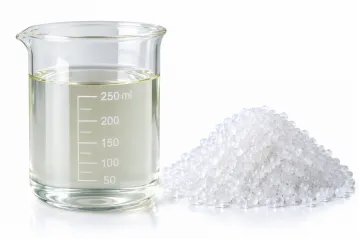
To address the problems of high toxicity and poor environmental performance of traditional lead salt and barium-cadmium heat stabilizers in PVC processing, as well as the insufficient thermal stability and poor transparency of calcium-zinc stabilizers, liquid barium-zinc stabilizers were developed. This product is an environmentally friendly PVC heat stabilizer composed of barium salts, zinc salts, and organic ligands. The core principle is that barium and zinc ions work synergistically to capture hydrogen chloride gas produced during PVC degradation, inhibiting chain degradation reactions. Simultaneously, the organic ligands improve metal ion compatibility, reduce blooming, and achieve efficient thermal stabilization of PVC materials. Since the late 20th century, with increasingly stringent global environmental regulations, liquid barium-zinc stabilizers have gradually replaced traditional toxic stabilizers, expanding from basic chemical fields to high-end PVC product processing, forming a mature industrial application system. Currently, liquid barium-zinc stabilizers have formed a complete product range covering general-purpose, transparent, and high-temperature resistant types, and are widely used in PVC films, pipes, profiles, cable materials, and medical packaging.
Global Liquid Barium Zinc Stabilizer Market Size (US$ Million), 2026-2032
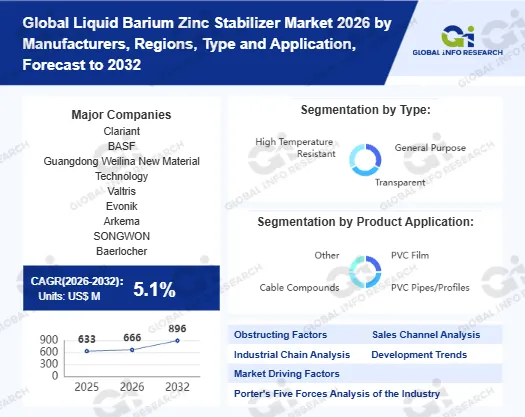
According to the latest report published "Global Liquid Barium Zinc Stabilizer Market 2026 by Manufacturers, Regions, Type and Application, Forecast to 2032" by GIR (Global Info Research), the global Liquid Barium Zinc Stabilizer market was valued at approximately USD 633 million and is projected to reach USD 896 million in the coming years, expanding at a CAGR of 5.1%. This growth reflects sustained market momentum and increasing opportunities driven by evolving industry demand and emerging application scenarios.
Global Liquid Barium Zinc Stabilizer Top 24 Players Ranking and Market Share (Ranking is based on the revenue of 2025, continually updated)
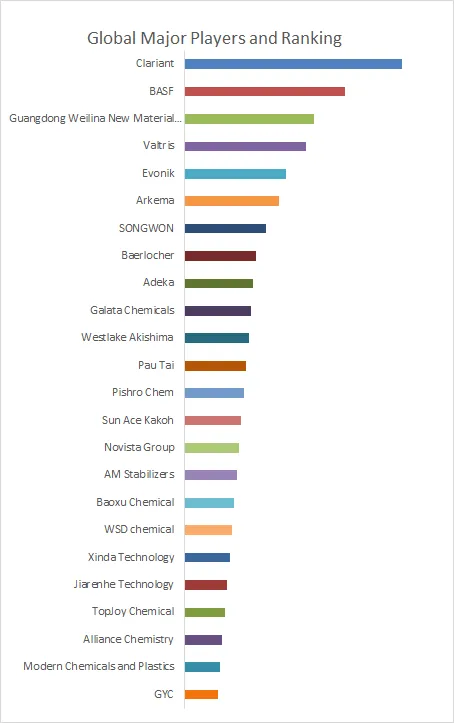
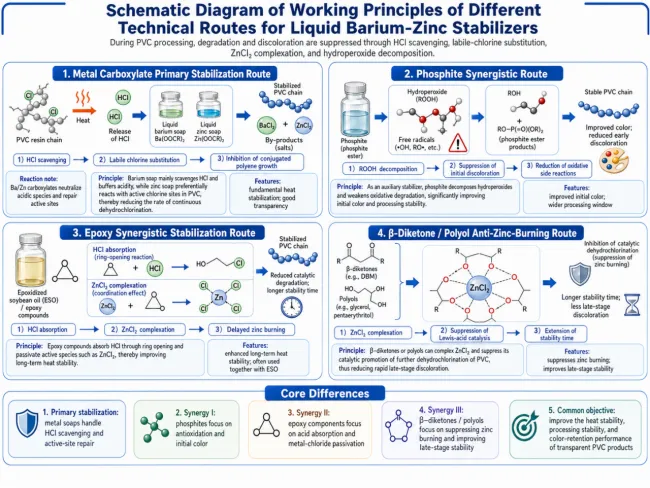
Table 1. Liquid Barium Zinc Stabilizer Industry Chain Analysis
|
|
Item |
Description |
|
Upstream |
Barium Salts |
Barium salts are organometallic salt compounds with barium as the core element. They possess excellent long-term thermal stability, efficiently capturing hydrogen chloride produced during PVC degradation, inhibiting polymer chain decomposition and aging, and delaying yellowing and embrittlement. They synergistically improve the heat resistance and weather resistance of processed products, making them a key component in long-term stable systems. |
|
Zinc Salts |
Zinc salts are organozinc metal compounds with excellent initial thermal stability. They can quickly improve the initial color of PVC during processing, preventing initial discoloration and blackening. Combined with barium salts, they form a barium-zinc synergistic system, balancing initial whiteness and long-term heat resistance, and improving processing fluidity and surface smoothness. |
|
|
Organic Ligands |
Organic ligands are a class of functional organic chelating agents that can form stable complexes with barium and zinc metal ions, improving the solubility and dispersibility of metal salts in the system. They weaken the side effects of metal ion catalytic degradation, inhibit precipitation, whitening, and blooming, enhance system compatibility, and optimize the overall stable synergistic effect. |
|
|
Environmentally Friendly Ester Solvents |
Environmentally friendly ester solvents are bio-based or low-toxicity composite ester additives, characterized by low volatility, minimal odor, environmental compliance, and strong dissolving power. As a carrier, they uniformly dissolve barium salts, zinc salts, and organic ligands, maintaining a homogeneous liquid state with good flowability and easy mixing. They are free of heavy metal toxicity and meet the requirements of green PVC production. |
|
|
Downstream |
PVC Films |
They are widely used in the production of packaging films, agricultural films, flexible films, and transparent films. Liquid barium-zinc stabilizers are environmentally friendly and non-toxic, with high transparency and excellent initial coloring, preventing film yellowing and increased haze. They are suitable for calendering, blown film, and other processes. They impart good aging and migration resistance to the film, ensuring its softness and long-term stability, meeting food contact and daily environmental standards. |
|
PVC Pipes/Profiles |
They are also used in the processing of rigid PVC products such as water supply and drainage pipes, fittings, door and window profiles, and decorative profiles. They meet the thermal stability requirements of high-temperature extrusion and shaping processes, effectively inhibiting long-term thermal degradation and improving the dimensional stability and surface smoothness of the products. This lead-free, environmentally friendly formula meets the requirements of green production in building materials, balancing processing efficiency with outdoor weather resistance and anti-aging properties. |
|
|
Cables |
Suitable for flexible cable materials such as PVC wire and cable insulation layers and sheathing materials. It possesses excellent heat resistance, aging resistance, and anti-exudation properties, allowing it to adapt to high-speed extrusion processing of cables and preventing high-temperature processing cracking. Simultaneously, it improves the low-temperature toughness, abrasion resistance, and long-term service stability of cables, is environmentally friendly and low in toxicity, and meets the safety specifications and flame-retardant processing requirements of wires and cables. |
Table 2. Liquid Barium Zinc Stabilizer Industry Policy Analysis
|
|
Policy |
Description |
|
1 |
14th Five-Year Plan Action Plan for Plastic Pollution Control |
The use of lead-containing additives in sensitive areas such as food packaging and medical products is explicitly restricted, driving the penetration rate of lead-free stabilizers (such as liquid barium zinc stabilizers) from 35% in 2020 to 58% in 2025, and projected to reach over 65% in 2026, directly promoting market substitution by environmentally friendly PVC heat stabilizers. |
|
2 |
EU RoHS |
Restrictions on harmful substances such as lead, mercury, and cadmium in electronic and electrical equipment have made liquid barium zinc stabilizers a major environmentally friendly alternative to lead salt stabilizers due to their lead-free and low-toxicity characteristics, widely used in the processing of PVC cables, films, and profiles in the EU market. |
|
3 |
List of Key Controlled New Pollutants |
Lead salt heat stabilizers are included in the key control scope, requiring the promotion of lead salt substitution technologies by the end of 2025, promoting the large-scale application of liquid barium zinc stabilizers in rigid PVC products such as building profiles and pipes, with supporting policies including tax incentives and special subsidies. |
Table 3. Liquid Barium Zinc Stabilizer Industry Development Trends
|
|
Development Trends |
Description |
|
1 |
Market Size Continues to Expand, but Growth Rates Diverge |
The Chinese market exhibits a divergent trend: liquid products are growing faster than solid products. Liquid products are expected to grow at 9.6% due to increased penetration in high-growth areas such as UPVC profiles and medical tubing; while solid powder products are experiencing slower growth at 6.1% due to the lagging adoption of automated metering equipment. |
|
2 |
Technological Upgrading and Innovation Driven |
The industry's technological barriers continue to rise. In 2025, 142 new invention patents related to barium-zinc stabilizers were filed, focusing on three main directions: zinc source microencapsulation, silane coupling modification of barium salt surfaces, and bio-based polyol ligand design. |
|
3 |
Application Areas Become More High-End and Functional |
Liquid barium-zinc stabilizers continue to develop towards lower migration, lower VOCs, higher transparency, and higher temperature resistance, with functionalized formulations gradually increasing in proportion. The market share of high-end products is expected to increase from the current 20% to 35% by 2032, with food-grade/medical-grade products having high added value and significant growth potential. |
Liquid Barium Zinc Stabilizer Report Chapter Summary:
Chapter 1: Liquid Barium Zinc Stabilizer Industry Definition and Market Overview
This chapter clearly defines the product definition, characteristics, and industry statistical scope of Liquid Barium Zinc Stabilizer, systematically introduces its mainstream product classifications and key application areas, and presents the overall size and future outlook of the global market.
Chapter 2: In-depth Analysis of Core Liquid Barium Zinc Stabilizer Companies (2021-2025)
This chapter focuses on the main players in the Liquid Barium Zinc Stabilizer market. For each representative company, it not only introduces its basic overview, main business, and product portfolio, but also highlights its core operating data in the Liquid Barium Zinc Stabilizer field, including sales volume, sales revenue, pricing strategies, and the latest development trends of the company from 2021 to 2025.
Chapter 3: Global Competitive Landscape Analysis (2021-2025)
This chapter examines the global Liquid Barium Zinc Stabilizer competitive landscape from a macro perspective. By comparing the Liquid Barium Zinc Stabilizer sales volume, pricing, revenue, and market share of major companies from 2021 to 2025, it quantitatively analyzes market concentration and interprets the competitive strategies and market position evolution of core manufacturers.
Chapter 4: Liquid Barium Zinc Stabilizer Major Regional Market Size and Prospects (2021-2032)
This chapter conducts a regional-level analysis of the global Liquid Barium Zinc Stabilizer core markets. It will present historical data on the Liquid Barium Zinc Stabilizer market size (sales volume and revenue from 2021-2025) in major regions such as North America, Europe, and Asia Pacific, and provide market outlook forecasts for 2026-2032.
Chapter 5: Liquid Barium Zinc Stabilizer Product Type Segmentation Market Forecast (2021-2032)
This chapter delves into the Liquid Barium Zinc Stabilizer product structure. It will segment the Liquid Barium Zinc Stabilizer market by different types (such as General Purpose、Transparent、High Temperature Resistant, etc.), and analyze in detail the historical market size of each segmented product category from 2021 to 2025 and the future growth trends from 2026 to 2032.
Chapter 6: Liquid Barium Zinc Stabilizer Application Field Segmentation Market Forecast (2021-2032)
This chapter delves into the downstream application demand for Liquid Barium Zinc Stabilizer. The market will be segmented by different application areas (such as PVC Film、PVC Pipes/Profiles、Cable Compounds、Other, etc.), presenting the historical market size for each area from 2021-2025 and future demand forecasts from 2026-2032.
Chapters 7-11: In-depth Analysis of Global Regional Markets (2021-2032)
This section is the core module of the Liquid Barium Zinc Stabilizer report, providing an in-depth country/regional analysis across five major regions: North America, Europe, Asia Pacific, South America, and the Middle East & Africa. The chapter structure for each region is consistent:
Segmentation by Country/Region: Analysis of the market size and forecasts for major countries within the region from 2021-2032.
Segmentation by Product Type: Presentation of the market structure and development forecasts for different product types within the region from 2021-2032.
Segmentation by Application Area: Analysis of market demand and prospects for different application areas within the region from 2021-2032.
Chapter 12: Global Liquid Barium Zinc Stabilizer Market Dynamics, Challenges, and Trends
This chapter aims to analyze the key internal and external factors affecting the development of the Liquid Barium Zinc Stabilizer market. It systematically reviews the core drivers of Liquid Barium Zinc Stabilizer market growth, the main obstacles and challenges faced, and assesses future product, technology, and market development trends.
Chapter 13: Liquid Barium Zinc Stabilizer Industry Chain Structure Analysis
This chapter analyzes the entire industry chain ecosystem of the Liquid Barium Zinc Stabilizer industry. From upstream raw material supply to midstream production and manufacturing, and then to downstream end-use applications, it analyzes the current status, cost structure, and collaborative relationships of each link.
Chapter 14: Sales Channel Model Research
This chapter focuses on the distribution channels of Liquid Barium Zinc Stabilizer products. It analyzes the market share, advantages and disadvantages, and typical cases of mainstream sales channels, and explores the innovation and development trends of channel models.
Chapter 15: Research Conclusions and Strategic Recommendations
As a summary of the report, this chapter will distill the core findings and conclusions of the entire report and, based on a comprehensive understanding of the Liquid Barium Zinc Stabilizer market, provide actionable strategic development recommendations for industry participants and potential entrants.
For more information, please refer to "Global Liquid Barium Zinc Stabilizer Market 2026 by Manufacturers, Regions, Type and Application, Forecast to 2032". This report analyzes the supply and demand situation, development status, and changes in the industry, focusing on the development status of the industry, how to face the development challenges of the industry, industry development suggestions, industry competitiveness, and industry investment analysis and trend forecasts. The report also summarizes the overall development dynamics of the industry, including the impact of the latest US tariffs on the global supply chain, the supply relationship analysis of the industrial chain, and provides reference suggestions and specific solutions for the industry in terms of products.
Previous News:
EEG Conductive Gel Market 2026: A 5.7% CAGR Points to a USD 301 Million Opportunity by 2032 as Brain-Computer Interface and Wearable EEG Demand Accelerate
Next News:
Global Ferrite Cores Market Is Projected to Reach USD 546 Million by 2032, Expanding at a 5.4% CAGR During the 2026–2032 Forecast Period
The copyright of this article belongs to Global Info Research. Without the written authorization of our company, no organization or individual may reprint, quote, copy, adapt or use it for commercial purposes in any way. When authorized to use, the original source must be indicated as "Global Info Research" and the complete copyright information must be retained.
- We Provide Professional, Accurate Market Analysis to Help You Stay Ahead of Your Competition.Speak to our analyst >>

Our Clients
What We Can Provide?
With better results and higher quality products,Our professional reports can achieve four things:

Insight into the industry market information

Analyze market development needs

Prospects for future development

Develop industry investment strategy
- Digging deeper into global industry information and providing market strategies.Contact Us >>
- We Provide Professional, Accurate Market Analysis to Help You Stay Ahead of Your Competition.Speak to our analyst >>
Our Clients
What We Can Provide?
With better results and higher quality products,Our professional reports can achieve four things:
Insight into the industry market information
Analyze market development needs
Prospects for future development
Develop industry investment strategy
- Digging deeper into global industry information and providing market strategies.Contact Us >>