
Medical Supply Chain Management Solutions Market 2026: A 6.6% CAGR Points to a USD 7,824 Million Opportunity by 2032 as Cost Control and Supply Resilience Drive Digitalization
Published Date: Wednesday,18 Nov,2026


 Medical Supply Chain Management Solutions
 Market Summary

Medical supply chain management solutions are integrated digital platforms and services designed to optimize the procurement, inventory control, logistics, and distribution processes of medical products within healthcare networks. These solutions enable real-time tracking of medical supplies, demand forecasting, automated replenishment, and compliance management. They are widely used in hospitals, pharmaceutical distribution networks, public health systems, and medical logistics service providers. By improving transparency and operational efficiency, these systems help reduce waste, prevent shortages, and enhance the reliability of the healthcare service delivery chain. The medical supply chain management solutions industry chain includes several key links. Upstream primarily covers core technologies such as cloud computing infrastructure, data storage systems, IoT devices, RFID tags, barcode scanning technology, and network communication services. Midstream involves software development and system integration, including supply chain management platform development, data analytics algorithm construction, and digital integration of medical processes. Downstream applications are mainly concentrated in hospital systems, pharmaceutical companies, medical device distributors, and public health institutions for procurement management, inventory control, and logistics optimization. The industry chain also includes system deployment, data maintenance, technical support, and continuous upgrade services to ensure supply chain operational efficiency, data accuracy, and optimized allocation of medical resources. The gross profit margin of major companies in this industry ranges from 35% to 60%.
Global Medical Supply Chain Management Solutions Market Size (US$ Million), 2026-2032
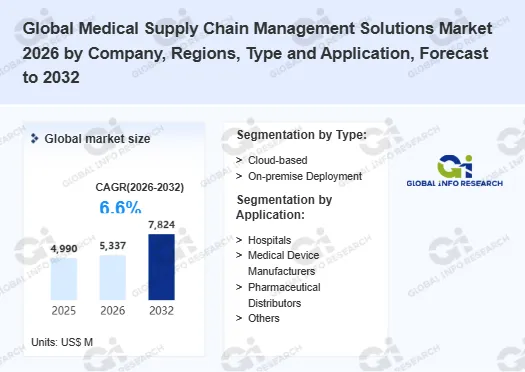
According to the latest report published "Global Medical Supply Chain Management Solutions Market 2026 by Manufacturers, Regions, Type and Application, Forecast to 2032" by GIR (Global Info Research), the global Medical Supply Chain Management Solutions market was valued at approximately USD 4990 million in 2025 and is projected to reach USD 5337 million in 2026. With a CAGR of 6.6% during the forecast period from 2026 to 2032, the market is expected to further expand to approximately USD 7824 million by 2032. This growth is driven by increasing market demand, evolving industry trends, and expanding application opportunities worldwide.
Global Medical Supply Chain Management Solutions Top 11 Players Ranking and Market Share (Ranking is based on the revenue of 2025, continually updated)
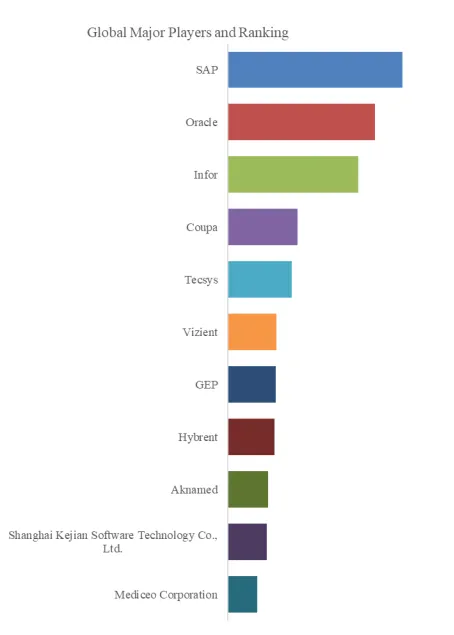
This report profiles key players of Medical Supply Chain Management Solutions such as SAP,Oracle,Infor,Coupa
In 2025, the global top five Medical Supply Chain Management Solutions players account for 38.05% of market share in terms of revenue. Above figure shows the key players ranked by revenue in Medical Supply Chain Management Solutions.
Figure. Medical Supply Chain Management Solutions, Market Overview
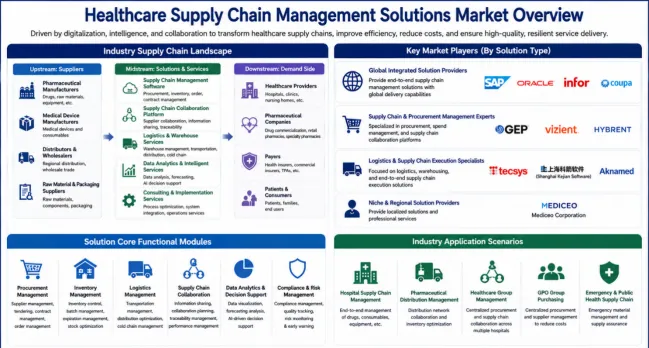
Market Drivers:
1. The global healthcare system is facing ongoing cost control pressures, a core driver of the rapid development of Medical Supply Chain Management Solutions. Hospitals, healthcare groups, and regional health systems have long been impacted by rising costs of pharmaceuticals, consumables, and equipment procurement, coupled with reduced healthcare reimbursement. Traditional supply chain models relying on manual and decentralized procurement are no longer sufficient to meet the demands of modern healthcare operations. Healthcare institutions are increasingly emphasizing the use of digital supply chain systems to achieve centralized procurement, refined inventory management, and operational transparency, thereby reducing waste and inventory buildup. Particularly in the areas of high-value consumables, implantable devices, and pharmaceutical management, supply chain systems can help hospitals optimize procurement plans, improve inventory turnover, and reduce obsolescence losses. Furthermore, large healthcare groups are advancing the construction of unified supply chain platforms to achieve cross-site resource sharing and economies of scale in procurement, further expanding the market demand for medical supply chain management solutions. As global healthcare costs continue to rise, supply chain digitalization has gradually transformed from an "efficiency tool" into a crucial infrastructure for healthcare institutions to enhance their operational capabilities.
2. The COVID-19 pandemic and global supply chain volatility have significantly increased the healthcare industry's focus on supply chain resilience, accelerating the upgrade of medical supply chain management systems. During the pandemic, hospitals worldwide experienced widespread shortages of protective equipment, pharmaceuticals, testing reagents, and critical medical equipment, exposing the shortcomings of traditional healthcare supply chains in inventory forecasting, supply coordination, and emergency response. Subsequently, an increasing number of healthcare institutions began investing in intelligent supply chain systems to enhance their procurement forecasting, risk monitoring, and supplier collaboration capabilities. Healthcare supply chain management solutions, through real-time inventory monitoring, multi-level supplier management, and demand forecasting algorithms, can help hospitals improve their ability to respond to public health emergencies. Simultaneously, governments and regulatory agencies are strengthening requirements for the security of critical medical supply chains, driving hospitals and healthcare groups to establish more transparent and traceable supply systems. Supply chain security has become a crucial strategic issue for modern healthcare systems, providing sustained growth momentum for the industry.
3. The ongoing digital transformation of healthcare and the construction of hospital information systems are also accelerating the adoption of healthcare supply chain management solutions. In recent years, Hospital Information Systems (HIS), Electronic Medical Records (EMR), ERP systems, and smart hospital platforms have developed rapidly, with healthcare institutions gradually upgrading from single-point information systems to overall operational digitalization. In this process, supply chain management is considered a crucial core link connecting clinical, financial, and logistical functions. Modern medical supply chain systems not only possess procurement and inventory management functions but also integrate with clinical consumables management, financial settlement, operating room management, and medical insurance cost control systems to achieve end-to-end data collaboration. With the deepening application of cloud computing, IoT, RFID, and AI technologies, medical supply chain management is transforming from traditional warehousing management to intelligent operation platforms. Improved digital infrastructure enables more and more medical institutions to deploy intelligent supply chain systems, thereby driving the continuous expansion of the industry.
4. Stricter regulations on high-value consumables and increased medical compliance requirements are important institutional drivers for industry development. In recent years, governments in many countries have strengthened the regulation of the circulation, procurement, and use of medical consumables, especially in the areas of high-value medical consumables and implantable interventional products. Hospitals need to more accurately record product origins, batches, usage records, and inventory flows to meet regulatory compliance and audit requirements. Medical supply chain management solutions can achieve full lifecycle management of consumables through UDI (Unique Device Identifier), RFID tracking, and digital ledgers, improving product traceability and risk control capabilities. Furthermore, centralized procurement policies, DRG/DIP payment reforms, and medical insurance cost control policies are also forcing hospitals to improve the level of refined supply chain management. As the regulatory environment intensifies, healthcare supply chain systems are gradually evolving from "operational tools" to "compliance infrastructure," leading to continuously increasing market demand.
5. The healthcare service model is shifting towards large-scale healthcare groups and regional healthcare collaboration, further driving up demand for healthcare supply chain management solutions. In recent years, more and more countries have promoted the integration of healthcare resources, resulting in a continuous increase in the number of large hospital groups, regional medical consortia, and chain medical institutions. These organizations often have multiple campuses and complex procurement systems, placing higher demands on unified supply chain management capabilities. Traditional decentralized procurement and manual inventory models are insufficient to support cross-regional, multi-campus operations and management, while centralized supply chain platforms can help healthcare groups achieve unified procurement, unified inventory allocation, and centralized supplier management, thereby reducing procurement costs and improving operational efficiency. Simultaneously, the rapid adoption of third-party SPD (Supply Processing and Distribution) models in markets such as China has also boosted demand for healthcare supply chain software and services. The trend towards larger and more networked organizational structures in the healthcare industry is becoming a significant driver of the expansion of the supply chain management solutions market.
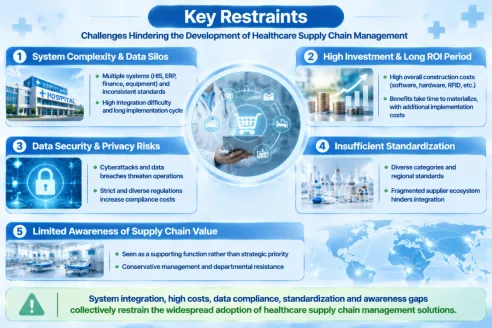
Restraint:
1. The complexity of system architectures and the severe information silos in the healthcare industry are significant obstacles to the implementation of healthcare supply chain management solutions. Most hospitals have long used HIS, ERP, financial, and equipment management systems developed by different vendors, resulting in inconsistent data standards and poor interface compatibility, making supply chain system integration extremely difficult. Many medical institutions still rely on paper records, manual inventory checks, and non-standardized inventory processes, indicating a relatively weak digital infrastructure. Achieving data linkage between procurement, inventory, clinical consumables, and finance through supply chain management platforms often requires complex system integration and process refactoring, leading to long implementation cycles and high technical challenges. Furthermore, the complex internal departmental structures of large hospitals can easily trigger organizational resistance when adjusting management processes, further increasing the difficulty of project implementation. The complexity of system integration and the cost of internal hospital process transformation are significant challenges in industry adoption.
2. The high investment and long return on investment period of healthcare supply chain management projects also limit the procurement enthusiasm of some medical institutions. Large-scale healthcare supply chain platforms typically involve software licensing, system deployment, hardware equipment, RFID tags, automated warehousing, and long-term operation and maintenance services, resulting in high overall construction costs. For small and medium-sized hospitals and primary healthcare institutions, limited IT budgets lead to a preference for prioritizing investment in diagnostic and treatment equipment and clinical systems over back-end operational management systems. While supply chain digitization can help hospitals reduce inventory and procurement costs in the long term, its benefits often take a long time to materialize, making some management teams hesitant to invest under short-term budget pressures. Furthermore, the additional costs associated with project implementation, such as business interruptions, personnel training, and process adjustments, further increase the difficulty of market promotion.
3. Increasingly stringent data security and patient privacy regulations also constrain industry development. Modern healthcare supply chain systems require deep integration with core hospital information systems, involving procurement data, patient consumable usage records, supplier information, and financial settlement data. Cyberattacks, data breaches, or service interruptions can severely impact hospital operations and patient safety. Recent frequent cybersecurity attacks on the global healthcare industry have made healthcare institutions highly cautious about cloud-based supply chain systems. At the same time, significant differences in national requirements regarding cross-border medical data flows, information security, and privacy protection increase the compliance complexity for multinational software vendors. Especially with the rapid development of cloud deployment models, data security has become a crucial factor influencing customer procurement decisions
4. Insufficient industry standardization and a fragmented supplier ecosystem are also significant factors hindering market maturity. The healthcare supply chain involves various categories such as pharmaceuticals, consumables, equipment, and diagnostic reagents, with significant differences in coding rules, procurement processes, and regulatory requirements across different countries and regions. Some hospitals even have custom material codes and non-uniform inventory standards, leading to difficulties in cross-system data sharing. Meanwhile, the global healthcare supply chain involves numerous participants, including hospitals, distributors, SPD service providers, pharmaceutical companies, and consumable manufacturers, making supply chain collaboration challenging. Because the industry lacks unified data interfaces and operational standards, compatibility between different vendor systems is limited, impacting the overall digitalization efficiency of the industry. Insufficient standardization not only increases the complexity of project implementation but also limits the industry's ability to scale and replicate.
5. Insufficient understanding of the value of supply chain management within healthcare institutions is also a real obstacle to industry development. Compared to clinical diagnostic equipment and core medical systems, supply chain management has long been considered a logistical support department, and its strategic value is easily underestimated. Many hospital management teams focus more on increasing medical revenue and building clinical capabilities, while paying relatively limited attention to inventory optimization, procurement collaboration, and operational efficiency improvements. Furthermore, some hospitals, with their conservative traditional management models, are hesitant to adopt new digital supply chain systems, fearing that the system's implementation will disrupt the stability of existing processes. Some clinical departments may also resist the need for transparency in consumable requisition and inventory. Industry market education is still ongoing, and the speed at which customer awareness increases is impacting industry penetration rates to some extent.

Opportunity:
1. The development of artificial intelligence, big data, and predictive analytics technologies has brought significant upgrade opportunities to healthcare supply chain management solutions. The future healthcare supply chain will no longer be simply about procurement and inventory management, but will gradually evolve into a data-driven intelligent decision-making platform. Through AI algorithms, the system can analyze historical procurement data, disease trends, surgical volume changes, and seasonal demand, thereby achieving more accurate inventory forecasting and procurement optimization. Intelligent supply chains can also proactively identify supply risks, optimize supplier combinations, and reduce the risks of inventory backlog and stockouts. As the digitalization of the healthcare industry increases and the value of data assets continues to rise, supply chain systems will gradually become a crucial hub for hospital operational decision-making. AI-driven intelligent supply chain solutions are expected to become a key area of competition in the future.
2. The rapid adoption of the SPD (Supply Processing and Distribution) model has brought new growth opportunities to the industry. Especially in the Chinese market, more and more hospitals are introducing the SPD service model, using third-party platforms to achieve centralized procurement of consumables, in-hospital distribution, and inventory management. The SPD model has not only driven the growth in demand for supply chain software platforms but has also spurred the development of RFID, smart cabinets, automated warehousing, and logistics systems. With the advancement of DRG/DIP payment reforms, hospitals are facing increasing pressure to control costs, further highlighting the value of the SPD (Supply, Processing, Distribution) model in reducing inventory and improving operational efficiency. The SPD market is expected to expand from large tertiary hospitals to regional medical groups and primary care hospitals, becoming a significant driver of long-term industry growth.
3. Regional medical collaboration and the trend towards large-scale medical groups will create tremendous opportunities for supply chain platform development. As medical consortia, regional medical centers, and chain medical institutions continue to develop, the demand for shared medical resources and centralized procurement continues to increase. Future medical supply chain systems will not only serve individual hospitals but will gradually evolve towards regional collaborative platforms, achieving multi-hospital inventory sharing, unified procurement, and centralized logistics distribution. This trend is conducive to large supply chain platform companies establishing stronger data networks and customer loyalty, and also helps drive the industry towards large-scale and platform-based development. The trend of medical group development is changing the traditional decentralized procurement model, creating greater market space for the industry.
4. Accelerated construction of medical infrastructure in emerging markets also provides broad opportunities for the industry's internationalization. Countries in Asia, Latin America, the Middle East, and parts of Africa are continuously increasing their investment in healthcare and accelerating the digitalization of hospitals. Many hospitals in emerging markets have low levels of IT adoption, and their healthcare supply chain management is still in its early stages, leaving significant room for upgrades. At the same time, these regions generally face problems such as low drug distribution efficiency, significant inventory waste, and insufficient supply chain transparency, leading to a growing demand for digital supply chain systems. With the increasing prevalence of cloud deployments and the maturity of SaaS products, the barriers to deploying supply chain systems for small and medium-sized healthcare institutions are decreasing. International markets, especially developing countries, are likely to become one of the fastest-growing regions in the industry in the future.
5. The rise of green hospitals and sustainable operations is also bringing new development directions to the healthcare supply chain management industry. Global healthcare systems are increasingly focused on carbon emissions, resource waste, and sustainable procurement, and supply chain management is one of the most critical resource-consuming aspects of hospital operations. Through digital supply chain platforms, hospitals can optimize inventory turnover, reduce expired consumables, and minimize transportation waste, thereby improving overall operational sustainability. Meanwhile, more and more large healthcare groups are requiring suppliers to disclose environmental data and ESG indicators, promoting supply chain transparency. In the future, platforms with green supply chain management capabilities and sustainable data analysis functions will have a stronger competitive advantage in the international market.
Medical Supply Chain Management Solutions Report Chapter Summary:
Chapter 1: Medical Supply Chain Management Solutions Industry Definition and Market Overview
This chapter clearly defines the product definition, characteristics, and industry statistical scope of Medical Supply Chain Management Solutions, systematically introduces its mainstream product classifications and key application areas, and presents the overall size and future outlook of the global market.
Chapter 2: In-depth Analysis of Core Medical Supply Chain Management Solutions Companies (2021-2025)
This chapter focuses on the main players in the Medical Supply Chain Management Solutions market. For each representative company, it not only introduces its basic overview, main business, and product portfolio, but also highlights its core operating data in the Medical Supply Chain Management Solutions field, including sales volume, sales revenue, pricing strategies, and the latest development trends of the company from 2021 to 2025.
Chapter 3: Global Competitive Landscape Analysis (2021-2025)
This chapter examines the global Medical Supply Chain Management Solutions competitive landscape from a macro perspective. By comparing the Medical Supply Chain Management Solutions sales volume, pricing, revenue, and market share of major companies from 2021 to 2025, it quantitatively analyzes market concentration and interprets the competitive strategies and market position evolution of core manufacturers.
Chapter 4: Medical Supply Chain Management Solutions Major Regional Market Size and Prospects (2021-2032)
This chapter conducts a regional-level analysis of the global Medical Supply Chain Management Solutions core markets. It will present historical data on the Medical Supply Chain Management Solutions market size (sales volume and revenue from 2021-2025) in major regions such as North America, Europe, and Asia Pacific, and provide market outlook forecasts for 2026-2032.
Chapter 5: Medical Supply Chain Management Solutions Product Type Segmentation Market Forecast (2021-2032)
This chapter delves into the Medical Supply Chain Management Solutions product structure. It will segment the Medical Supply Chain Management Solutions market by different types (such as Cloud-based、On-premise Deployment, etc.), and analyze in detail the historical market size of each segmented product category from 2021 to 2025 and the future growth trends from 2026 to 2032.
Chapter 6: Medical Supply Chain Management Solutions Application Field Segmentation Market Forecast (2021-2032)
This chapter delves into the downstream application demand for Medical Supply Chain Management Solutions. The market will be segmented by different application areas (such as Hospitals、Medical Device Manufacturers、Pharmaceutical Distributors、Others, etc.), presenting the historical market size for each area from 2021-2025 and future demand forecasts from 2026-2032.
Chapters 7-11: In-depth Analysis of Global Regional Markets (2021-2032)
This section is the core module of the Medical Supply Chain Management Solutions report, providing an in-depth country/regional analysis across five major regions: North America, Europe, Asia Pacific, South America, and the Middle East & Africa. The chapter structure for each region is consistent:
Segmentation by Country/Region: Analysis of the market size and forecasts for major countries within the region from 2021-2032.
Segmentation by Product Type: Presentation of the market structure and development forecasts for different product types within the region from 2021-2032.
Segmentation by Application Area: Analysis of market demand and prospects for different application areas within the region from 2021-2032.
Chapter 12: Global Medical Supply Chain Management Solutions Market Dynamics, Challenges, and Trends
This chapter aims to analyze the key internal and external factors affecting the development of the Medical Supply Chain Management Solutions market. It systematically reviews the core drivers of Medical Supply Chain Management Solutions market growth, the main obstacles and challenges faced, and assesses future product, technology, and market development trends.
Chapter 13: Medical Supply Chain Management Solutions Industry Chain Structure Analysis
This chapter analyzes the entire industry chain ecosystem of the Medical Supply Chain Management Solutions industry. From upstream raw material supply to midstream production and manufacturing, and then to downstream end-use applications, it analyzes the current status, cost structure, and collaborative relationships of each link.
Chapter 14: Sales Channel Model Research
This chapter focuses on the distribution channels of Medical Supply Chain Management Solutions products. It analyzes the market share, advantages and disadvantages, and typical cases of mainstream sales channels, and explores the innovation and development trends of channel models.
Chapter 15: Research Conclusions and Strategic Recommendations
As a summary of the report, this chapter will distill the core findings and conclusions of the entire report and, based on a comprehensive understanding of the Medical Supply Chain Management Solutions market, provide actionable strategic development recommendations for industry participants and potential entrants.
For more information, please refer to "Global Medical Supply Chain Management Solutions Market 2026 by Manufacturers, Regions, Type and Application, Forecast to 2032". This report analyzes the supply and demand situation, development status, and changes in the industry, focusing on the development status of the industry, how to face the development challenges of the industry, industry development suggestions, industry competitiveness, and industry investment analysis and trend forecasts. The report also summarizes the overall development dynamics of the industry, including the impact of the latest US tariffs on the global supply chain, the supply relationship analysis of the industrial chain, and provides reference suggestions and specific solutions for the industry in terms of products.
Previous News:
Non-Methane Hydrocarbon Analyzer Market 2026: A 6.7% CAGR Points to a USD 501 Million Opportunity by 2032 as VOC and Ozone Pollution Control Policies Tighten
Next News:
NCM and NCA Precursor Material Market 2026: A 6.9% CAGR Points to a USD 37,682 Million Opportunity by 2032 as EV Demand and High-Nickel Routes Deepen
The copyright of this article belongs to Global Info Research. Without the written authorization of our company, no organization or individual may reprint, quote, copy, adapt or use it for commercial purposes in any way. When authorized to use, the original source must be indicated as "Global Info Research" and the complete copyright information must be retained.
- We Provide Professional, Accurate Market Analysis to Help You Stay Ahead of Your Competition.Speak to our analyst >>

Our Clients
What We Can Provide?
With better results and higher quality products,Our professional reports can achieve four things:

Insight into the industry market information

Analyze market development needs

Prospects for future development

Develop industry investment strategy
- Digging deeper into global industry information and providing market strategies.Contact Us >>
- We Provide Professional, Accurate Market Analysis to Help You Stay Ahead of Your Competition.Speak to our analyst >>
Our Clients
What We Can Provide?
With better results and higher quality products,Our professional reports can achieve four things:
Insight into the industry market information
Analyze market development needs
Prospects for future development
Develop industry investment strategy
- Digging deeper into global industry information and providing market strategies.Contact Us >>