
Global TFT Touch Screen Display Market Is Projected to Reach USD 468 Million by 2032, Expanding at a 4.3% CAGR During the 2026–2032 Forecast Period
Published Date: Thursday,19 Nov,2026


 Thin Film Transistor (TFT) Display
TFT Touch Screen Display Market Summary
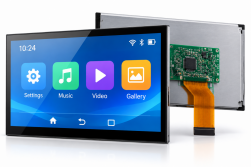
TFT (Thin Film Transistor) refers to a flat-panel display technology that controls the brightness of its backlight source to present images. A TFT Touch Screen Display integrates touch sensing functionality on top of the TFT display, allowing users to operate the device through touch. Its core value lies in providing an intuitive, responsive, and reliable visual feedback and operational input interface for human-machine interaction. The system typically consists of a TFT-LCD panel, touch sensor, driver IC, backlight module, and control board, enabling high-resolution image display and precise touch positioning. In the fields of industrial automation, medical equipment, and consumer electronics, the TFT Touch Screen Display has become an indispensable "intelligent interactive core interface," with its technological evolution focused on continuous enhancement of display performance, touch response optimization, wide-temperature adaptability, and system integration.
This growth is underpinned by three core factors: the rigid demand for visual human-machine interfaces in industrial automation and smart manufacturing, the continuous pursuit of high-reliability display interaction solutions for medical equipment digital upgrades, and the widespread adoption of integrated touch-and-display solutions in consumer electronics scenarios such as smart homes and in-vehicle applications. However, the impact of global trade landscape shifts in 2025 on the supply chain of display driver chips and touch controllers, coupled with differentiated demands for size, reliability, and cost across various application scenarios, is profoundly shaping the product structure and competitive landscape of the global TFT Touch Screen Display market. This report analyzes product performance classification, market dynamics, and industry application characteristics, providing data-driven insights for strategic decision-making.
The global market presents a pattern of "Japan, South Korea, and Taiwan leading in high-end segments, with Mainland China driving growth." Japan, South Korea, and Taiwan, leveraging advanced liquid crystal material processes, comprehensive patent portfolios, and global customer service systems, occupy a dominant position in the global high-end industrial and medical display market, focusing on high-reliability, wide-temperature displays and high-precision touch solutions. Mainland China, on the other hand, relying on the world's largest electronics manufacturing base, responsive local technical support, and continuously iterating product capabilities, has become the core engine of global market growth, releasing significant incremental space particularly in the mid-to-large-size industrial HMI and smart home application segments.
Global TFT Touch Screen Display Market Size (US$ Million), 2026-2032
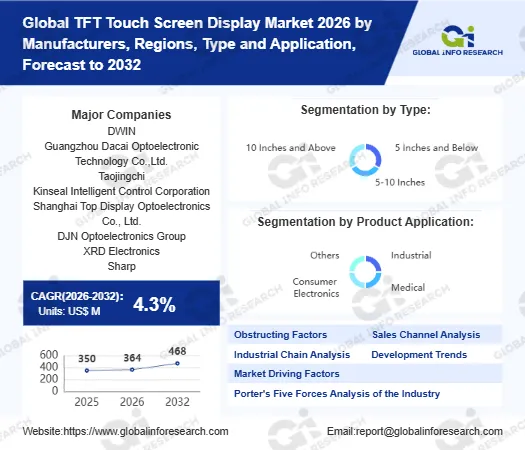
According to the latest report "Global TFT Touch Screen Display Market 2026 by Manufacturers, Regions, Type and Application, Forecast to 2032" published by GIR (Global Info Research), the global TFT Touch Screen Display market was valued at approximately USD 350 million in 2025 and is projected to reach USD 364 million in 2026. With a CAGR of 4.3% during the forecast period from 2026 to 2032, the market is expected to further expand to approximately USD 468 million by 2032. This growth is driven by increasing market demand, evolving industry trends, and expanding application opportunities worldwide.
Technology Characteristics & Product Classification
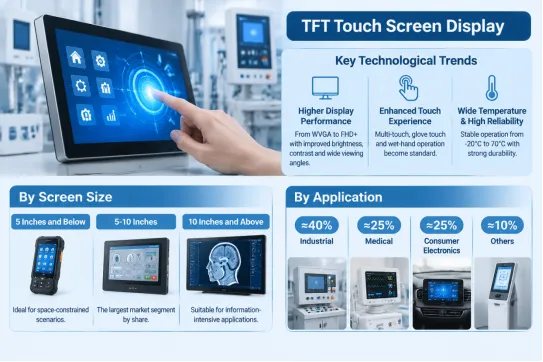
The core value of TFT Touch Screen Display lies in the highly integrated combination of active-matrix liquid crystal display technology with capacitive or resistive touch sensing technology, providing an intuitive, responsive, and reliable visual feedback and operational input interface for human-machine interaction. Its technological evolution presents three major trends: first, continuously improving display performance, with resolution evolving from WVGA to FHD and higher, while brightness, contrast, and wide-viewing-angle characteristics are constantly optimized to adapt to outdoor strong light and complex lighting environments; second, enhanced touch response and accuracy, with special scenario adaptability such as multi-touch, glove touch, and wet-hand operation becoming standard features of mid-to-high-end products; third, wide-temperature and wide-voltage range with enhanced reliability, with industrial and medical grade products requiring stable operation within a -20°C to 70°C temperature range, along with vibration resistance, electromagnetic interference resistance, and long operational life.
By Type (Screen Size) :
- 5 Inches and Below: Suitable for space-constrained scenarios such as portable industrial handheld terminals, medical monitors, and small household devices, with high requirements for power consumption and integration.
- 5-10 Inches: The largest market segment by share, widely used in industrial HMIs, medical imaging equipment, smart home control centers, and in-vehicle infotainment systems, balancing display content and operational convenience.
- 10 inches and Above: Suitable for scenarios requiring rich information display and multi-user collaboration, such as industrial control centers, medical diagnostic workstations, and self-service terminals, with higher demands for resolution, brightness, and visual comfort.
By Application:
- Industrial: The largest application segment (approximately 40%), covering industrial HMIs, CNC systems, automation equipment, smart meters, and construction machinery displays, with the highest requirements for wide temperature range, noise immunity, long life, and supply stability.
- Medical: Approximately 25%, focusing on monitors, ultrasound devices, ventilators, infusion pumps, and operating room information terminals, with stringent standards for display accuracy, touch reliability, disinfectant corrosion resistance, and electromagnetic compatibility.
- Consumer Electronics: Approximately 25%, including smart home control panels, smart appliance displays, aftermarket in-vehicle infotainment systems, and portable smart devices, with high cost sensitivity and pursuit of rapid iteration.
- Others (self-service terminals, rail transit, commercial POS, etc.): Approximately 10%.
Actual Procurement & Application Characteristics
The procurement process for TFT Touch Screen Display involves industrial equipment manufacturers, medical device manufacturers, consumer electronics brands, and integrators. The process is highly specialized and relies on annual procurement frameworks and project-specific requirements, centering on display quality, touch sensitivity, supply stability, and cost control.
In the early procurement stage, buyers typically conduct rigorous qualification audits and technical validation of module suppliers, including high-low temperature reliability testing, touch linearity verification, ESD immunity testing, and communication compatibility verification with host systems. After validation, large industrial and medical clients typically adopt an annual framework agreement + rolling delivery model to ensure supply chain security and cost stability while reducing inventory pressure.
In terms of procurement structure, industrial automation and medical device manufacturers tend to directly purchase mid-to-high-end modules with long-term warranty agreements to ensure end-product reliability. Smart home and consumer electronics brands, in contrast, focus more on cost control and rapid delivery, often using competitive bidding + batch procurement methods, emphasizing cost-effectiveness and large-scale supply capabilities. In the post-procurement phase, users continuously evaluate module suppliers based on after-sales response speed, defect rates, and product iteration capabilities, proposing customized upgrade requirements, forming a complete application system of "qualification validation—annual framework—batch delivery—continuous feedback."
Tariff Policies & Supply Chain Restructuring
Changes in the global trade landscape in 2025 are having structural impacts on the TFT Touch Screen Display market:
1. Supply Chain Risks for Display Driver Chips and Touch Controllers Become Evident. The supply of core chips such as display driver ICs and touch controller ICs is highly concentrated among a few Taiwanese and South Korean companies. Trade policy fluctuations and capacity allocation may lead to extended delivery lead times and increased costs, forcing domestic module manufacturers to accelerate the validation and adoption of domestic chips while strengthening capacity lock-in cooperation with chip foundries.
2. Increased Uncertainty in Supply of Basic Materials Such as Panel Glass and Polarizers. The supply chain for core TFT panel materials is highly globalized, but受 trade policies and logistics impacts, some specialty glass substrates and optical films may experience supply fluctuations. Module manufacturers need to establish diversified supply channels and safety stock strategies.
3. Localized Service and Rapid Delivery Capabilities Become Competitive Focus. Industrial and medical customers often require TFT Touch Screen Display modules in multi-variety, small-batch, customized formats, demanding high levels of local technical support, rapid sample delivery, and after-sales response capabilities from module suppliers. Chinese local enterprises have built a competitive moat in this regard by leveraging geographic and language advantages.
4. Overseas Market Expansion and Certification Challenges. As Chinese TFT Touch Screen Display companies expand into European and American markets and the "Belt and Road" initiative, they must address differentiated certification requirements across countries regarding medical electrical safety (IEC 60601), industrial electromagnetic compatibility (IEC 61000), RoHS environmental compliance, and REACH chemicals regulations.t.
Market Participant Competitive Landscape Analysis
- DWIN (Private, China)
- Guangzhou Dacai optoelectronic Technology Co.,Ltd. (Private, China)
- Taojingchi (Private, China)
- Kinseal intelligent Control Corporation (Private, China)
- Shanghai Top Display optoelectronics Co., Ltd. (Private, China)
- DJN Optoelectronics Group (Private, China)
- XRD Electronics (Private, China)
- Sharp (Public, Japan)
- LG Display (Public, South Korea)
- DENSO (Public, Japan)
- Nippon Seiki (Public, Japan)
- Exson Tech (Private, China)
- Winstar (Private, Taiwan, China)
- STONE (Private, China)
- Newhaven Display (Private, USA)
- Orient Display (Private, USA)
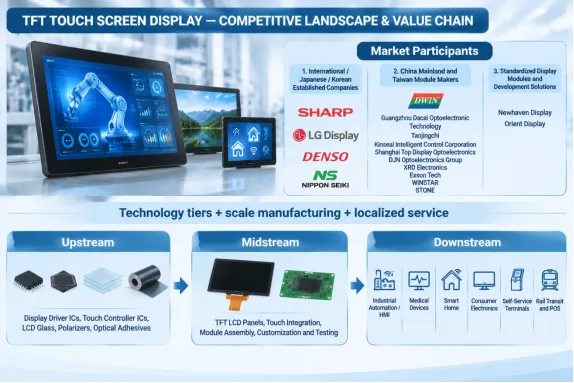
Global TFT Touch Screen Display market participants exhibit distinct characteristics of "technology tier differentiation + scale manufacturing driving + localized service differentiation." The industry chain is primarily driven by industrial automation and consumer electronics demands, with upstream and downstream coordination highly dependent on standardized production and customized module delivery capabilities.
The upstream core focuses on key materials and chips such as display driver ICs, touch controller ICs, LCD panel glass, polarizers, and optical adhesives. Core competitiveness is concentrated in high-yield manufacturing, narrow bezel design, and low-power performance. Among these, the supply of display driver ICs and touch controller ICs is highly concentrated among a few Taiwanese and South Korean companies, with their performance stability and capacity allocation directly affecting module manufacturers' delivery cycles and cost structures.
The midstream market presents a pattern of "Japanese, South Korean, and Taiwanese leading enterprises + large-scale Chinese mainland module manufacturers + specialized niche players" coexisting. International leading enterprises such as Sharp, LG Display, DENSO, and Nippon Seiki, leveraging their deep accumulation in LCD technology, comprehensive patent portfolios, and global service systems, occupy core shares in the global high-end industrial and medical display market, covering a wide range of high-reliability, high-specification customized scenarios. Chinese mainland and specialized manufacturers such as DWIN, Guangzhou Dacai, Taojingchi, Kinseal, Shanghai Top Display, DJN Optoelectronics, XRD Electronics, Exson Tech, Winstar, and STONE, relying on local manufacturing advantages, rapid response capabilities, and flexible customization services, have formed large-scale supply in mid-tier applications such as industrial HMIs, medical equipment, and smart homes, while gradually penetrating the high-end market. Additionally, Newhaven Display and Orient Display have built differentiated advantages in standardized display modules and development kits.
Downstream end demand is primarily composed of industrial automation equipment manufacturers, medical device manufacturers, smart home brands, and consumer electronics integrators. Industrial HMI and medical monitoring equipment constitute the core demand drivers, while smart homes and emerging IoT devices contribute to incremental market expansion. Unlike specialized audiovisual equipment markets, the end demand for TFT Touch Screen Displays exhibits distinct characteristics of "standardized large-scale procurement + customized project support," with equipment procurement decisions highly dependent on supply chain stability, cost control, and module manufacturers' local technical support capabilities, which in turn directly influences the product iteration paths and capacity of midstream manufacturers in directions such as ultra-narrow bezels, full lamination processes, and embedded systems.
Upstream and Downstream Industry Chain Structure
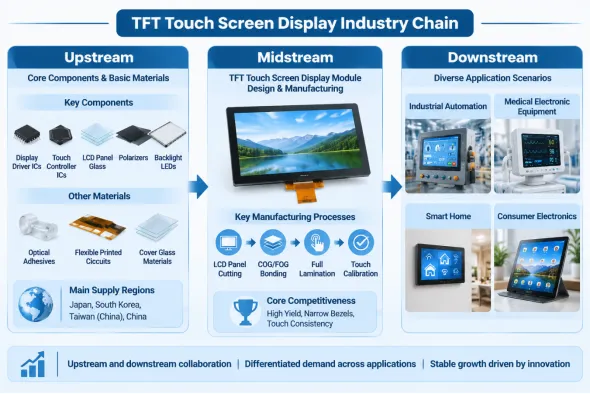
The TFT Touch Screen Display industry chain has a clear division of labor, with highly coordinated upstream and downstream sectors, the "human-machine interaction interface," with core resources concentrated in display panel manufacturing and touch module integration:
The upstream mainly includes core component supply and basic material manufacturing. The component sector focuses on display driver ICs, touch controller ICs, LCD panel glass, polarizers, backlight LEDs, and optical adhesives, also including flexible printed circuits and cover glass materials. Supply is concentrated in Japan, South Korea, Taiwan (China), and some Mainland China industrial clusters. The performance, power consumption, and supply stability of display driver ICs and touch controller ICs directly determine the display quality, touch response speed, and delivery cycles of modules; the optical performance of LCD glass substrates and polarizers directly affects brightness, contrast, and viewing angles.
The midstream is the TFT Touch Screen Display module design and manufacturing segment. Through processes such as LCD panel cutting, COG/FOG bonding, full lamination, backlight assembly, and touch calibration, upstream components are integrated into standardized or customized display modules for various end applications. This segment is the key hub connecting basic materials and end applications. Core competitiveness is concentrated in full lamination yield, narrow bezel processes, touch consistency calibration, and anti-interference design. This segment is dominated by large-scale Mainland Chinese module manufacturers and Japanese, South Korean, and Taiwanese panel giants, forming a competitive ecosystem characterized by "panel manufacturers extending downstream" and "specialized module manufacturers integrating upstream."
The downstream applications are clearly divided into four major categories: industrial automation equipment, medical electronic equipment, smart home terminals, and consumer electronics. Among these, industrial HMI and medical monitoring equipment constitute the core demand sources, emphasizing wide-temperature operation, electromagnetic interference resistance, and long-life supply; smart homes and consumer electronics drive demand for thinness, light weight, low cost, and rapid iteration. Overall, downstream demand exhibits distinct characteristics of "cost-driven + quality stratification," with differentiated demands for reliability, lifespan, and price across application areas directly influencing the technological roadmap and capacity of midstream enterprises in areas such as full lamination processes, embedded system integration, and wide-temperature design.
Technology Roadmap & Innovation Directions
2023: LG Display officially launched an advanced full-lamination optical bonding technology. By optimizing optical adhesive materials and lamination processes, it significantly reduced display module thickness and reflectivity while improving outdoor readability. This technology is used in high-end industrial handheld terminals and medical tablet scenarios, further consolidating the company's technological leadership in the high-end display field.
2024: Beijing DWIN Technology released a next-generation embedded AIoT touch screen control system at an industry exhibition. By highly integrating the main control MCU, IoT communication module, and TFT display driver, it achieved an integrated "display + control + connectivity" solution, significantly reducing the development threshold and system costs for industrial clients. It is widely used in smart factory HMIs and remote operations and maintenance terminals.
2025: Sharp strengthened the power consumption and resolution advantages of its IGZO (Indium Gallium Zinc Oxide) display technology in an official technical update, launching industrial-grade TFT panels with higher light transmittance and lower power consumption, enabling medical and industrial equipment operating 7x24 hours to achieve longer battery life or lower energy consumption with superior display quality.
The above industry developments indicate that TFT Touch Screen Display technology iteration is concentrated in three major directions: continuous improvement of display performance and energy efficiency ratio (high brightness, narrow bezels, low power consumption), enhanced touch integration and scenario adaptability (glove operation, wet-hand operation, antimicrobial cover glass), and highly integrated embedded systems (main control + display + connectivity + AI) , driving the evolution of devices from "standard display modules" to "scenario-deeply-adapted intelligent interactive terminals."
Future Development Outlook
In the future, TFT Touch Screen Displays will continue to evolve around Industry 4.0 human-machine interaction upgrades, intelligent transformation of medical equipment, and expansion of smart home ecosystems, achieving further penetration in high-end industrial displays and medical monitoring.
In the industrial and medical fields, with the increasing demand for highly reliable human-machine interfaces in smart manufacturing and smart healthcare, TFT Touch Screen Displays will develop toward higher brightness, wider operating temperature ranges, longer service life, and stronger anti-interference capabilities, while deeply integrating with industrial IoT platforms to become core information nodes in digital factories and smart hospitals.
In the consumer electronics and smart home fields, devices will further develop toward ultra-narrow bezels, low power consumption, and embedded voice/sensor integration, improving mid-tier market penetration by lowering operational thresholds and enhancing system integration. Meanwhile, full lamination and antimicrobial/anti-glare surface treatment technologies will continue to proliferate, enhancing user experience.
In the virtual production and professional display fields, with the of LED virtual studios and high-end medical imaging systems, TFT Touch Screen Displays will gradually become core control nodes for precise color rendition and real-time touch interaction, forming deep integration with AI image processing and real-time rendering engines.
Overall, the TFT Touch Screen Display industry remains in a phase of parallel technological upgrade and application expansion. With the maturation of industrial digitalization, medical intelligence, and smart home ecosystems, the industry's long-term growth certainty is strong, and it is expected to from a "standard electronic component" to "human-machine interaction infrastructure-grade product."
TFT Touch Screen Display Report Chapter Summary:
Chapter 1: TFT Touch Screen Display Industry Definition and Market Overview
This chapter clearly defines the product definition, characteristics, and industry statistical scope of TFT Touch Screen Display, systematically introduces its mainstream product classifications and key application areas, and presents the overall size and future outlook of the global market.
Chapter 2: In-depth Analysis of Core TFT Touch Screen Display Companies (2021-2025)
This chapter focuses on the main players in the TFT Touch Screen Display market. For each representative company, it not only introduces its basic overview, main business, and product portfolio, but also highlights its core operating data in the TFT Touch Screen Display field, including sales volume, sales revenue, pricing strategies, and the latest development trends of the company from 2021 to 2025.
Chapter 3: Global Competitive Landscape Analysis (2021-2025)
This chapter examines the global TFT Touch Screen Display competitive landscape from a macro perspective. By comparing the TFT Touch Screen Display sales volume, pricing, revenue, and market share of major companies from 2021 to 2025, it quantitatively analyzes market concentration and interprets the competitive strategies and market position evolution of core manufacturers.
Chapter 4: TFT Touch Screen Display Major Regional Market Size and Prospects (2021-2032)
This chapter conducts a regional-level analysis of the global TFT Touch Screen Display core markets. It will present historical data on the TFT Touch Screen Display market size (sales volume and revenue from 2021-2025) in major regions such as North America, Europe, and Asia Pacific, and provide market outlook forecasts for 2026-2032.
Chapter 5: TFT Touch Screen Display Product Type Segmentation Market Forecast (2021-2032)
This chapter delves into the TFT Touch Screen Display product structure. It will segment the TFT Touch Screen Display market by different types (such as 5 Inches and Below、5-10 Inches、10 Inches and Above, etc.), and analyze in detail the historical market size of each segmented product category from 2021 to 2025 and the future growth trends from 2026 to 2032.
Chapter 6: TFT Touch Screen Display Application Field Segmentation Market Forecast (2021-2032)
This chapter delves into the downstream application demand for TFT Touch Screen Display. The market will be segmented by different application areas (such as Industrial、Medical、Consumer Electronics、Others, etc.), presenting the historical market size for each area from 2021-2025 and future demand forecasts from 2026-2032.
Chapters 7-11: In-depth Analysis of Global Regional Markets (2021-2032)
This section is the core module of the TFT Touch Screen Display report, providing an in-depth country/regional analysis across five major regions: North America, Europe, Asia Pacific, South America, and the Middle East & Africa. The chapter structure for each region is consistent:
Segmentation by Country/Region: Analysis of the market size and forecasts for major countries within the region from 2021-2032.
Segmentation by Product Type: Presentation of the market structure and development forecasts for different product types within the region from 2021-2032.
Segmentation by Application Area: Analysis of market demand and prospects for different application areas within the region from 2021-2032.
Chapter 12: Global TFT Touch Screen Display Market Dynamics, Challenges, and Trends
This chapter aims to analyze the key internal and external factors affecting the development of the TFT Touch Screen Display market. It systematically reviews the core drivers of TFT Touch Screen Display market growth, the main obstacles and challenges faced, and assesses future product, technology, and market development trends.
Chapter 13: TFT Touch Screen Display Industry Chain Structure Analysis
This chapter analyzes the entire industry chain ecosystem of the TFT Touch Screen Display industry. From upstream raw material supply to midstream production and manufacturing, and then to downstream end-use applications, it analyzes the current status, cost structure, and collaborative relationships of each link.
Chapter 14: Sales Channel Model Research
This chapter focuses on the distribution channels of TFT Touch Screen Display products. It analyzes the market share, advantages and disadvantages, and typical cases of mainstream sales channels, and explores the innovation and development trends of channel models.
Chapter 15: Research Conclusions and Strategic Recommendations
As a summary of the report, this chapter will distill the core findings and conclusions of the entire report and, based on a comprehensive understanding of the TFT Touch Screen Display market, provide actionable strategic development recommendations for industry participants and potential entrants.
For more information, please refer to "Global TFT Touch Screen Display Market 2026 by Manufacturers, Regions, Type and Application, Forecast to 2032". This report analyzes the supply and demand situation, development status, and changes in the industry, focusing on the development status of the industry, how to face the development challenges of the industry, industry development suggestions, industry competitiveness, and industry investment analysis and trend forecasts. The report also summarizes the overall development dynamics of the industry, including the impact of the latest US tariffs on the global supply chain, the supply relationship analysis of the industrial chain, and provides reference suggestions and specific solutions for the industry in terms of products.
Previous News:
Global Medical Ventilator Market Is Projected to Reach USD 3,863 Million by 2032, Expanding at a 6.8% CAGR During the 2026–2032 Forecast Period
Next News:
High-Capacity Silicon-Carbon Anode Material Market 2026: A 15.6% CAGR Points to a USD 290 Million Opportunity by 2032 as Fast-Charging EV and Premium Device Demand Accelerates
The copyright of this article belongs to Global Info Research. Without the written authorization of our company, no organization or individual may reprint, quote, copy, adapt or use it for commercial purposes in any way. When authorized to use, the original source must be indicated as "Global Info Research" and the complete copyright information must be retained.
- We Provide Professional, Accurate Market Analysis to Help You Stay Ahead of Your Competition.Speak to our analyst >>

Our Clients
What We Can Provide?
With better results and higher quality products,Our professional reports can achieve four things:

Insight into the industry market information

Analyze market development needs

Prospects for future development

Develop industry investment strategy
- Digging deeper into global industry information and providing market strategies.Contact Us >>
- We Provide Professional, Accurate Market Analysis to Help You Stay Ahead of Your Competition.Speak to our analyst >>
Our Clients
What We Can Provide?
With better results and higher quality products,Our professional reports can achieve four things:
Insight into the industry market information
Analyze market development needs
Prospects for future development
Develop industry investment strategy
- Digging deeper into global industry information and providing market strategies.Contact Us >>