
Dual-motor E-Axle Drive Unit Market 2026: An 18.2% CAGR Points to a USD 5,182 Million Opportunity by 2032 as AWD EV Platforms and Torque Vectoring Demand Accelerate
Published Date: Wednesday,25 Nov,2026


Dual-motor E-Axle Drive Unit Market Summary
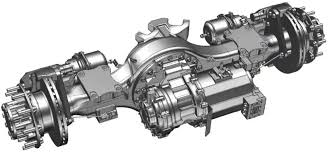
Dual-motor E-Axle Drive Units are integrated electric drive assemblies that combine two electric motors with reduction gears, inverters, differential structures, control units, and axle housings. They are mainly used in electric vehicles requiring higher torque output, four-wheel drive performance, redundancy, or improved power distribution. Compared with single-motor drive units, dual-motor systems can provide stronger acceleration, better traction control, and improved energy management under different driving conditions. They are widely adopted in high-performance electric cars, SUVs, light commercial vehicles, and specialized electric platforms requiring compact integration and high power density.
The industrial chain of Dual-motor E-Axle Drive Units covers upstream motor laminations, magnets, copper windings, bearings, gears, power semiconductors, controllers, sensors, housings, and cooling components. The midstream includes motor manufacturing, inverter integration, gear machining, assembly, calibration, software control, NVH optimization, and reliability testing. Downstream applications mainly include passenger electric vehicles, electric SUVs, light commercial vehicles, performance electric vehicles, off-road electric platforms, and specialized electric mobility systems. Related services include design validation, vehicle matching, thermal management optimization, software updates, maintenance support, and performance calibration for different vehicle platforms.
Global Dual-motor E-Axle Drive Unit Market Size (US$ Million), 2021-2032
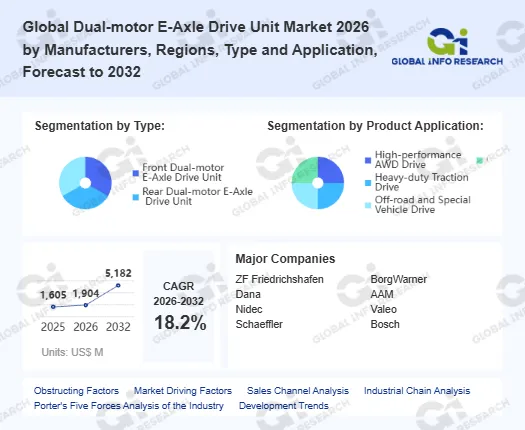
According to the latest report "Global Dual-motor E-Axle Drive Unit Market 2026 by Manufacturers, Regions, Type and Application, Forecast to 2032" published by GIR (Global Info Research), the global Dual-motor E-Axle Drive Unit market was valued at approximately USD 1605 million in 2025 and is projected to reach USD 1904 million in 2026. With a CAGR of 18.2% during the forecast period from 2026 to 2032, the market is expected to further expand to approximately USD 5182 million by 2032. This growth is driven by increasing market demand, evolving industry trends, and expanding application opportunities worldwide.
Global Dual-motor E-Axle Drive Unit Top 10 Players Ranking and Market Share
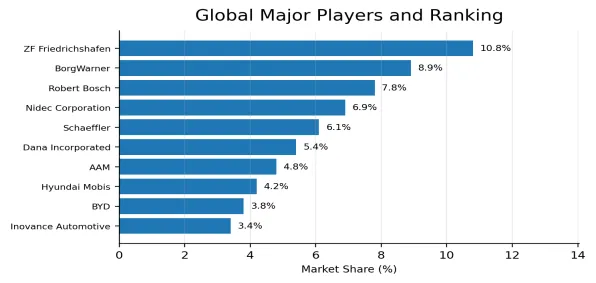
In 2026, the global top 10 players revenue share was approximately 62.1%.
Competitive Landscape
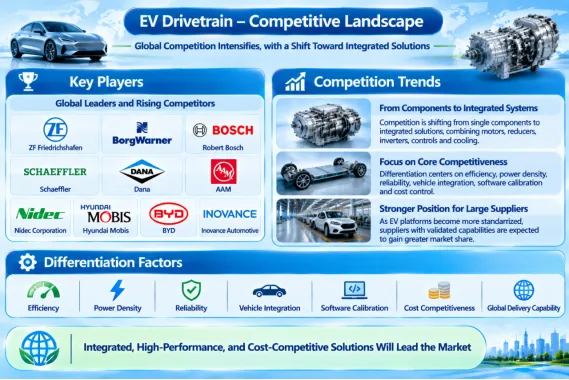
The competitive landscape is shaped by global drivetrain suppliers, electrification specialists and leading vehicle manufacturers with in-house powertrain capabilities. ZF Friedrichshafen, BorgWarner, Robert Bosch, Schaeffler, Dana and AAM have long experience in transmission, axle, motor and system integration, giving them advantages in OEM qualification, manufacturing quality and global program delivery. Nidec Corporation has strong capabilities in electric motor and integrated e-axle platforms, while Hyundai Mobis benefits from close cooperation with major Korean vehicle platforms. BYD and Inovance Automotive represent the rising Chinese supply base, supported by large domestic EV demand, cost control and rapid product iteration. Competition is moving from component supply toward integrated systems that combine motors, reducers, inverters, controls and cooling into a compact module. Supplier differentiation depends on efficiency, power density, reliability, vehicle integration, software calibration, cost competitiveness and the ability to support global OEM production cycles. As EV platforms become more standardized, large-scale validated suppliers are expected to gain stronger positions.
Main Type
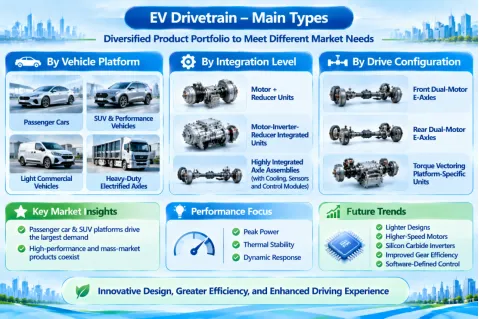
Main product types can be segmented by vehicle platform, integration level and drive configuration. By vehicle platform, dual-motor E-Axle drive units include passenger car systems, SUV and performance vehicle systems, light commercial vehicle systems and heavy-duty electrified axle units. Passenger car and SUV platforms currently represent the largest opportunity because OEMs use dual-motor configurations to provide all-wheel drive, stronger acceleration and improved driving stability without traditional mechanical shafts. By integration level, products can be divided into motor-plus-reducer units, motor-inverter-reducer integrated units and highly integrated axle assemblies with cooling, sensors and control modules. By drive configuration, the market includes front dual-motor e-axles, rear dual-motor e-axles and platform-specific units designed for torque vectoring. High-performance systems emphasize peak power, thermal stability and dynamic response, while mass-market systems focus on cost, compact packaging and manufacturability. Future product evolution will favor lighter housings, higher-speed motors, silicon carbide inverters, improved gear efficiency and stronger software-defined control.
Downstream Applications
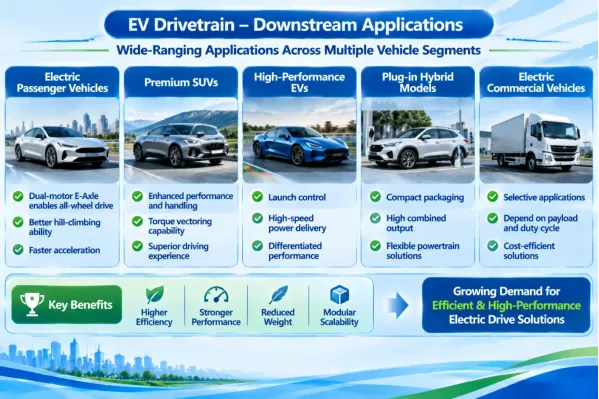
Downstream applications are mainly concentrated in electric passenger vehicles, premium SUVs, high-performance EVs, plug-in hybrid models and selected electric commercial vehicles. In passenger cars and SUVs, dual-motor E-Axle drive units help OEMs provide all-wheel drive functions, better hill-climbing ability, faster acceleration and more stable handling under different road conditions. In premium and performance EVs, the technology supports torque vectoring, launch control, high-speed power delivery and differentiated driving experience, making it an important selling point for brands competing in intelligent electric platforms. Plug-in hybrid vehicles may also adopt dual-motor axle systems when compact packaging and high combined output are required. In commercial vehicles, applications are more selective and depend on payload, duty cycle, axle load and cost requirements. The strongest demand is expected from models that require both efficiency and performance, especially where OEMs want to simplify mechanical transmission layouts, reduce system weight and improve platform scalability through modular electric driveline solutions.
Regional Perspective
China is expected to be the fastest-growing regional market for dual-motor E-Axle drive units because of its large EV production base, rapid adoption of intelligent electric platforms and strong participation from domestic suppliers such as BYD and Inovance Automotive. Local OEMs increasingly use integrated e-axle solutions to improve performance, reduce cost and accelerate platform development. Europe remains a major market due to strong premium vehicle brands, strict emissions policies and established suppliers such as ZF, Bosch, Schaeffler and BorgWarner with deep OEM relationships. North America is supported by demand for electric SUVs, pickups and high-performance EVs, where dual-motor systems are often used to deliver all-wheel drive and strong acceleration. Japan and South Korea maintain stable demand through Nidec, Hyundai Mobis and regional OEM electrification programs. Other regions are still smaller but will grow as EV assembly localizes and global OEMs export modular electric drivetrains. Regional competitiveness will depend on OEM sourcing strategy, battery platform design, cost pressure and regulatory support for electrification.
Price Analysis
Pricing for dual-motor E-Axle drive units is influenced by power rating, torque capacity, inverter technology, gear design, cooling method, housing material, software requirements, safety validation and production volume. Systems used in high-performance EVs or premium SUVs are priced higher because they require stronger motors, more advanced thermal management, precise torque control and higher reliability under continuous high-load operation. Mass-market systems generally face stronger cost pressure, pushing suppliers to improve integration, reduce part count and standardize platforms across multiple vehicle models. Prices also differ depending on whether the unit includes only motors and reducers or a highly integrated package with inverters, sensors, cooling circuits, control electronics and calibrated software. In the medium term, unit prices are expected to decline as scale increases, motor manufacturing becomes more automated and power electronics integration improves. However, premium dual-motor e-axles with silicon carbide inverters, advanced torque-vectoring control and compact lightweight design will maintain higher margins because they deliver meaningful vehicle performance and efficiency benefits.
Market Drivers
Market growth is driven by the rapid electrification of passenger vehicles, rising demand for all-wheel drive EV platforms and OEM efforts to improve acceleration, handling and energy efficiency. Dual-motor E-Axle drive units allow automakers to replace complex mechanical drivetrain structures with compact electric modules, supporting more flexible vehicle architecture and faster platform development. Consumers increasingly associate electric vehicles with strong acceleration, stable road performance and intelligent driving experience, which supports adoption in premium cars, SUVs and performance models. Regulatory pressure to reduce emissions also accelerates investment in electric driveline systems, while battery cost declines make higher-performance EV configurations more accessible. Another important driver is the shift toward integrated propulsion modules that combine motors, inverters, gears and control software, reducing assembly complexity and improving reliability. As OEMs standardize EV platforms, suppliers that can provide scalable e-axle families across multiple power levels and vehicle segments will benefit from larger program volumes and long-term strategic sourcing relationships.
Industry Chain
The industry chain includes upstream suppliers of electrical steel, magnets, copper windings, power semiconductors, sensors, bearings, gears, shafts, housings, seals, lubricants, connectors, control chips and thermal management components. Midstream manufacturers design and assemble electric motors, inverters, reducers, differential structures, control boards, cooling circuits and integrated axle housings into complete dual-motor E-Axle drive units. They are responsible for electromagnetic design, gear machining, inverter packaging, software calibration, NVH optimization, durability testing, functional safety and vehicle-level validation. Downstream customers are mainly automotive OEMs, EV platform developers and, in some cases, Tier 1 system integrators that supply complete electrified drivetrains. The value chain is increasingly shifting toward system integration because performance depends not only on individual components but also on how motors, gears, electronics, cooling and software work together. Suppliers with strong engineering capability, global production footprint, cost control and long-term OEM relationships are better positioned as EV platforms move toward higher integration and scalable modular propulsion architectures.
Dual-motor E-Axle Drive Unit Report Chapter Summary:
Chapter 1: Dual-motor E-Axle Drive Unit Industry Definition and Market Overview
This chapter clearly defines the product definition, characteristics, and industry statistical scope of Dual-motor E-Axle Drive Unit, systematically introduces its mainstream product classifications and key application areas, and presents the overall size and future outlook of the global market.
Chapter 2: In-depth Analysis of Core Dual-motor E-Axle Drive Unit Companies (2021-2025)
This chapter focuses on the main players in the Dual-motor E-Axle Drive Unit market. For each representative company, it not only introduces its basic overview, main business, and product portfolio, but also highlights its core operating data in the Dual-motor E-Axle Drive Unit field, including sales volume, sales revenue, pricing strategies, and the latest development trends of the company from 2021 to 2025.
Chapter 3: Global Competitive Landscape Analysis (2021-2025)
This chapter examines the global Dual-motor E-Axle Drive Unit competitive landscape from a macro perspective. By comparing the Dual-motor E-Axle Drive Unit sales volume, pricing, revenue, and market share of major companies from 2021 to 2025, it quantitatively analyzes market concentration and interprets the competitive strategies and market position evolution of core manufacturers.
Chapter 4: Dual-motor E-Axle Drive Unit Major Regional Market Size and Prospects (2021-2032)
This chapter conducts a regional-level analysis of the global Dual-motor E-Axle Drive Unit core markets. It will present historical data on the Dual-motor E-Axle Drive Unit market size (sales volume and revenue from 2021-2025) in major regions such as North America, Europe, and Asia Pacific, and provide market outlook forecasts for 2026-2032.
Chapter 5: Dual-motor E-Axle Drive Unit Product Type Segmentation Market Forecast (2021-2032)
This chapter delves into the Dual-motor E-Axle Drive Unit product structure. It will segment the Dual-motor E-Axle Drive Unit market by different types (such as Front Dual-motor E-Axle Drive Unit、Rear Dual-motor E-Axle Drive Unit、Integrated Front-Rear Dual-motor E-Axle Drive Unit, etc.), and analyze in detail the historical market size of each segmented product category from 2021 to 2025 and the future growth trends from 2026 to 2032.
Chapter 6: Dual-motor E-Axle Drive Unit Application Field Segmentation Market Forecast (2021-2032)
This chapter delves into the downstream application demand for Dual-motor E-Axle Drive Unit. The market will be segmented by different application areas (such as High-performance AWD Drive、Heavy-duty Traction Drive、Off-road and Special Vehicle Drive、Others, etc.), presenting the historical market size for each area from 2021-2025 and future demand forecasts from 2026-2032.
Chapters 7-11: In-depth Analysis of Global Regional Markets (2021-2032)
This section is the core module of the Dual-motor E-Axle Drive Unit report, providing an in-depth country/regional analysis across five major regions: North America, Europe, Asia Pacific, South America, and the Middle East & Africa. The chapter structure for each region is consistent:
Segmentation by Country/Region: Analysis of the market size and forecasts for major countries within the region from 2021-2032.
Segmentation by Product Type: Presentation of the market structure and development forecasts for different product types within the region from 2021-2032.
Segmentation by Application Area: Analysis of market demand and prospects for different application areas within the region from 2021-2032.
Chapter 12: Global Dual-motor E-Axle Drive Unit Market Dynamics, Challenges, and Trends
This chapter aims to analyze the key internal and external factors affecting the development of the Dual-motor E-Axle Drive Unit market. It systematically reviews the core drivers of Dual-motor E-Axle Drive Unit market growth, the main obstacles and challenges faced, and assesses future product, technology, and market development trends.
Chapter 13: Dual-motor E-Axle Drive Unit Industry Chain Structure Analysis
This chapter analyzes the entire industry chain ecosystem of the Dual-motor E-Axle Drive Unit industry. From upstream raw material supply to midstream production and manufacturing, and then to downstream end-use applications, it analyzes the current status, cost structure, and collaborative relationships of each link.
Chapter 14: Sales Channel Model Research
This chapter focuses on the distribution channels of Dual-motor E-Axle Drive Unit products. It analyzes the market share, advantages and disadvantages, and typical cases of mainstream sales channels, and explores the innovation and development trends of channel models.
Chapter 15: Research Conclusions and Strategic Recommendations
As a summary of the report, this chapter will distill the core findings and conclusions of the entire report and, based on a comprehensive understanding of the Dual-motor E-Axle Drive Unit market, provide actionable strategic development recommendations for industry participants and potential entrants.
For more information, please refer to "Global Dual-motor E-Axle Drive Unit Market 2026 by Manufacturers, Regions, Type and Application, Forecast to 2032". This report analyzes the supply and demand situation, development status, and changes in the industry, focusing on the development status of the industry, how to face the development challenges of the industry, industry development suggestions, industry competitiveness, and industry investment analysis and trend forecasts. The report also summarizes the overall development dynamics of the industry, including the impact of the latest US tariffs on the global supply chain, the supply relationship analysis of the industrial chain, and provides reference suggestions and specific solutions for the industry in terms of products.
Previous News:
Quick Couplings for Liquid Cooling Market 2026: A 13.5% CAGR Points to a USD 14.41 Million Opportunity by 2032 as AI Data Center Liquid Cooling Scales
Next News:
Ethylene Oxide Sterilization System Market 2026: A 7.0% CAGR Points to a USD 1,123 Million Opportunity by 2032 as Outsourced Sterilization Demand and Emission Rules Tighten
The copyright of this article belongs to Global Info Research. Without the written authorization of our company, no organization or individual may reprint, quote, copy, adapt or use it for commercial purposes in any way. When authorized to use, the original source must be indicated as "Global Info Research" and the complete copyright information must be retained.
- We Provide Professional, Accurate Market Analysis to Help You Stay Ahead of Your Competition.Speak to our analyst >>

Our Clients
What We Can Provide?
With better results and higher quality products,Our professional reports can achieve four things:

Insight into the industry market information

Analyze market development needs

Prospects for future development

Develop industry investment strategy
- Digging deeper into global industry information and providing market strategies.Contact Us >>
- We Provide Professional, Accurate Market Analysis to Help You Stay Ahead of Your Competition.Speak to our analyst >>
Our Clients
What We Can Provide?
With better results and higher quality products,Our professional reports can achieve four things:
Insight into the industry market information
Analyze market development needs
Prospects for future development
Develop industry investment strategy
- Digging deeper into global industry information and providing market strategies.Contact Us >>