
Global Uncoated Rice Cooker Market Is Set for 8.4% CAGR Growth, Reaching an Estimated USD 1,361 Million by 2032, According to the Latest 2026 Industry Report
Published Date: Thursday,26 Nov,2026


Uncoated Rice Cooker
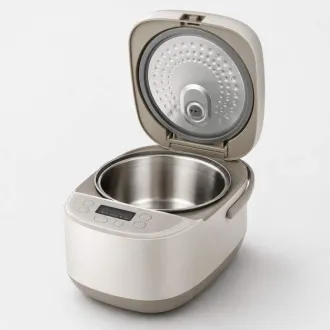
Uncoated rice cookers are rice cooker appliances whose food-contact inner pot does not use a conventional chemical non-stick coating. The inner pot is typically made from food-grade stainless steel, ceramic, glass, ceramic-composite material or specially polished metal, while the appliance uses structural design, heating curves and temperature-control algorithms to provide rice cooking, steaming, stewing and warming functions. This product category emphasizes abrasion resistance, high-temperature durability, easy cleaning and long-term food-contact safety for household kitchens, dormitories, office pantries, serviced apartments and health-oriented cooking users.
The market is growing quickly as consumers pay more attention to food-contact safety, healthy kitchens and durable small appliances. Demand is supported by household replacement, consumption upgrades among mother-and-baby and health-conscious groups, smart kitchen adoption, online channel promotion and globalization of Asian cooking appliances. Suppliers with strong inner-pot material processing, temperature-control algorithms, heating-system design, supply-chain cost control and brand channel capabilities are expected to gain stronger positions in mid-to-high-end replacement and overseas expansion.
Global Uncoated Rice Cooker Market Size (US$ Million), 2025 VS 2026 VS 2032
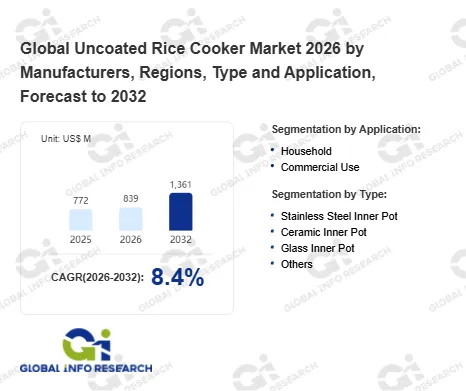
According to the latest report "Global Uncoated Rice Cooker Market 2026 by Manufacturers, Regions, Type and Application, Forecast to 2032" published by GIR (Global Info Research), the global Uncoated Rice Cooker market was valued at approximately USD 772 million in 2025 and is projected to reach USD 839 million in 2026. With a CAGR of 8.4% during the forecast period from 2026 to 2032, the market is expected to further expand to approximately USD 1361 million by 2032. This growth is driven by increasing market demand, evolving industry trends, and expanding application opportunities worldwide.
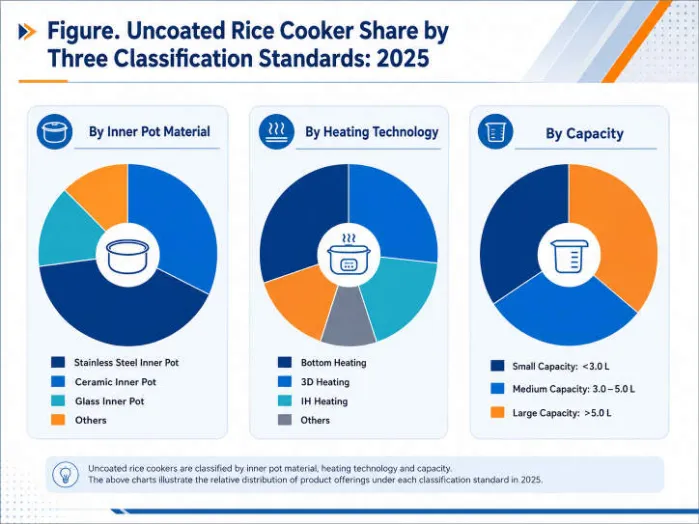
Global Uncoated Rice Cooker Share by Inner Pot Material: 2025
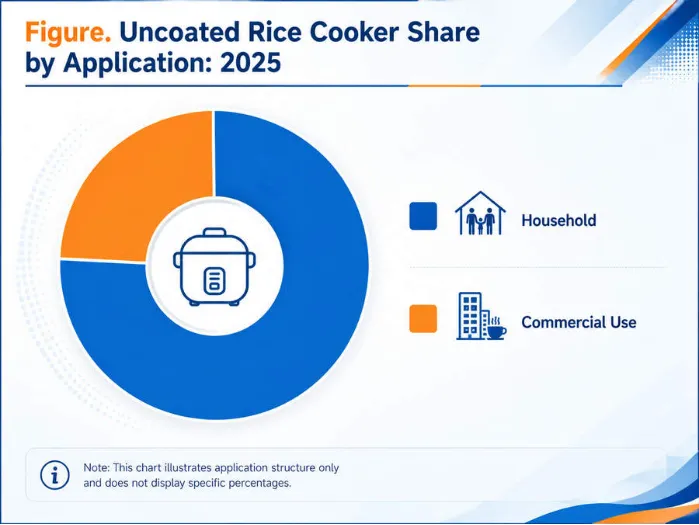
Global Uncoated Rice Cooker Share by Application: 2025
Global Uncoated Rice Cooker Top 13 Players Ranking and Market Share (Ranking is based on the revenue of 2025, continually updated)
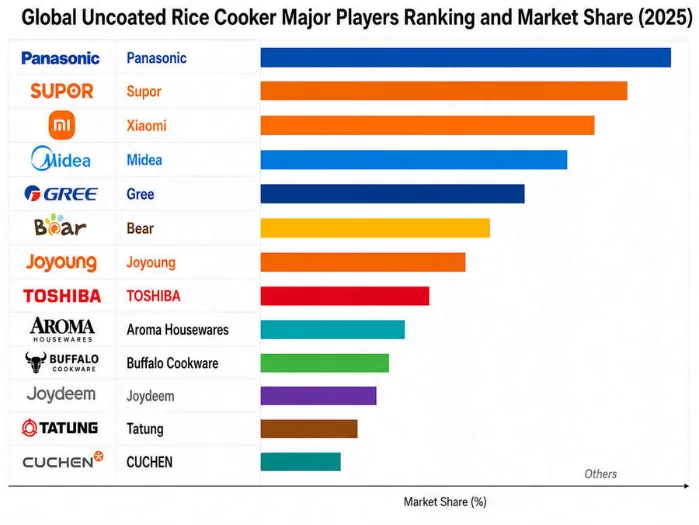
Competition is led by large diversified home-appliance companies, kitchen small-appliance brands and regional rice cooker specialists. Panasonic, TOSHIBA, CUCHEN and Tatung have accumulated rice-cooking technology, brand recognition and mid-to-high-end product positioning. Supor, Xiaomi, Midea, Gree, Bear, Joyoung and Joydeem benefit from China’s manufacturing capability, e-commerce channels and rapid product iteration, and are active in uncoated, smart and health-oriented kitchen scenarios. Aroma Housewares and Buffalo Cookware have channel and consumer foundations in North America and Southeast Asia.
Uncoated Rice Cooker Industry Chain Analysis
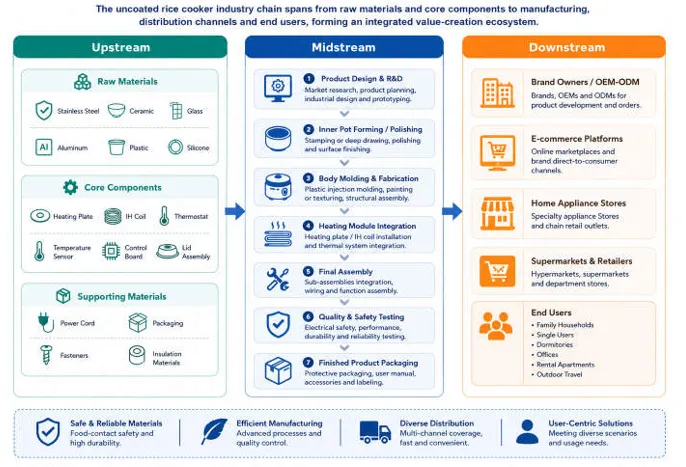
The upstream chain includes food-grade stainless steel, ceramic powders, glass materials, heating plates, thermostats, sensors, control boards, plastic housings, sealing parts, power cords and packaging materials. Midstream suppliers handle inner-pot forming, polishing or sintering, heating-system design, plastic injection, electronic control development, final assembly, quality inspection and safety certification. Downstream demand comes from household kitchens, dormitories and single apartments, office pantry rooms, serviced apartments, healthy catering and online/offline retail channels.
Table. Uncoated Rice Cooker Industry Development Trends
|
|
Development Trends |
Description |
|
1 |
Health-Oriented Inner Pot Upgrading |
Consumer attention to food-contact safety, coating wear, high-temperature durability and healthier home cooking is increasing, turning uncoated inner pots from a simple marketing claim into a broader product-upgrade direction. Stainless steel, ceramic, glass and composite metal inner pots are replacing part of the conventional coated-pot base, while brands are no longer emphasizing only “no chemical coating”. They are also improving surface polishing, pot curvature, heat distribution, corrosion resistance and cleaning convenience. Going forward, uncoated products will need to combine verified food-contact material safety, long service life, visible cleanliness, scratch resistance and reliable after-sales support. Companies that integrate material selection, forming technology, heating structure and replacement inner-pot service will be better positioned to convert the health concept into stable word-of-mouth and mid-to-high-end pricing power. |
|
2 |
Smart Temperature Control and Multi-Function Integration |
Uncoated rice cookers are moving beyond inner-pot material differentiation. Temperature-control algorithms, pressure or micro-pressure structures, IH three-dimensional heating, multi-stage heating curves, rice-type recognition, reservation, keep-warm control and automatic menus are becoming core competitive elements. Because uncoated pots differ from coated pots in non-stick performance, heat storage and heat-transfer speed, manufacturers need to optimize bottom-and-side heating coordination, sensor placement, steam control and water-rice ratio guidance to improve rice texture and reduce sticking. Mid-to-high-end models are expected to integrate brown rice, mixed grains, low-sugar rice, soup, steaming, stewing, baby food and one-pot meal functions, while APP connectivity, voice ecosystems and cloud recipes can increase use frequency and shift the product from a single rice-cooking appliance to a smart healthy-kitchen device. |
|
3 |
Premiumization and Scenario Segmentation |
Replacement demand, quality-kitchen upgrades, mother-and-baby users, senior users, single-person households, small families, dormitories and rental scenarios are driving continuous segmentation by capacity, design, function and price band. Small-capacity models emphasize portability, low energy consumption and small-portion cooking; family models emphasize larger capacity, stable keep-warm performance and diversified menus; premium models highlight IH heating, pressure cooking, thick-pot structures, detachable lids and higher-quality inner pots. Consumers are comparing not only price and capacity, but also rice texture, ease of cleaning, product life, mixed-grain performance and concerns over inner-pot scratches. The market is likely to form multiple layers, including basic health-oriented models, smart multi-function models, mother-and-baby/senior-friendly models, premium lifestyle models and export-oriented localized models. |
|
4 |
Digital Channels and Brand Globalization |
E-commerce, content seeding, short-video reviews, livestreaming and cross-border platforms are accelerating the launch and education cycle for uncoated rice cookers, but they also make user reviews and negative experiences more visible. Chinese, Japanese and Korean brands have strong foundations in rice-cooking know-how, inner-pot manufacturing, supply-chain organization and cost control, and are entering North America, Europe, Southeast Asia and the Middle East through Amazon, regional marketplaces, local distributors and direct-to-consumer stores. Future channel competition will shift from traffic acquisition to content education, scenario demonstration, after-sales response and localized menu support. Brands need to design product portfolios based on local rice varieties, diets, voltage standards, certification requirements and kitchen-space conditions. |
Table. Uncoated Rice Cooker Industry Development Opportunities
|
|
Development Opportunities |
Description |
|
1 |
Healthy Kitchen Consumption Upgrade |
The uncoated rice cooker fits consumer demand for food-contact safety, lower perceived chemical-residue risk, durable inner pots and healthier home diets. It is especially suitable for positioning around families with infants, health-conscious users, quality-kitchen upgrades and consumers who care about long-term ownership cost. Compared with ordinary rice cookers, uncoated products can connect “safer material”, “less concern over scratching”, “more durable pot” and “visible cleaning” with better rice texture, mixed-grain cooking, low-sugar rice and low-oil steaming. As consumers become more willing to pay for health attributes, durability and brand trust, companies with strong material explanation, credible test content and reliable after-sales service have opportunities to increase average selling prices and repeat purchases. |
|
2 |
Replacement Demand and Mid-to-High-End Penetration |
The installed base of conventional coated rice cookers is very large worldwide. Once users experience coating scratches, wear, sticking, odor, difficult cleaning or weaker keep-warm performance, they often have clear replacement demand. Uncoated products can be positioned as an upgrade alternative by offering thicker pots, more stable heating, richer menus and longer service life. Companies may first capture replacement demand with basic models and then extend toward mid-to-high-end products through IH heating, pressure structures, low-sugar rice functions, detachable cleaning designs and premium appearance. For retailers, uncoated rice cookers also create bundling opportunities with cookware, rice products, healthy food, small-appliance sets and membership services. |
|
3 |
Overseas Market and Localized Menus |
Differences in diets across Asia, North America, Europe and Southeast Asia provide cross-regional growth opportunities for uncoated rice cookers. Asian users typically care more about rice texture, keep-warm quality and multi-rice compatibility; Western users may use rice cookers for brown rice, quinoa, oats, steaming vegetables and one-pot meals; Southeast Asian users often emphasize capacity, durability and value for money. Brands can develop localized menus and capacity combinations around local rice varieties, water quality, cooking habits, voltage standards, kitchen space and language interfaces. Through cross-border e-commerce testing, local certification, service networks and social-media education, manufacturers can translate the uncoated health proposition into a differentiated overseas advantage. |
|
4 |
Material and Structural Innovation |
There is still significant room to improve heat-transfer efficiency, impact resistance, surface smoothness, anti-sticking performance and weight control for stainless steel, ceramic, glass and composite inner pots. This creates opportunities for joint innovation between material suppliers and appliance brands. Future competition will not be a simple substitution of one material for another; it will depend on system-level design covering inner-pot materials, pot thickness, composite bottom layers, heating plates or IH coils, temperature sensors, steam structures and cleaning design. Companies with capabilities in material formulation, forming and polishing, thermal-efficiency optimization and smart-control algorithms are more likely to build patents and process barriers, while launching differentiated products for premium families, mother-and-baby health, light cooking and small commercial scenarios. |
Table. Uncoated Rice Cooker Obstacles/Challenges to Industry Development
|
|
Obstacles/Challenges |
Description |
|
1 |
Trade-off Between Uncoated Design and Non-Stick Experience |
Although uncoated inner pots reduce consumer concerns over coating wear and peeling, they do not naturally provide the same strong non-stick performance as conventional fluoropolymer-type coatings. Their daily performance depends heavily on surface treatment, pot curvature, heating curves, water-rice ratio guidance and user cleaning habits. If rice sticks to the bottom, forms excessive crust or becomes difficult to clean, consumers may feel that the health upgrade sacrifices convenience, which can directly affect ratings and repeat purchases. Manufacturers need to reduce experience volatility through real-scenario testing, clear instructions, reasonable menu settings, detachable cleaning structures and after-sales education; otherwise, the uncoated concept may quickly be amplified into negative feedback on online review platforms. |
|
2 |
Material Cost and Processing Yield Pressure |
Food-grade stainless steel, ceramic, glass and multi-layer composite inner pots require higher standards for raw materials, forming, sintering, stamping, welding, polishing, inspection and protective packaging, and their costs are usually higher than ordinary coated aluminum-alloy pots. Ceramic and glass pots also require strict control of impact resistance, thermal-shock stability and breakage rates, while stainless-steel pots need solutions for slower heat transfer, local scorching and surface-treatment consistency. If mass-production yield is insufficient, brands will face pressure among retail price, gross margin and after-sales cost. This challenge is especially difficult in entry-level and mid-price segments, where consumers are price sensitive but still expect clear quality improvement. |
|
3 |
Safety Certification and Regional Standards |
Uncoated rice cookers involve multiple compliance requirements, including electrical safety, food-contact materials, energy efficiency, wireless connectivity, packaging labels, environmental recycling and warranty responsibility. Testing standards, certification cycles and documentation requirements vary across countries and regions. Cross-border sales also require management of voltage and frequency, plug types, manual languages, APP data compliance and local after-sales obligations. For small and medium-sized brands, certification fees, rectification costs after failed tests and uncertainty in launch schedules may weaken product-launch momentum. For large brands, multi-region SKU management and ongoing compliance maintenance also increase operational complexity. |
|
4 |
Homogeneous Competition and Pricing Pressure |
The small-appliance market is highly transparent online. Consumers can directly compare price, capacity, power, functions and reviews across e-commerce platforms. Once the uncoated concept is adopted by many brands, marketing messages may become homogeneous quickly. If a product emphasizes only “uncoated” without stable rice texture, easy cleaning, durability verification, clear material explanation and after-sales assurance, its premium will be compressed by price competition. The industry challenge is to avoid low-price and concept-only competition by building verifiable technical standards, meaningful user-experience differences and stronger brand trust. Otherwise, market expansion may be accompanied by declining profitability. |
Table. Current Market Status and Future Development Outlook
|
Topic |
Analysis |
|
Market Status |
The global uncoated rice cooker market is moving from a health-concept-driven stage toward systematic product upgrading. Japanese, Chinese, Korean, U.S. and Southeast Asian brands are all participating in the market. Current products cover basic mechanical models, microcomputer-controlled models, IH heating, pressure or micro-pressure cooking, multifunction steaming/stewing and low-sugar rice functions. Inner-pot materials include stainless steel, ceramic, glass and composite metal structures. Chinese brands have strong competitiveness in mid-range and mass-market segments due to manufacturing scale, e-commerce operation and rapid iteration; Japanese and Korean brands remain influential in premium temperature control, rice texture, inner-pot craftsmanship and brand trust; U.S. and European brands or retailers focus more on healthy kitchens, convenient meals and online retail scenarios. Overall demand is shifting from a single concern about coating peeling to a combined competition around healthy materials, good taste, easy cleaning, durability and smart functions. |
|
Future Direction |
Future development of uncoated rice cookers will follow four main directions. First, inner-pot materials and structures will continue to improve through composite bottoms, thick-pot designs, surface polishing, ceramicized treatment or glass-pot solutions to enhance durability and heat uniformity. Second, smart temperature control and menu algorithms will be upgraded to reduce sticking, improve texture across rice varieties and expand scenarios such as mixed grains, low-sugar rice, steaming/stewing and one-pot meals. Third, user experience and after-sales systems will become more important, including detachable lids, cleaning reminders, inner-pot warranty, accessory supply and usage education. Fourth, globalization and localization will progress together, with differentiated SKUs based on local diets, certification rules and channel structures. In the long term, the product will extend from a single rice-cooking appliance to a core healthy-kitchen small appliance linked more closely with e-commerce content, kitchen ecosystems and smart-home entry points. |
|
Authors’ View |
The business opportunity of uncoated rice cookers is not simply replacing conventional coated pots with stainless steel, ceramic or glass. It is about integrating material safety, cooking performance, cleaning convenience, smart control and brand trust into product value that consumers are willing to use for years. The key tension in this market is that consumers want lower coating-related concerns but do not want to sacrifice non-stick convenience or ease of operation. Therefore, brands with stronger growth potential need to solve experience issues through craftsmanship and algorithms, lower the usage threshold through content and after-sales service, and expand coverage through multiple capacities, price bands and scenario-based menus. Two types of winners are likely to emerge: integrated small-appliance brands with supply-chain efficiency and channel scale, and specialized brands that can build differentiated recognition in premium inner-pot materials, rice texture or health-oriented cooking scenarios. |
Uncoated Rice Cooker Report Chapter Summary:
Chapter 1: Uncoated Rice Cooker Industry Definition and Market Overview
This chapter clearly defines the product definition, characteristics, and industry statistical scope of Uncoated Rice Cooker, systematically introduces its mainstream product classifications and key application areas, and presents the overall size and future outlook of the global market.
Chapter 2: In-depth Analysis of Core Uncoated Rice Cooker Companies (2021-2025)
This chapter focuses on the main players in the Uncoated Rice Cooker market. For each representative company, it not only introduces its basic overview, main business, and product portfolio, but also highlights its core operating data in the Uncoated Rice Cooker field, including sales volume, sales revenue, pricing strategies, and the latest development trends of the company from 2021 to 2025.
Chapter 3: Global Competitive Landscape Analysis (2021-2025)
This chapter examines the global Uncoated Rice Cooker competitive landscape from a macro perspective. By comparing the Uncoated Rice Cooker sales volume, pricing, revenue, and market share of major companies from 2021 to 2025, it quantitatively analyzes market concentration and interprets the competitive strategies and market position evolution of core manufacturers.
Chapter 4: Uncoated Rice Cooker Major Regional Market Size and Prospects (2021-2032)
This chapter conducts a regional-level analysis of the global Uncoated Rice Cooker core markets. It will present historical data on the Uncoated Rice Cooker market size (sales volume and revenue from 2021-2025) in major regions such as North America, Europe, and Asia Pacific, and provide market outlook forecasts for 2026-2032.
Chapter 5: Uncoated Rice Cooker Product Type Segmentation Market Forecast (2021-2032)
This chapter delves into the Uncoated Rice Cooker product structure. It will segment the Uncoated Rice Cooker market by different types (such as Stainless Steel Inner Pot、Ceramic Inner Pot、Glass Inner Pot、Others, etc.), and analyze in detail the historical market size of each segmented product category from 2021 to 2025 and the future growth trends from 2026 to 2032.
Chapter 6: Uncoated Rice Cooker Application Field Segmentation Market Forecast (2021-2032)
This chapter delves into the downstream application demand for Uncoated Rice Cooker. The market will be segmented by different application areas (such as Household、Commercial Use, etc.), presenting the historical market size for each area from 2021-2025 and future demand forecasts from 2026-2032.
Chapters 7-11: In-depth Analysis of Global Regional Markets (2021-2032)
This section is the core module of the Uncoated Rice Cooker report, providing an in-depth country/regional analysis across five major regions: North America, Europe, Asia Pacific, South America, and the Middle East & Africa. The chapter structure for each region is consistent:
Segmentation by Country/Region: Analysis of the market size and forecasts for major countries within the region from 2021-2032.
Segmentation by Product Type: Presentation of the market structure and development forecasts for different product types within the region from 2021-2032.
Segmentation by Application Area: Analysis of market demand and prospects for different application areas within the region from 2021-2032.
Chapter 12: Global Uncoated Rice Cooker Market Dynamics, Challenges, and Trends
This chapter aims to analyze the key internal and external factors affecting the development of the Uncoated Rice Cooker market. It systematically reviews the core drivers of Uncoated Rice Cooker market growth, the main obstacles and challenges faced, and assesses future product, technology, and market development trends.
Chapter 13: Uncoated Rice Cooker Industry Chain Structure Analysis
This chapter analyzes the entire industry chain ecosystem of the Uncoated Rice Cooker industry. From upstream raw material supply to midstream production and manufacturing, and then to downstream end-use applications, it analyzes the current status, cost structure, and collaborative relationships of each link.
Chapter 14: Sales Channel Model Research
This chapter focuses on the distribution channels of Uncoated Rice Cooker products. It analyzes the market share, advantages and disadvantages, and typical cases of mainstream sales channels, and explores the innovation and development trends of channel models.
Chapter 15: Research Conclusions and Strategic Recommendations
As a summary of the report, this chapter will distill the core findings and conclusions of the entire report and, based on a comprehensive understanding of the Uncoated Rice Cooker market, provide actionable strategic development recommendations for industry participants and potential entrants.
For more information, please refer to "Global Uncoated Rice Cooker Market 2026 by Manufacturers, Regions, Type and Application, Forecast to 2032". This report analyzes the supply and demand situation, development status, and changes in the industry, focusing on the development status of the industry, how to face the development challenges of the industry, industry development suggestions, industry competitiveness, and industry investment analysis and trend forecasts. The report also summarizes the overall development dynamics of the industry, including the impact of the latest US tariffs on the global supply chain, the supply relationship analysis of the industrial chain, and provides reference suggestions and specific solutions for the industry in terms of products.
Previous News:
Lateral Flow Readers Market Value Set to Rise from USD 541 Million in 2026 to USD 651 Million by 2032, Sustaining a 3.1% CAGR
Next News:
Industrial Access Control System Market 2026: A 6.4% CAGR Points to a USD 3,949 Million Opportunity by 2032 as Smart Factory and Critical Infrastructure Upgrades Accelerate
The copyright of this article belongs to Global Info Research. Without the written authorization of our company, no organization or individual may reprint, quote, copy, adapt or use it for commercial purposes in any way. When authorized to use, the original source must be indicated as "Global Info Research" and the complete copyright information must be retained.
- We Provide Professional, Accurate Market Analysis to Help You Stay Ahead of Your Competition.Speak to our analyst >>

Our Clients
What We Can Provide?
With better results and higher quality products,Our professional reports can achieve four things:

Insight into the industry market information

Analyze market development needs

Prospects for future development

Develop industry investment strategy
- Digging deeper into global industry information and providing market strategies.Contact Us >>
- We Provide Professional, Accurate Market Analysis to Help You Stay Ahead of Your Competition.Speak to our analyst >>
Our Clients
What We Can Provide?
With better results and higher quality products,Our professional reports can achieve four things:
Insight into the industry market information
Analyze market development needs
Prospects for future development
Develop industry investment strategy
- Digging deeper into global industry information and providing market strategies.Contact Us >>