
Surgical Planning, Simulation Training and Drug Screening Platforms: Global 3D Printed Vasculature to Reach USD 0.03162 Billion by 2032, CAGR 6.7%.
Published Date: Friday,27 Nov,2026


3D Printed Vasculature Market Summary
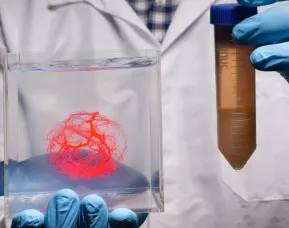
3D Printed Vasculature refers to the creation of artificial blood vessel networks using 3D printing technologies. These structures mimic the natural vascular systems found in biological tissues, enabling advances in medical research, tissue engineering, and regenerative medicine. The process involves biocompatible materials and bioinks, which can support the growth and functionality of cells.
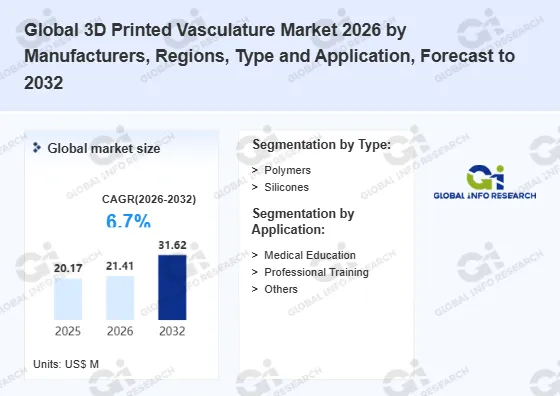
According to the latest report "Global 3D Printed Vasculature Market 2026 by Manufacturers, Regions, Type and Application, Forecast to 2032" published by GIR (Global Info Research), the global 3D Printed Vasculature market was valued at approximately USD 20.17 million in 2025 and is projected to reach USD 21.41 million in 2026. With a CAGR of 6.7% during the forecast period from 2026 to 2032, the market is expected to further expand to approximately USD 31.62 million by 2032. This growth is driven by increasing market demand, evolving industry trends, and expanding application opportunities worldwide.
Global 3D Printed Vasculature Market Size (US$ Million)
Global 3D Printed Vasculature Top 5 Players Ranking and Market Share (Ranking is based on the revenue of 2024, continually updated)
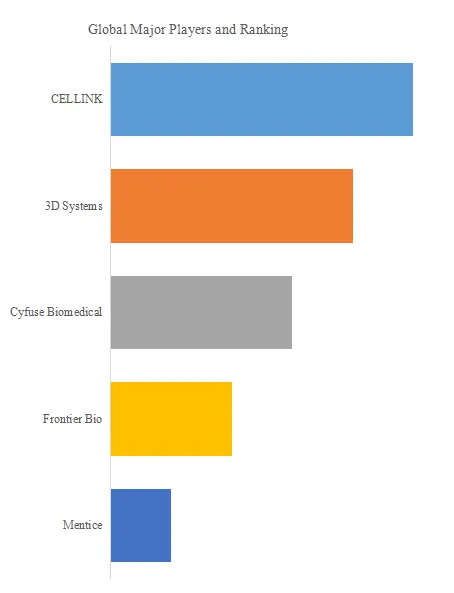
According to Global Info Research Top Players Research Center, the global key manufacturers of 3D Printed Vasculature include CELLINK, 3D Systems, etc. In 2023, the global top three players had a share approximately 66.0% in terms of revenue.
Market Drivers:
Increasing Demand for Surgical Planning and Preoperative Simulation: 3D-printed vascular models can transform complex vascular anatomy into visualized, operable physical models, thus their application in vascular surgery, interventional therapy, and preoperative planning for complex cases is constantly increasing. Their value lies primarily in helping doctors understand lesion sites more intuitively, optimize pathway design, and improve surgical preparation efficiency.
Increasing Demand for Medical Training and Simulation Teaching: Compared to teaching solely based on imaging data or cadavers, 3D-printed vascular models are more suitable for repeated operational training and can be used in scenarios such as catheter manipulation, stent deployment, vascular suturing, and interventional pathway simulation. With the increasing demand for surgical training and simulation teaching, the educational attributes of these models have become an important market driver.
Development of Drug Screening and In Vitro Testing Platforms: The development of 3D bioprinting and tissue engineering has enabled vascular models to go beyond morphological display and gradually enter the fields of drug development, vascular response research, and in vitro efficacy/toxicity testing. With the increasing demand for more realistic in vitro models, the application space of 3D-printed vascular models in drug screening is expanding.
Market Barriers:
High Manufacturing Costs and Usage Barriers: 3D printed vascular models, especially bioprinted or highly realistic perfusion models, often require expensive printing equipment, biomaterials, image modeling software, and post-processing workflows, which raises the adoption threshold for hospitals, research institutions, and corporate clients.
Significant Limitations in Material Performance: Vascular models have high requirements for materials, needing to be printable while also possessing mechanical strength, biocompatibility, flexibility, and stability. However, currently commonly used bio-inks and printing materials still have shortcomings in terms of mechanical properties, degradation rate, and long-term stability, which limits the widespread application of highly realistic vascular models.
Difficulty in Constructing Complex Vascular Networks: Truly commercially valuable vascular models not only need to be "printed," but also need to closely approximate the hierarchical structure, branching complexity, perfusion function, and microenvironment characteristics of real human blood vessels. Currently, complex, mature, stable, and long-term functional vascular networks remain a technological bottleneck.
Market Opportunities:
Personalized Surgical Planning Market Has Expansion Potential: 3D-printed vascular models can construct individualized anatomical structures based on patient imaging data such as CT and MRI, suitable for complex vascular lesions, aneurysms, congenital malformations, and interventional treatment pathway planning. With the continued advancement of personalized medicine, the application space of these patient-specific models in preoperative planning and doctor-patient communication continues to expand.
Medical Training and Simulation Teaching Demand Continues to Grow: Vascular models can be used for training in procedures such as guidewire, catheter, stent deployment, and embolization, providing a more intuitive and repeatable training platform than two-dimensional images. As surgical and interventional training increasingly emphasizes simulation teaching, opportunities for 3D-printed vascular models in hospital training centers, medical schools, and device training are significantly increasing.
Device R&D and Validation Scenarios Are Expanding: Vascular interventional devices, catheters, stents, and embolization products require numerous in vitro testing platforms during the R&D phase. 3D-printed vascular models can provide a validation environment close to real anatomical structures, thus possessing strong application potential in medical device design optimization, operational evaluation, and performance testing.
3D Printed Vasculature Report Chapter Summary:
Chapter 1: 3D Printed Vasculature Industry Definition and Market Overview
This chapter clearly defines the product definition, characteristics, and industry statistical scope of 3D Printed Vasculature, systematically introduces its mainstream product classifications and key application areas, and presents the overall size and future outlook of the global market.
Chapter 2: In-depth Analysis of Core 3D Printed Vasculature Companies (2021-2025)
This chapter focuses on the main players in the 3D Printed Vasculature market. For each representative company, it not only introduces its basic overview, main business, and product portfolio, but also highlights its core operating data in the 3D Printed Vasculature field, including sales volume, sales revenue, pricing strategies, and the latest development trends of the company from 2021 to 2025.
Chapter 3: Global Competitive Landscape Analysis (2021-2025)
This chapter examines the global 3D Printed Vasculature competitive landscape from a macro perspective. By comparing the 3D Printed Vasculature sales volume, pricing, revenue, and market share of major companies from 2021 to 2025, it quantitatively analyzes market concentration and interprets the competitive strategies and market position evolution of core manufacturers.
Chapter 4: 3D Printed Vasculature Major Regional Market Size and Prospects (2021-2032)
This chapter conducts a regional-level analysis of the global 3D Printed Vasculature core markets. It will present historical data on the 3D Printed Vasculature market size (sales volume and revenue from 2021-2025) in major regions such as North America, Europe, and Asia Pacific, and provide market outlook forecasts for 2026-2032.
Chapter 5: 3D Printed Vasculature Product Type Segmentation Market Forecast (2021-2032)
This chapter delves into the 3D Printed Vasculature product structure. It will segment the 3D Printed Vasculature market by different types (such as Polymers、Silicones, etc.), and analyze in detail the historical market size of each segmented product category from 2021 to 2025 and the future growth trends from 2026 to 2032.
Chapter 6: 3D Printed Vasculature Application Field Segmentation Market Forecast (2021-2032)
This chapter delves into the downstream application demand for 3D Printed Vasculature. The market will be segmented by different application areas (such as Medical Education、Professional Training、Others, etc.), presenting the historical market size for each area from 2021-2025 and future demand forecasts from 2026-2032.
Chapters 7-11: In-depth Analysis of Global Regional Markets (2021-2032)
This section is the core module of the 3D Printed Vasculature report, providing an in-depth country/regional analysis across five major regions: North America, Europe, Asia Pacific, South America, and the Middle East & Africa. The chapter structure for each region is consistent:
Segmentation by Country/Region: Analysis of the market size and forecasts for major countries within the region from 2021-2032.
Segmentation by Product Type: Presentation of the market structure and development forecasts for different product types within the region from 2021-2032.
Segmentation by Application Area: Analysis of market demand and prospects for different application areas within the region from 2021-2032.
Chapter 12: Global 3D Printed Vasculature Market Dynamics, Challenges, and Trends
This chapter aims to analyze the key internal and external factors affecting the development of the 3D Printed Vasculature market. It systematically reviews the core drivers of 3D Printed Vasculature market growth, the main obstacles and challenges faced, and assesses future product, technology, and market development trends.
Chapter 13: 3D Printed Vasculature Industry Chain Structure Analysis
This chapter analyzes the entire industry chain ecosystem of the 3D Printed Vasculature industry. From upstream raw material supply to midstream production and manufacturing, and then to downstream end-use applications, it analyzes the current status, cost structure, and collaborative relationships of each link.
Chapter 14: Sales Channel Model Research
This chapter focuses on the distribution channels of 3D Printed Vasculature products. It analyzes the market share, advantages and disadvantages, and typical cases of mainstream sales channels, and explores the innovation and development trends of channel models.
Chapter 15: Research Conclusions and Strategic Recommendations
As a summary of the report, this chapter will distill the core findings and conclusions of the entire report and, based on a comprehensive understanding of the 3D Printed Vasculature market, provide actionable strategic development recommendations for industry participants and potential entrants.
For more information, please refer to "Global 3D Printed Vasculature Market 2026 by Manufacturers, Regions, Type and Application, Forecast to 2032". This report analyzes the supply and demand situation, development status, and changes in the industry, focusing on the development status of the industry, how to face the development challenges of the industry, industry development suggestions, industry competitiveness, and industry investment analysis and trend forecasts. The report also summarizes the overall development dynamics of the industry, including the impact of the latest US tariffs on the global supply chain, the supply relationship analysis of the industrial chain, and provides reference suggestions and specific solutions for the industry in terms of products.
Previous News:
Ultra High Pressure Hydro Blasting Machine Market 2026: A 6.2% CAGR Points to a USD 2,699 Million Opportunity by 2032 as Chemical and Abrasive Cleaning Methods Get Replaced
Next News:
Global AI Fetal Ultrasound View Detection Software Market at USD 388 Million in 2026, Reaching USD 933 Million by 2032, CAGR 15.8%, Driven by Congenital Defect Screening Demand.
The copyright of this article belongs to Global Info Research. Without the written authorization of our company, no organization or individual may reprint, quote, copy, adapt or use it for commercial purposes in any way. When authorized to use, the original source must be indicated as "Global Info Research" and the complete copyright information must be retained.
- We Provide Professional, Accurate Market Analysis to Help You Stay Ahead of Your Competition.Speak to our analyst >>

Our Clients
What We Can Provide?
With better results and higher quality products,Our professional reports can achieve four things:

Insight into the industry market information

Analyze market development needs

Prospects for future development

Develop industry investment strategy
- Digging deeper into global industry information and providing market strategies.Contact Us >>
- We Provide Professional, Accurate Market Analysis to Help You Stay Ahead of Your Competition.Speak to our analyst >>
Our Clients
What We Can Provide?
With better results and higher quality products,Our professional reports can achieve four things:
Insight into the industry market information
Analyze market development needs
Prospects for future development
Develop industry investment strategy
- Digging deeper into global industry information and providing market strategies.Contact Us >>