
Global Robotic Automated Fiber Placement (AFP) Market Valued at US$394 Million and Projected to Reach US$655 Million at 7.4% CAGR Through 2032
Published Date: Friday,06 Nov,2026


 Robotic Automated Fiber Placement (AFP)
 Market Summary
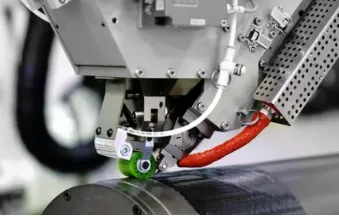
Robotic Automated Fiber Placement (AFP) is an advanced composite material manufacturing technology that integrates industrial robotics with precision fiber placement processes, designed to efficiently and accurately lay continuous fiber-reinforced materials (such as carbon fiber tows pre-impregnated with epoxy resin) onto molds or mandrels to form high-performance composite structures. Composed of a robotic arm, a specialized placement head, fiber tow feeding systems, heating and compaction modules, and intelligent control software, the system enables automated, programmable placement of fiber tows in specific orientations (typically 0°, +45°, -45°, and 90°) to build up plies with balanced mechanical properties in all directions. Each fiber tow can be independently controlled, cut, and restarted, allowing the system to adapt to complex curved surfaces and variable part geometries, minimize material waste, and ensure consistent layup precision that surpasses manual methods or traditional automated tape laying (ATL) technology. It is characterized by high efficiency, high precision, and strong adaptability, serving as a core technology for manufacturing lightweight, high-strength composite components in high-performance industries.
Currently, the robotic automated fiber placement (AFP) market is growing steadily, dominated by aerospace applications and expanding into wind energy, automotive, and industrial sectors, with demand driven by lightweight composite needs, high precision, and material efficiency; systems are primarily robotic or gantry-based, focused on accuracy and repeatability but limited by high costs, complex integration, and reliance on skilled labor.
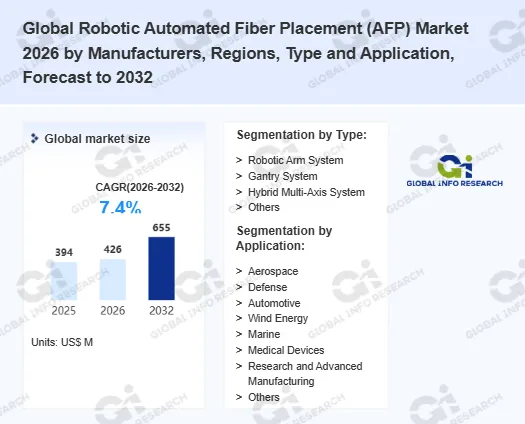
According to the latest report "Global Robotic Automated Fiber Placement (AFP) Market 2026 by Manufacturers, Regions, Type and Application, Forecast to 2032" published by GIR (Global Info Research), the global Robotic Automated Fiber Placement (AFP) market was valued at approximately USD 394 million and is projected to reach USD 655 million in the coming years, expanding at a CAGR of 7.4%. This growth reflects sustained market momentum and increasing opportunities driven by evolving industry demand and emerging application scenarios.
Robotic Automated Fiber Placement (AFP) Industry Chain Analysis
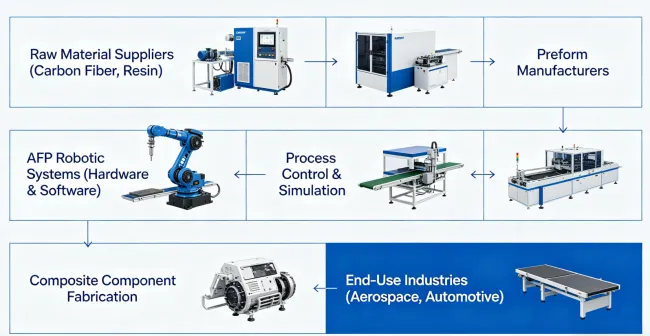
Table 1. Robotic Automated Fiber Placement (AFP) Industry Development Trends
|
|
Development Trends |
Description |
|
1 |
Intelligent process control |
Systems increasingly adopt AI and real-time monitoring to optimize placement path, tension control, and defect detection, enhancing manufacturing stability and precision. |
|
2 |
Expanded material compatibility |
Technology is evolving to handle a wider range of composite materials, including thermoplastics and sustainable fibers, supporting diversified industrial application needs. |
|
3 |
Modular and flexible integration |
Equipment design shifts to modular robotic platforms for easier configuration, smaller footprint, and better integration with flexible production lines. |
Table 2. Robotic Automated Fiber Placement (AFP) Industry Development Opportunities
|
|
Development Opportunities |
Description |
|
1 |
Lightweight demand across industries |
Growing need for high-performance lightweight components in aerospace, wind energy, and automotive drives continuous AFP market demand. |
|
2 |
Advancement of composite materials |
Rapid development and application of advanced composites create a stable downstream foundation for automated fiber placement equipment. |
|
3 |
Industrial upgrading and automation trends |
Global manufacturing automation and smart production trends encourage manufacturers to replace manual layup with AFP for higher efficiency and consistency. |
Table 3. Robotic Automated Fiber Placement (AFP) Obstacles/Challenges to Industry Development
|
|
Obstacles/Challenges |
Description |
|
1 |
High technical and R&D barriers |
Core technologies in path planning, precision control, and defect compensation require long-term accumulation, raising entry thresholds. |
|
2 |
High equipment and application costs |
High investment in robotic systems, software, and mold development limits adoption among small and medium-sized manufacturers. |
|
3 |
Talent and application complexity |
Operation and maintenance of AFP systems require professional technicians, and complex process debugging increases application difficulty. |
Future trends will center on AI-driven process optimization, real-time quality monitoring, modular and lower-cost robotic platforms, hybrid manufacturing integration, advanced material compatibility (including thermoplastics and sustainable fibers), and broader industry adoption as automation, digitalization, and cost reduction democratize AFP technology beyond aerospace.
Robotic Automated Fiber Placement (AFP) Report Chapter Summary:
Chapter 1: Robotic Automated Fiber Placement (AFP) Industry Definition and Market Overview
This chapter clearly defines the product definition, characteristics, and industry statistical scope of Robotic Automated Fiber Placement (AFP), systematically introduces its mainstream product classifications and key application areas, and presents the overall size and future outlook of the global market.
Chapter 2: In-depth Analysis of Core Robotic Automated Fiber Placement (AFP) Companies (2021-2025)
This chapter focuses on the main players in the Robotic Automated Fiber Placement (AFP) market. For each representative company, it not only introduces its basic overview, main business, and product portfolio, but also highlights its core operating data in the Robotic Automated Fiber Placement (AFP) field, including sales volume, sales revenue, pricing strategies, and the latest development trends of the company from 2021 to 2025.
Chapter 3: Global Competitive Landscape Analysis (2021-2025)
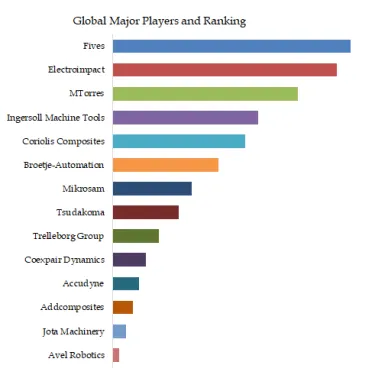
This chapter examines the global Robotic Automated Fiber Placement (AFP) competitive landscape from a macro perspective. By comparing the Robotic Automated Fiber Placement (AFP) sales volume, pricing, revenue, and market share of major companies from 2021 to 2025, it quantitatively analyzes market concentration and interprets the competitive strategies and market position evolution of core manufacturers.
Chapter 4: Robotic Automated Fiber Placement (AFP) Major Regional Market Size and Prospects (2021-2032)
This chapter conducts a regional-level analysis of the global Robotic Automated Fiber Placement (AFP) core markets. It will present historical data on the Robotic Automated Fiber Placement (AFP) market size (sales volume and revenue from 2021-2025) in major regions such as North America, Europe, and Asia Pacific, and provide market outlook forecasts for 2026-2032.
Chapter 5: Robotic Automated Fiber Placement (AFP) Product Type Segmentation Market Forecast (2021-2032)
This chapter delves into the Robotic Automated Fiber Placement (AFP) product structure. It will segment the Robotic Automated Fiber Placement (AFP) market by different types (such as Robotic Arm System、Gantry System、Hybrid Multi-Axis System、Others, etc.), and analyze in detail the historical market size of each segmented product category from 2021 to 2025 and the future growth trends from 2026 to 2032.
Chapter 6: Robotic Automated Fiber Placement (AFP) Application Field Segmentation Market Forecast (2021-2032)
This chapter delves into the downstream application demand for Robotic Automated Fiber Placement (AFP). The market will be segmented by different application areas (such as Aerospace、Defense、Automotive、Wind Energy、Marine、Medical Devices、Research and Advanced Manufacturing、Others, etc.), presenting the historical market size for each area from 2021-2025 and future demand forecasts from 2026-2032.
Chapters 7-11: In-depth Analysis of Global Regional Markets (2021-2032)
This section is the core module of the Robotic Automated Fiber Placement (AFP) report, providing an in-depth country/regional analysis across five major regions: North America, Europe, Asia Pacific, South America, and the Middle East & Africa. The chapter structure for each region is consistent:
Segmentation by Country/Region: Analysis of the market size and forecasts for major countries within the region from 2021-2032.
Segmentation by Product Type: Presentation of the market structure and development forecasts for different product types within the region from 2021-2032.
Segmentation by Application Area: Analysis of market demand and prospects for different application areas within the region from 2021-2032.
Chapter 12: Global Robotic Automated Fiber Placement (AFP) Market Dynamics, Challenges, and Trends
This chapter aims to analyze the key internal and external factors affecting the development of the Robotic Automated Fiber Placement (AFP) market. It systematically reviews the core drivers of Robotic Automated Fiber Placement (AFP) market growth, the main obstacles and challenges faced, and assesses future product, technology, and market development trends.
Chapter 13: Robotic Automated Fiber Placement (AFP) Industry Chain Structure Analysis
This chapter analyzes the entire industry chain ecosystem of the Robotic Automated Fiber Placement (AFP) industry. From upstream raw material supply to midstream production and manufacturing, and then to downstream end-use applications, it analyzes the current status, cost structure, and collaborative relationships of each link.
Chapter 14: Sales Channel Model Research
This chapter focuses on the distribution channels of Robotic Automated Fiber Placement (AFP) products. It analyzes the market share, advantages and disadvantages, and typical cases of mainstream sales channels, and explores the innovation and development trends of channel models.
Chapter 15: Research Conclusions and Strategic Recommendations
As a summary of the report, this chapter will distill the core findings and conclusions of the entire report and, based on a comprehensive understanding of the Robotic Automated Fiber Placement (AFP) market, provide actionable strategic development recommendations for industry participants and potential entrants.
For more information, please refer to "Global Robotic Automated Fiber Placement (AFP) Market 2026 by Manufacturers, Regions, Type and Application, Forecast to 2032". This report analyzes the supply and demand situation, development status, and changes in the industry, focusing on the development status of the industry, how to face the development challenges of the industry, industry development suggestions, industry competitiveness, and industry investment analysis and trend forecasts. The report also summarizes the overall development dynamics of the industry, including the impact of the latest US tariffs on the global supply chain, the supply relationship analysis of the industrial chain, and provides reference suggestions and specific solutions for the industry in terms of products.
Previous News:
Global Software Outsourcing to Japan Market Valued at US$41,144 Million in 2026, Projected to Reach US$51,545 Million by 2032 at 3.8% CAGR
Next News:
Global High-temperature Heat Pump Drying System Market Valued at US$966 Million in 2026, Projected to Reach US$1,619 Million by 2032 at 9.0% CAGR
The copyright of this article belongs to Global Info Research. Without the written authorization of our company, no organization or individual may reprint, quote, copy, adapt or use it for commercial purposes in any way. When authorized to use, the original source must be indicated as "Global Info Research" and the complete copyright information must be retained.
- We Provide Professional, Accurate Market Analysis to Help You Stay Ahead of Your Competition.Speak to our analyst >>

Our Clients
What We Can Provide?
With better results and higher quality products,Our professional reports can achieve four things:

Insight into the industry market information

Analyze market development needs

Prospects for future development

Develop industry investment strategy
- Digging deeper into global industry information and providing market strategies.Contact Us >>
- We Provide Professional, Accurate Market Analysis to Help You Stay Ahead of Your Competition.Speak to our analyst >>
Our Clients
What We Can Provide?
With better results and higher quality products,Our professional reports can achieve four things:
Insight into the industry market information
Analyze market development needs
Prospects for future development
Develop industry investment strategy
- Digging deeper into global industry information and providing market strategies.Contact Us >>