
Global High-temperature Heat Pump Drying System Market Valued at US$966 Million in 2026, Projected to Reach US$1,619 Million by 2032 at 9.0% CAGR
Published Date: Friday,06 Nov,2026


 High-temperature Heat Pump Drying System
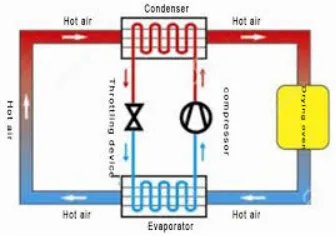
High-temperature Heat Pump Drying Systems are energy-saving drying systems that use heat pump cycles to generate higher drying temperatures while recovering waste heat and controlling humidity. They are suitable for food, agricultural products, wood, sludge, chemicals, and industrial materials requiring efficient and stable drying.
The industrial chain covers upstream compressors, heat exchangers, fans, refrigerants, sensors, control systems, chambers, and insulation materials; midstream system design, heat pump integration, air circulation, temperature control, assembly, and testing; downstream food processing, agricultural drying, wood treatment, chemical drying, sludge reduction, and industrial production lines.
Figure1. Global High-temperature Heat Pump Drying System Market Size (US$ Million), 2021-2032
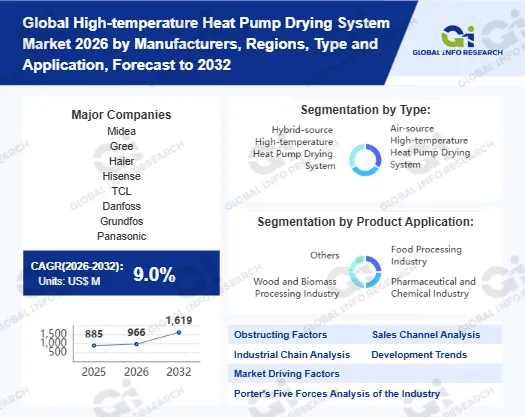
According to the latest report"Global High-temperature Heat Pump Drying System Market 2026 by Manufacturers, Regions, Type and Application, Forecast to 2032" published by GIR (Global Info Research), the global High-temperature Heat Pump Drying System market was valued at approximately USD 885 million in 2025 and is projected to reach USD 966 million in 2026. With a CAGR of 9.0% during the forecast period from 2026 to 2032, the market is expected to further expand to approximately USD 1619 million by 2032. This growth is driven by increasing market demand, evolving industry trends, and expanding application opportunities worldwide.
Figure2. Global High-temperature Heat Pump Drying System Top 10 Players Ranking and Market Share
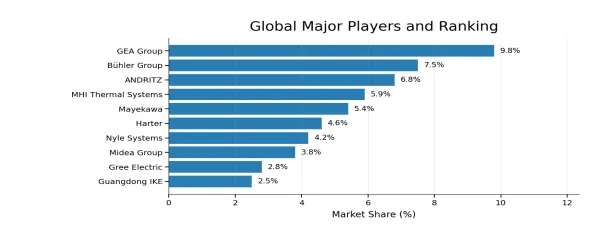
In 2026, the global top 10 players revenue share was approximately 53.3%.
A high-temperature heat pump drying system is an industrial drying solution that uses a heat pump cycle to remove moisture from materials while recovering and reusing heat within the drying process. Unlike conventional hot-air, steam or fossil-fuel dryers, it combines a compressor, evaporator, condenser, expansion device, air circulation system, dehumidification unit, drying chamber and intelligent controls to provide stable drying temperatures, usually in the medium- to high-temperature range required by food, agricultural, chemical, wood, sludge and industrial products. The system heats process air, absorbs moisture from the material, condenses water from humid exhaust air and recycles latent heat to reduce energy consumption. Its value lies in energy efficiency, product quality control, lower emissions, reduced thermal damage and safer enclosed operation. In this report, the market scope covers industrial high-temperature heat pump drying equipment and integrated drying systems, rather than small household dryers or ordinary low-temperature dehumidifiers.
Competitive Landscape
The competitive landscape is relatively fragmented but led by several industrial equipment groups and specialized drying technology suppliers. GEA Group, Bühler Group and ANDRITZ have strong advantages in process engineering, food processing, biomass, sludge and continuous production systems. Mitsubishi Heavy Industries Thermal Systems and Mayekawa Mfg. bring strengths in heat pump, refrigeration and industrial thermal management technologies, while Harter GmbH and Nyle Systems focus on energy-efficient low- and high-temperature drying applications. Chinese suppliers such as Midea Group, Gree Electric Appliances and Guangdong IKE Industrial are expanding through cost-effective heat pump platforms, domestic manufacturing scale and growing demand from agricultural and industrial users. Competition is based on drying efficiency, temperature range, moisture control accuracy, equipment reliability, application customization, after-sales service and project integration capability. Because drying performance depends heavily on material characteristics, leading suppliers often compete through application know-how rather than standardized equipment alone. As customers seek lower energy cost and cleaner production, suppliers with integrated heat pump design and process optimization capability are expected to gain share.
Main Type
Main product types can be divided by drying configuration, temperature range, heating structure and operating mode. By configuration, the market includes batch chamber dryers, cabinet dryers, tunnel dryers, belt dryers, tray dryers and continuous integrated drying lines. By system structure, products can be classified into closed-loop condensation drying systems, open-loop heat pump hot-air dryers and hybrid systems that combine heat pump heating with electric, steam, biomass or gas auxiliary heating. By temperature range, standard units usually operate at moderate temperatures, while high-temperature systems are designed for applications requiring stronger moisture removal, faster drying cycles or stable processing above conventional heat pump limits. By operating mode, systems are divided into standalone equipment and turnkey drying projects integrated with feeding, conveying, exhaust treatment, control and packaging processes. Closed-loop and hybrid high-temperature systems are gaining attention because they can improve energy utilization, reduce emissions and support sensitive materials. Product selection is normally determined by material moisture, drying capacity, final moisture target, hygiene requirements and factory energy conditions.
Downstream Applications
Downstream applications cover food processing, agricultural products, wood processing, medicinal materials, chemicals, textiles, sludge treatment and various industrial materials. In food and agriculture, high-temperature heat pump dryers are used for fruits, vegetables, grains, seafood, meat products, tea, herbs, spices and other materials that require controlled moisture removal and stable product quality. In wood and biomass processing, the systems help reduce moisture content while improving energy efficiency compared with traditional kiln or hot-air drying. In environmental applications, they are used for sludge drying, waste treatment and resource recovery where enclosed operation and reduced exhaust emissions are important. Chemical and pharmaceutical-related users value precise temperature and humidity control to protect material stability and consistency. Demand is also emerging from ceramics, coatings, textiles, paper products and specialty industrial components. The application base is broad because drying is a common industrial process, but the strongest growth is expected in sectors where energy cost, carbon reduction, hygiene control and product quality improvement are major investment drivers.
Regional Perspective
Asia-Pacific is the largest and fastest-growing regional market, supported by strong food processing capacity, agricultural product upgrading, industrial manufacturing and government emphasis on energy conservation. China is particularly important because heat pump drying is increasingly used in agricultural processing, medicinal herbs, food dehydration, sludge treatment and small to medium industrial facilities. Chinese manufacturers also benefit from local compressor supply, mature heat pump production and cost advantages. Europe is a high-value market due to strict energy efficiency standards, carbon reduction policies and demand for clean industrial drying in food, biomass, sludge and specialty materials. North America maintains stable demand in food processing, wood drying, cannabis and industrial applications, with customers focusing on lifecycle energy savings and reliability. Japan and South Korea have demand linked to advanced thermal management, seafood, food processing and industrial materials. Emerging markets in Southeast Asia, India, Latin America and the Middle East are expected to adopt more systems as agricultural processing, cold-chain infrastructure and industrial modernization expand. Regional competition is shaped by energy prices, subsidy policies, climate conditions and local service networks.
Price Analysis
The price of high-temperature heat pump drying systems varies widely according to drying capacity, temperature range, compressor configuration, chamber size, airflow design, heat exchanger material, automation level, hygiene requirements and project integration scope. Small cabinet or chamber systems can be sold as standardized equipment, while large belt, tunnel or continuous drying lines are typically customized engineering projects with higher unit prices. Compared with conventional hot-air or electric resistance dryers, heat pump drying systems usually require a higher initial investment because they include refrigeration circuits, heat exchangers, moisture recovery systems, controls and safety components. However, customers often evaluate the product on total cost of ownership because operating energy savings can offset the higher purchase price over time. Prices are also influenced by refrigerant selection, stainless steel usage, insulation quality, installation complexity and after-sales support. In the medium term, component localization and larger production scale may reduce hardware costs, especially in China. Nevertheless, high-performance industrial systems with precise moisture control, high-temperature capability and turnkey engineering will continue to maintain premium pricing.
Market Drivers
Market growth is mainly driven by industrial energy conservation, carbon reduction requirements and the need to replace coal, gas or electric resistance drying with cleaner and more efficient technologies. Drying is one of the most energy-intensive processes in food, agriculture, chemical and environmental treatment industries, so heat pump systems are attractive where electricity prices, fuel restrictions or emissions policies pressure users to reduce operating costs. Demand is also supported by rising requirements for product quality, because controlled temperature and humidity can reduce cracking, discoloration, nutrient loss, deformation and uneven drying. Agricultural modernization and food processing upgrading create additional demand for standardized dehydration equipment, especially for fruits, vegetables, herbs, seafood and specialty crops. Environmental applications such as sludge drying are expanding as municipalities and industrial plants seek volume reduction and lower exhaust emissions. Automation, remote monitoring and process data control further improve system value. Although high upfront cost remains a barrier, payback analysis, energy subsidies and stricter environmental regulation are encouraging broader adoption across industrial and agricultural sectors.
High-temperature Heat Pump Drying System Report Chapter Summary:
Chapter 1: High-temperature Heat Pump Drying System Industry Definition and Market Overview
This chapter clearly defines the product definition, characteristics, and industry statistical scope of High-temperature Heat Pump Drying System, systematically introduces its mainstream product classifications and key application areas, and presents the overall size and future outlook of the global market.
Chapter 2: In-depth Analysis of Core High-temperature Heat Pump Drying System Companies (2021-2025)
This chapter focuses on the main players in the High-temperature Heat Pump Drying System market. For each representative company, it not only introduces its basic overview, main business, and product portfolio, but also highlights its core operating data in the High-temperature Heat Pump Drying System field, including sales volume, sales revenue, pricing strategies, and the latest development trends of the company from 2021 to 2025.
Chapter 3: Global Competitive Landscape Analysis (2021-2025)
This chapter examines the global High-temperature Heat Pump Drying System competitive landscape from a macro perspective. By comparing the High-temperature Heat Pump Drying System sales volume, pricing, revenue, and market share of major companies from 2021 to 2025, it quantitatively analyzes market concentration and interprets the competitive strategies and market position evolution of core manufacturers.
Chapter 4: High-temperature Heat Pump Drying System Major Regional Market Size and Prospects (2021-2032)
This chapter conducts a regional-level analysis of the global High-temperature Heat Pump Drying System core markets. It will present historical data on the High-temperature Heat Pump Drying System market size (sales volume and revenue from 2021-2025) in major regions such as North America, Europe, and Asia Pacific, and provide market outlook forecasts for 2026-2032.
Chapter 5: High-temperature Heat Pump Drying System Product Type Segmentation Market Forecast (2021-2032)
This chapter delves into the High-temperature Heat Pump Drying System product structure. It will segment the High-temperature Heat Pump Drying System market by different types (such as Air-source High-temperature Heat Pump Drying System、Water-source High-temperature Heat Pump Drying System、Hybrid-source High-temperature Heat Pump Drying System, etc.), and analyze in detail the historical market size of each segmented product category from 2021 to 2025 and the future growth trends from 2026 to 2032.
Chapter 6: High-temperature Heat Pump Drying System Application Field Segmentation Market Forecast (2021-2032)
This chapter delves into the downstream application demand for High-temperature Heat Pump Drying System. The market will be segmented by different application areas (such as Food Processing Industry、Pharmaceutical and Chemical Industry、Wood and Biomass Processing Industry、Others, etc.), presenting the historical market size for each area from 2021-2025 and future demand forecasts from 2026-2032.
Chapters 7-11: In-depth Analysis of Global Regional Markets (2021-2032)
This section is the core module of the High-temperature Heat Pump Drying System report, providing an in-depth country/regional analysis across five major regions: North America, Europe, Asia Pacific, South America, and the Middle East & Africa. The chapter structure for each region is consistent:
Segmentation by Country/Region: Analysis of the market size and forecasts for major countries within the region from 2021-2032.
Segmentation by Product Type: Presentation of the market structure and development forecasts for different product types within the region from 2021-2032.
Segmentation by Application Area: Analysis of market demand and prospects for different application areas within the region from 2021-2032.
Chapter 12: Global High-temperature Heat Pump Drying System Market Dynamics, Challenges, and Trends
This chapter aims to analyze the key internal and external factors affecting the development of the High-temperature Heat Pump Drying System market. It systematically reviews the core drivers of High-temperature Heat Pump Drying System market growth, the main obstacles and challenges faced, and assesses future product, technology, and market development trends.
Chapter 13: High-temperature Heat Pump Drying System Industry Chain Structure Analysis
This chapter analyzes the entire industry chain ecosystem of the High-temperature Heat Pump Drying System industry. From upstream raw material supply to midstream production and manufacturing, and then to downstream end-use applications, it analyzes the current status, cost structure, and collaborative relationships of each link.
Chapter 14: Sales Channel Model Research
This chapter focuses on the distribution channels of High-temperature Heat Pump Drying System products. It analyzes the market share, advantages and disadvantages, and typical cases of mainstream sales channels, and explores the innovation and development trends of channel models.
Chapter 15: Research Conclusions and Strategic Recommendations
As a summary of the report, this chapter will distill the core findings and conclusions of the entire report and, based on a comprehensive understanding of the High-temperature Heat Pump Drying System market, provide actionable strategic development recommendations for industry participants and potential entrants.
For more information, please refer to "Global High-temperature Heat Pump Drying System Market 2026 by Manufacturers, Regions, Type and Application, Forecast to 2032". This report analyzes the supply and demand situation, development status, and changes in the industry, focusing on the development status of the industry, how to face the development challenges of the industry, industry development suggestions, industry competitiveness, and industry investment analysis and trend forecasts. The report also summarizes the overall development dynamics of the industry, including the impact of the latest US tariffs on the global supply chain, the supply relationship analysis of the industrial chain, and provides reference suggestions and specific solutions for the industry in terms of products.
Previous News:
Global Robotic Automated Fiber Placement (AFP) Market Valued at US$394 Million and Projected to Reach US$655 Million at 7.4% CAGR Through 2032
Next News:
Global Sodium-Ion Battery Pack Market Report 2026: 24.2% CAGR Forecast Through 2032 as Industry Value Set to Climb from USD 2,388 Million to USD 8,775 Million
The copyright of this article belongs to Global Info Research. Without the written authorization of our company, no organization or individual may reprint, quote, copy, adapt or use it for commercial purposes in any way. When authorized to use, the original source must be indicated as "Global Info Research" and the complete copyright information must be retained.
- We Provide Professional, Accurate Market Analysis to Help You Stay Ahead of Your Competition.Speak to our analyst >>

Our Clients
What We Can Provide?
With better results and higher quality products,Our professional reports can achieve four things:

Insight into the industry market information

Analyze market development needs

Prospects for future development

Develop industry investment strategy
- Digging deeper into global industry information and providing market strategies.Contact Us >>
- We Provide Professional, Accurate Market Analysis to Help You Stay Ahead of Your Competition.Speak to our analyst >>
Our Clients
What We Can Provide?
With better results and higher quality products,Our professional reports can achieve four things:
Insight into the industry market information
Analyze market development needs
Prospects for future development
Develop industry investment strategy
- Digging deeper into global industry information and providing market strategies.Contact Us >>