
Home Decoration Adhesive Market 2026: A 3.4% CAGR Points to a USD 1,563 Million Opportunity by 2032 as Renovation Demand and Green Product Upgrades Accelerate
Published Date: Monday,09 Nov,2026


Home Decoration Adhesive Market Summary
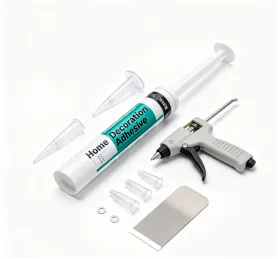
Home Decoration Adhesive refers to a category of bonding materials specifically designed for use in interior design, remodeling, and decorative applications. These adhesives are formulated to provide strong, durable, and often aesthetically clean bonds between a variety of materials commonly used in home decoration, such as wood, ceramics, glass, fabric, plastic, and lightweight construction elements. Unlike industrial adhesives that prioritize extreme mechanical strength or resistance to harsh environments, home decoration adhesives emphasize ease of use, low toxicity, fast curing times, and compatibility with delicate decorative surfaces. They may come in liquid, paste, tape, or spray form depending on the application, such as fixing wallpapers, attaching decorative moldings, securing tiles, mounting lightweight panels, or bonding ornamental pieces. Additionally, many home decoration adhesives incorporate features like low odor, environmental friendliness, and removability without surface damage, making them suitable for both permanent and temporary decoration projects. As consumer demand grows for DIY and customized home interiors, these adhesives play a crucial role in enabling flexibility, convenience, and creativity in modern living spaces.
Figure1. Global Home Decoration Adhesive Market Size (US$ Million), 2020-2031
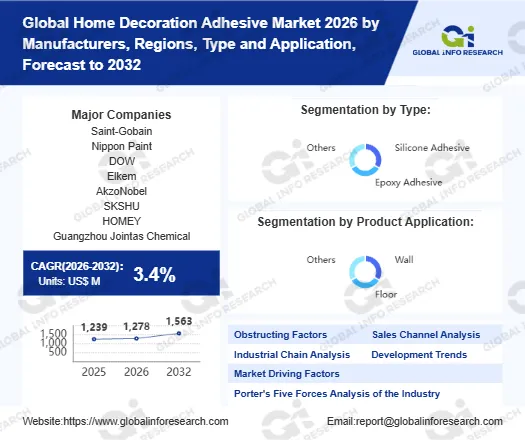
According to the latest report "Global Home Decoration Adhesive Market 2026 by Manufacturers, Regions, Type and Application, Forecast to 2032"published by GIR (Global Info Research), the global Home Decoration Adhesive market was valued at approximately USD 1239 million in 2025 and is projected to reach USD 1278 million in 2026. With a CAGR of 3.4% during the forecast period from 2026 to 2032, the market is expected to further expand to approximately USD 1563 million by 2032. This growth is driven by increasing market demand, evolving industry trends, and expanding application opportunities worldwide.
Figure2. Global Home Decoration Adhesive Top 16 Players Ranking and Market Share (Ranking is based on the revenue of 2024, continually updated)
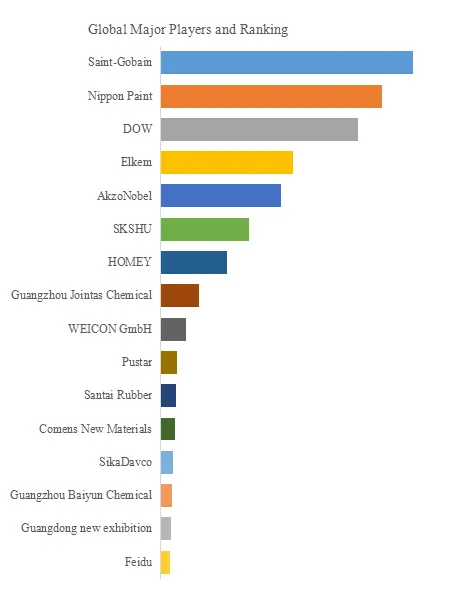
According to Global Info Research Top Players Research Center, the global key manufacturers of Home Decoration Adhesive include Saint-Gobain, Nippon Paint, DOW, Elkem, AkzoNobel, etc. In 2024, the global top five players had a share approximately 66.0% in terms of revenue.
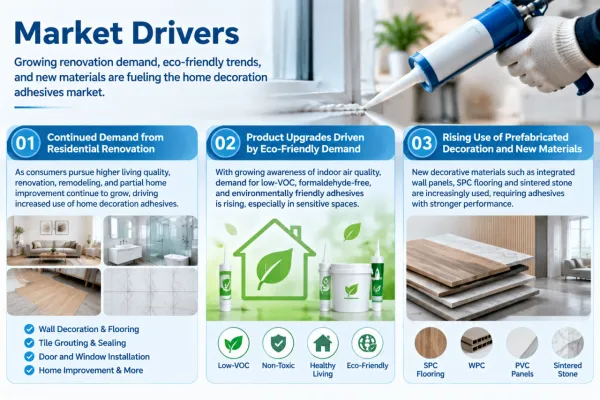
Market Drivers:
Continued demand from residential renovation, remodeling, and partial home improvement: Home decoration adhesives are widely used in wall decoration, flooring installation, tile grouting, kitchen and bathroom sealing, door and window installation, background wall fixing, woodwork assembly, skirting board installation, and soft decoration bonding. They are frequently used auxiliary materials in home renovation. As consumers pursue higher living quality and demand for second-hand home renovation, old house remodeling, and partial home improvement continues to increase, the application scope of home decoration adhesives is expanding. Compared with traditional nailing, screw fixing, or cement mortar methods, adhesives offer easier installation, broader material compatibility, and better alignment with modern decoration requirements for appearance, lightweight design, and construction efficiency.
Product upgrades driven by low-VOC, eco-friendly, and healthy home decoration demand: Home decoration adhesives are used directly in indoor environments, so consumers are paying increasing attention to odor, formaldehyde, VOC emissions, mildew resistance, water resistance, and long-term safety. As green building materials, eco-friendly decoration, and safety requirements for bedrooms, children’s rooms, kitchens, and other sensitive spaces become more important, demand is rising for low-VOC, formaldehyde-free, solvent-free, water-based, silane-modified, and environmentally friendly sealants, construction adhesives, and nail-free adhesives. Environmental performance is becoming an important factor in brand competition, channel access, and consumer purchasing decisions.
Rising use of prefabricated decoration and new decorative materials: New materials such as integrated wall panels, SPC flooring, wood-plastic composites, PVC decorative panels, sintered stone slabs, aluminum honeycomb panels, lightweight partitions, customized cabinets, and modular kitchen and bathroom systems are increasingly used in home decoration. These materials require adhesives with stronger bonding strength, initial tack, weather resistance, elasticity, movement tolerance, and multi-substrate compatibility. Home decoration adhesives are no longer used only for simple bonding; they are increasingly required to provide sealing, waterproofing, vibration reduction, gap filling, and auxiliary structural fixing functions, which supports the penetration of high-performance products.
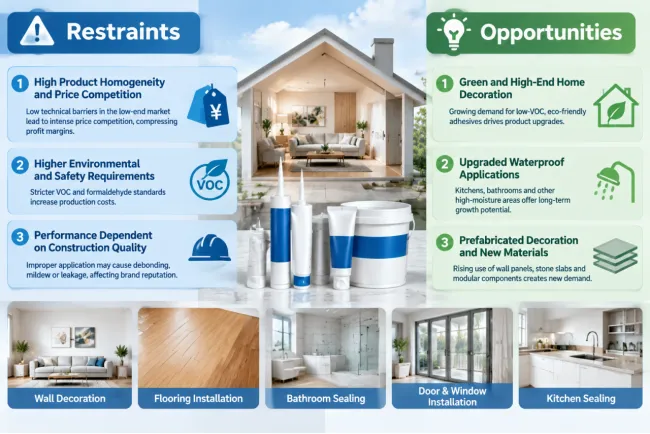
Restraint:
High product homogeneity and intense price competition in the low-end market: Home decoration adhesives include silicone sealants, construction sealants, nail-free adhesives, white glue, all-purpose adhesives, tile adhesives, grout sealants, and structural adhesives. Some low-end products have relatively low technical barriers, attracting many market participants. Numerous small and medium-sized brands compete mainly on price, packaging, and channel access, which compresses profit margins in the low-end segment. Without strong branding, environmental certification, stable quality, and channel control, companies can easily fall into price-based competition.
Higher environmental and consumer safety requirements increase cost pressure: Home decoration adhesives are closely related to indoor air quality and human health. Indicators such as VOCs, free formaldehyde, benzene-series compounds, heavy metals, odor, and curing by-products are receiving greater attention. Manufacturers need to invest more in raw material upgrades, formulation optimization, testing and certification, environmental labeling, and quality control. For companies relying on low-cost solvent-based products or low-end raw materials, stricter environmental standards can increase production costs and may eliminate non-compliant capacity.
Final performance is highly dependent on construction quality: Although home decoration adhesives are convenient to use, their final performance is strongly affected by substrate preparation, construction temperature, humidity, adhesive layer thickness, curing time, surface cleanliness, and worker experience. Improper application can lead to debonding, mildew, discoloration, bubbling, weak adhesion, shrinkage cracking, or sealing failure. These issues can affect consumer perception of brand and product quality and increase after-sales and channel management pressure.
Opportunity:
Green and high-end home decoration creates replacement opportunities for mid-to-high-end products: As consumers place greater emphasis on healthy indoor living environments, low-odor, low-VOC, mildew-resistant, water-resistant, yellowing-resistant, formaldehyde-free, and environmentally certified home decoration adhesives are expected to replace traditional low-end products. High-end residential decoration, furnished apartments, hotels, senior living spaces, and child-friendly environments have higher requirements for adhesive safety and durability, creating growth opportunities for branded and high-performance products. Manufacturers can increase product value through environmental certification, functional differentiation, and application-specific product development.
Kitchen, bathroom, door, window, and waterproof sealing applications have continuous upgrade potential: Kitchens, bathrooms, balconies, doors, windows, and basements are exposed to moisture, temperature variation, mildew, cleaning chemicals, and structural movement. These environments require stronger waterproofing, mildew resistance, weather resistance, elasticity, and long-term sealing performance. High-performance silicone sealants, MS adhesives, polyurethane adhesives, anti-mildew sealants, and kitchen-and-bathroom-specific adhesives still have strong replacement potential in these applications. As consumers become more sensitive to decoration durability and maintenance costs, acceptance of functional home decoration adhesives will continue to improve.
Prefabricated decoration and lightweight materials create new adhesive demand: The home decoration industry is gradually shifting from traditional wet construction toward more efficient, cleaner, and more standardized prefabricated construction methods. Wall panels, flooring, cabinets, decorative wall boards, sintered stone slabs, lightweight composites, and modular components require more suitable bonding and sealing solutions. Adhesive manufacturers can develop specialized products such as sintered stone adhesive, flooring adhesive, wall panel adhesive, nail-free adhesive, fast-curing structural adhesive, and multi-substrate universal adhesive, thereby entering higher-value decoration auxiliary material segments.
Home Decoration Adhesive Report Chapter Summary:
Chapter 1: Home Decoration Adhesive Industry Definition and Market Overview
This chapter clearly defines the product definition, characteristics, and industry statistical scope of Home Decoration Adhesive, systematically introduces its mainstream product classifications and key application areas, and presents the overall size and future outlook of the global market.
Chapter 2: In-depth Analysis of Core Home Decoration Adhesive Companies (2021-2025)
This chapter focuses on the main players in the Home Decoration Adhesive market. For each representative company, it not only introduces its basic overview, main business, and product portfolio, but also highlights its core operating data in the Home Decoration Adhesive field, including sales volume, sales revenue, pricing strategies, and the latest development trends of the company from 2021 to 2025.
Chapter 3: Global Competitive Landscape Analysis (2021-2025)
This chapter examines the global Home Decoration Adhesive competitive landscape from a macro perspective. By comparing the Home Decoration Adhesive sales volume, pricing, revenue, and market share of major companies from 2021 to 2025, it quantitatively analyzes market concentration and interprets the competitive strategies and market position evolution of core manufacturers.
Chapter 4: Home Decoration Adhesive Major Regional Market Size and Prospects (2021-2032)
This chapter conducts a regional-level analysis of the global Home Decoration Adhesive core markets. It will present historical data on the Home Decoration Adhesive market size (sales volume and revenue from 2021-2025) in major regions such as North America, Europe, and Asia Pacific, and provide market outlook forecasts for 2026-2032.
Chapter 5: Home Decoration Adhesive Product Type Segmentation Market Forecast (2021-2032)
This chapter delves into the Home Decoration Adhesive product structure. It will segment the Home Decoration Adhesive market by different types (such as Silicone Adhesive、Epoxy Adhesive、Others, etc.), and analyze in detail the historical market size of each segmented product category from 2021 to 2025 and the future growth trends from 2026 to 2032.
Chapter 6: Home Decoration Adhesive Application Field Segmentation Market Forecast (2021-2032)
This chapter delves into the downstream application demand for Home Decoration Adhesive. The market will be segmented by different application areas (such as Wall、Floor、Others, etc.), presenting the historical market size for each area from 2021-2025 and future demand forecasts from 2026-2032.
Chapters 7-11: In-depth Analysis of Global Regional Markets (2021-2032)
This section is the core module of the Home Decoration Adhesive report, providing an in-depth country/regional analysis across five major regions: North America, Europe, Asia Pacific, South America, and the Middle East & Africa. The chapter structure for each region is consistent:
Segmentation by Country/Region: Analysis of the market size and forecasts for major countries within the region from 2021-2032.
Segmentation by Product Type: Presentation of the market structure and development forecasts for different product types within the region from 2021-2032.
Segmentation by Application Area: Analysis of market demand and prospects for different application areas within the region from 2021-2032.
Chapter 12: Global Home Decoration Adhesive Market Dynamics, Challenges, and Trends
This chapter aims to analyze the key internal and external factors affecting the development of the Home Decoration Adhesive market. It systematically reviews the core drivers of Home Decoration Adhesive market growth, the main obstacles and challenges faced, and assesses future product, technology, and market development trends.
Chapter 13: Home Decoration Adhesive Industry Chain Structure Analysis
This chapter analyzes the entire industry chain ecosystem of the Home Decoration Adhesive industry. From upstream raw material supply to midstream production and manufacturing, and then to downstream end-use applications, it analyzes the current status, cost structure, and collaborative relationships of each link.
Chapter 14: Sales Channel Model Research
This chapter focuses on the distribution channels of Home Decoration Adhesive products. It analyzes the market share, advantages and disadvantages, and typical cases of mainstream sales channels, and explores the innovation and development trends of channel models.
Chapter 15: Research Conclusions and Strategic Recommendations
As a summary of the report, this chapter will distill the core findings and conclusions of the entire report and, based on a comprehensive understanding of the Home Decoration Adhesive market, provide actionable strategic development recommendations for industry participants and potential entrants.
For more information, please refer to "Global Home Decoration Adhesive Market 2026 by Manufacturers, Regions, Type and Application, Forecast to 2032". This report analyzes the supply and demand situation, development status, and changes in the industry, focusing on the development status of the industry, how to face the development challenges of the industry, industry development suggestions, industry competitiveness, and industry investment analysis and trend forecasts. The report also summarizes the overall development dynamics of the industry, including the impact of the latest US tariffs on the global supply chain, the supply relationship analysis of the industrial chain, and provides reference suggestions and specific solutions for the industry in terms of products.
Previous News:
Flush Diaphragm Pressure Sensor Market 2026: An 8.1% CAGR Opens a USD 4,532 Million Growth Opportunity by 2032 as Hygiene and Automation Demand Accelerates
Next News:
From Stacker Cranes to AMR fleets: Intelligent Automated Storage and Retrieval System Market Enters 2026 at 7.9% CAGR, Targeting USD 32,631 Million by 2032
The copyright of this article belongs to Global Info Research. Without the written authorization of our company, no organization or individual may reprint, quote, copy, adapt or use it for commercial purposes in any way. When authorized to use, the original source must be indicated as "Global Info Research" and the complete copyright information must be retained.
- We Provide Professional, Accurate Market Analysis to Help You Stay Ahead of Your Competition.Speak to our analyst >>

Our Clients
What We Can Provide?
With better results and higher quality products,Our professional reports can achieve four things:

Insight into the industry market information

Analyze market development needs

Prospects for future development

Develop industry investment strategy
- Digging deeper into global industry information and providing market strategies.Contact Us >>
- We Provide Professional, Accurate Market Analysis to Help You Stay Ahead of Your Competition.Speak to our analyst >>
Our Clients
What We Can Provide?
With better results and higher quality products,Our professional reports can achieve four things:
Insight into the industry market information
Analyze market development needs
Prospects for future development
Develop industry investment strategy
- Digging deeper into global industry information and providing market strategies.Contact Us >>