
From Stacker Cranes to AMR fleets: Intelligent Automated Storage and Retrieval System Market Enters 2026 at 7.9% CAGR, Targeting USD 32,631 Million by 2032
Published Date: Monday,09 Nov,2026


 Intelligent Automated Warehouses
Intelligent Automated Storage and Retrieval System Market Summary
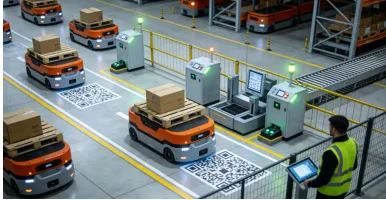
Intelligent automated warehouses (AS/RS) are modern logistics infrastructures that integrate automated storage equipment, robotic systems, and intelligent management software. They achieve efficient material storage and logistics management through automated storage and retrieval systems (AS/RS), stacker cranes, automated guided vehicles (AGVs), conveyor systems, and warehouse management systems (WMS). This system significantly improves warehouse space utilization, reduces manual operations, enhances inventory management accuracy, and enables real-time digital management of logistics operations. The upstream of this industry chain mainly includes suppliers of steel structure racks, sensors, core robot components, conveyor equipment, automated control systems, and industrial software platforms. The midstream consists of system integrators, responsible for the overall design, equipment integration, and engineering implementation of automated warehousing systems. Downstream applications mainly include e-commerce logistics companies, retail distribution centers, manufacturing companies, pharmaceutical logistics companies, and cold chain logistics operators. The gross profit margin for industry system integrators and solution providers is approximately 22%–35%.
Figure 1. Global Intelligent Automated Storage and Retrieval System Market Size (US$ Million), 2026-2032
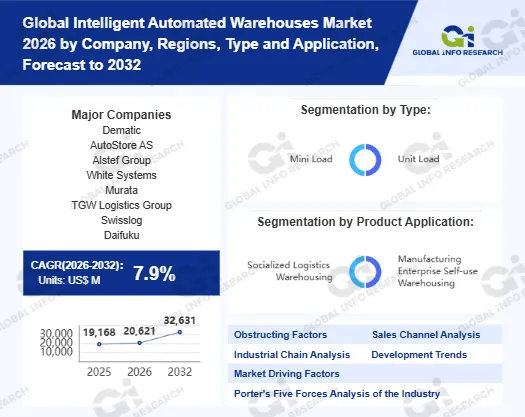
According to the latest report published "Global Intelligent Automated Warehouses Market 2026 by Manufacturers, Regions, Type and Application, Forecast to 2032" by GIR (Global Info Research), the global Intelligent Automated Warehouses market was valued at approximately USD 19168 million in 2025 and is projected to reach USD 20621 million in 2026. With a CAGR of 7.9% during the forecast period from 2026 to 2032, the market is expected to further expand to approximately USD 32631 million by 2032. This growth is driven by increasing market demand, evolving industry trends, and expanding application opportunities worldwide.
Figure 2. Global Intelligent Automated Storage and Retrieval System Top 14 Players Ranking and Market Share (Ranking is based on the revenue of 2025, continually updated)
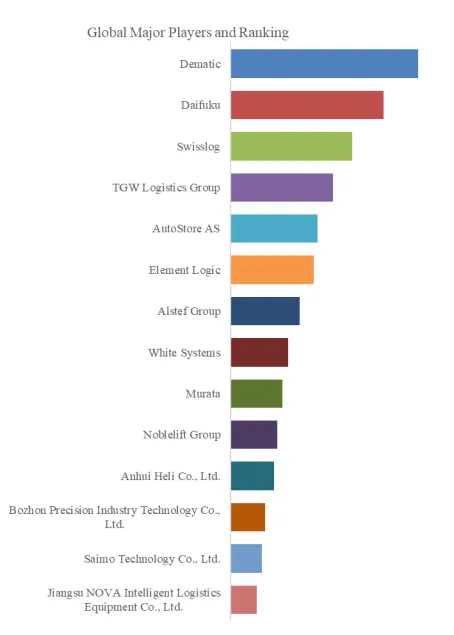
This report profiles key players of Intelligent Automated Storage and Retrieval System such as Dematic,Daifuku,Swisslog,TGW Logistics Group
In 2025, the global top five Intelligent Automated Storage and Retrieval System players account for 30.11% of market share in terms of revenue. Above figure shows the key players ranked by revenue in Intelligent Automated Storage and Retrieval System.
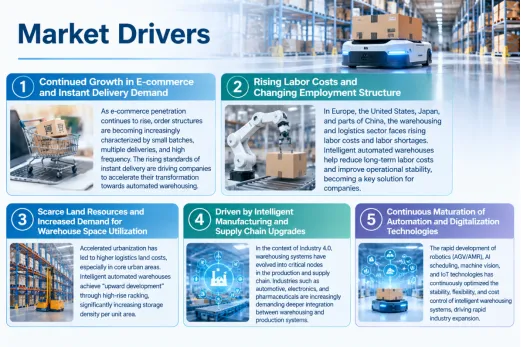
Market Drivers:
1. Continued Growth in E-commerce and Instant Delivery Demand
As e-commerce penetration continues to rise, order structures are becoming increasingly characterized by small batches, multiple deliveries, and high frequency. Traditional manual warehousing models are gradually failing to meet these demands in terms of efficiency and accuracy. Simultaneously, the rising standards of instant delivery and next-day delivery services place higher demands on the responsiveness and throughput capacity of warehousing systems, driving companies to accelerate their transformation towards automated and intelligent warehousing systems.
2. Rising Labor Costs and Changing Employment Structure
In Europe, the United States, Japan, and parts of China, the warehousing and logistics sector faces the problem of continuously rising labor costs and labor shortages, especially with a decline in the attractiveness of repetitive, high-intensity jobs. Intelligent automated warehouses, by replacing manual operations with automated equipment, not only reduce long-term labor costs but also improve operational stability and management efficiency, becoming an important means for companies to reduce costs and increase efficiency.
3. Scarce Land Resources and Increased Demand for Warehouse Space Utilization
Accelerated urbanization has led to a continuous increase in logistics land costs, especially in core urban areas where warehouse space resources are scarce. Intelligent automated warehouses (AS/RS) achieve "upward development" through high-rise racking and automated storage and retrieval systems, significantly increasing storage density per unit area. This allows them to meet higher inventory demands within limited space, offering significant economic advantages.
4. Driven by Intelligent Manufacturing and Supply Chain Upgrades
In the context of Industry 4.0 and intelligent manufacturing, warehousing systems have evolved from simple storage functions to crucial nodes in production and the supply chain. Industries such as automotive, electronics, and pharmaceuticals are increasingly demanding greater collaboration between warehousing and production systems, driving deep integration of AS/RS with MES, WMS, ERP, and other systems to achieve automated material flow and real-time information synchronization.
5. Continuous Maturation of Automation and Digitalization Technologies
The rapid development of robotics (AGV/AMR), AI scheduling, machine vision, and IoT technologies has continuously optimized the stability, flexibility, and cost control of intelligent warehousing systems. Simultaneously, modular design reduces system deployment difficulty and implementation time, making automated warehousing feasible for more enterprises and driving rapid industry expansion.
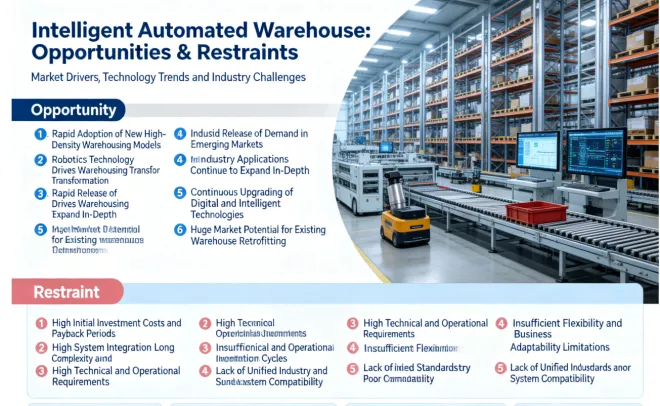
Restraint:
1. High Initial Investment Costs and Long Payback Periods
The construction of intelligent automated warehouses typically involves investments in automated equipment, software systems, and infrastructure upgrades, resulting in high overall capital expenditures. For SMEs, this represents a significant one-time investment burden. Furthermore, the payback period is generally between 3 and 7 years. In an uncertain market environment, businesses tend to be cautious in their decisions, suppressing some potential demand.
2. High System Integration Complexity and Long Implementation Cycles
Intelligent warehousing systems require deep integration with existing WMS, ERP, and production systems. Significant differences in business processes across industries lead to highly customized projects. System design, debugging, and deployment cycles are lengthy, and compatibility and stability issues may arise during implementation, increasing project risk and management complexity.
3. High Technical and Operational Requirements
Automated warehousing systems rely on the coordinated operation of software and hardware, placing high demands on a company's IT capabilities and operational expertise. System failures can disrupt overall logistics and even cause production interruptions. In addition, the high costs of training and maintaining professional technical personnel also hinder widespread adoption.
4. Insufficient Flexibility and Business Adaptability Limitations
Traditional stacker crane-based automated warehouses (AS/RS) have a relatively fixed structure, making expansion and modification difficult and hindering their ability to quickly adapt to changes in SKU structure or business fluctuations. For highly volatile industries such as e-commerce, this rigid structure limits the system's applicability to some extent, putting it at a disadvantage compared to more flexible robotic warehousing systems.
5. Lack of Unified Industry Standards and Poor System Compatibility
The current intelligent warehousing industry lacks unified technical standards. Significant differences exist between different vendors in hardware interfaces and software protocols, resulting in poor system compatibility. Customers face high switching costs when selecting suppliers, which also limits the openness and scalability of the industry ecosystem.
Opportunity:
1. Rapid Adoption of New High-Density Warehousing Models
New solutions, such as "goods-to-person" and cubic warehousing systems, significantly improve storage density and picking efficiency, making them particularly suitable for high-frequency scenarios like e-commerce and small-item warehousing. Compared to traditional automated warehouses (AS/RS), these systems offer advantages in flexibility and scalability, leading to rapid market demand growth and becoming a significant growth driver for the industry.
2. Robotics Technology Drives Warehousing Transformation
The maturity of mobile robot technologies such as AGVs/AMRs has enabled the transformation of warehousing systems from fixed automation to flexible automation. These systems have short deployment cycles, high adaptability, and can be applied to the renovation of existing warehouses, lowering the automation threshold for enterprises and becoming an important supplement or even replacement for traditional AS/RS systems.
3. Rapid Release of Demand in Emerging Markets
The rapid development of e-commerce and manufacturing in Asia, Latin America, and the Middle East is continuously increasing the demand for modern logistics infrastructure. As automation levels gradually improve in these regions, the market potential for intelligent automated warehouses is vast, providing opportunities for companies with cost and delivery advantages to expand into international markets.
4. Industry Applications Continue to Expand In-Depth
Smart warehousing is extending from traditional manufacturing and e-commerce sectors to high-value-added industries such as cold chain logistics, pharmaceuticals, semiconductors, and new energy. These sectors have higher requirements for warehousing precision, environmental control, and system stability, creating new growth opportunities for high-end automation solutions.
5. Continuous Upgrading of Digital and Intelligent Technologies
Artificial intelligence, big data, and digital twin technologies are reshaping warehouse management models, enabling intelligent inventory forecasting, route optimization, and equipment scheduling. Through data-driven operational optimization, enterprises can further improve efficiency and resource utilization, driving smart warehousing to a higher level.
6. Huge Market Potential for Existing Warehouse Retrofitting
Many traditional warehouses face problems of low efficiency and high reliance on manual labor, leading to a continuous release of demand for upgrades and retrofits. Modular automated equipment and robotic systems can achieve performance improvements without large-scale reconstruction, making the existing warehouse market one of the important sources of future growth.
Intelligent Automated Warehouses Report Chapter Summary:
Chapter 1: Intelligent Automated Warehouses Industry Definition and Market Overview
This chapter clearly defines the product definition, characteristics, and industry statistical scope of Intelligent Automated Warehouses, systematically introduces its mainstream product classifications and key application areas, and presents the overall size and future outlook of the global market.
Chapter 2: In-depth Analysis of Core Intelligent Automated Warehouses Companies (2021-2025)
This chapter focuses on the main players in the Intelligent Automated Warehouses market. For each representative company, it not only introduces its basic overview, main business, and product portfolio, but also highlights its core operating data in the Intelligent Automated Warehouses field, including sales volume, sales revenue, pricing strategies, and the latest development trends of the company from 2021 to 2025.
Chapter 3: Global Competitive Landscape Analysis (2021-2025)
This chapter examines the global Intelligent Automated Warehouses competitive landscape from a macro perspective. By comparing the Intelligent Automated Warehouses sales volume, pricing, revenue, and market share of major companies from 2021 to 2025, it quantitatively analyzes market concentration and interprets the competitive strategies and market position evolution of core manufacturers.
Chapter 4: Intelligent Automated Warehouses Major Regional Market Size and Prospects (2021-2032)
This chapter conducts a regional-level analysis of the global Intelligent Automated Warehouses core markets. It will present historical data on the Intelligent Automated Warehouses market size (sales volume and revenue from 2021-2025) in major regions such as North America, Europe, and Asia Pacific, and provide market outlook forecasts for 2026-2032.
Chapter 5: Intelligent Automated Warehouses Product Type Segmentation Market Forecast (2021-2032)
This chapter delves into the Intelligent Automated Warehouses product structure. It will segment the Intelligent Automated Warehouses market by different types (such as Unit Load、Mini Load, etc.), and analyze in detail the historical market size of each segmented product category from 2021 to 2025 and the future growth trends from 2026 to 2032.
Chapter 6: Intelligent Automated Warehouses Application Field Segmentation Market Forecast (2021-2032)
This chapter delves into the downstream application demand for Intelligent Automated Warehouses. The market will be segmented by different application areas (such as Manufacturing Enterprise Self-use Warehousing、Socialized Logistics Warehousing, etc.), presenting the historical market size for each area from 2021-2025 and future demand forecasts from 2026-2032.
Chapters 7-11: In-depth Analysis of Global Regional Markets (2021-2032)
This section is the core module of the Intelligent Automated Warehouses report, providing an in-depth country/regional analysis across five major regions: North America, Europe, Asia Pacific, South America, and the Middle East & Africa. The chapter structure for each region is consistent:
Segmentation by Country/Region: Analysis of the market size and forecasts for major countries within the region from 2021-2032.
Segmentation by Product Type: Presentation of the market structure and development forecasts for different product types within the region from 2021-2032.
Segmentation by Application Area: Analysis of market demand and prospects for different application areas within the region from 2021-2032.
Chapter 12: Global Intelligent Automated Warehouses Market Dynamics, Challenges, and Trends
This chapter aims to analyze the key internal and external factors affecting the development of the Intelligent Automated Warehouses market. It systematically reviews the core drivers of Intelligent Automated Warehouses market growth, the main obstacles and challenges faced, and assesses future product, technology, and market development trends.
Chapter 13: Intelligent Automated Warehouses Industry Chain Structure Analysis
This chapter analyzes the entire industry chain ecosystem of the Intelligent Automated Warehouses industry. From upstream raw material supply to midstream production and manufacturing, and then to downstream end-use applications, it analyzes the current status, cost structure, and collaborative relationships of each link.
Chapter 14: Sales Channel Model Research
This chapter focuses on the distribution channels of Intelligent Automated Warehouses products. It analyzes the market share, advantages and disadvantages, and typical cases of mainstream sales channels, and explores the innovation and development trends of channel models.
Chapter 15: Research Conclusions and Strategic Recommendations
As a summary of the report, this chapter will distill the core findings and conclusions of the entire report and, based on a comprehensive understanding of the Intelligent Automated Warehouses market, provide actionable strategic development recommendations for industry participants and potential entrants.
For more information, please refer to "Global Intelligent Automated Warehouses Market 2026 by Manufacturers, Regions, Type and Application, Forecast to 2032". This report analyzes the supply and demand situation, development status, and changes in the industry, focusing on the development status of the industry, how to face the development challenges of the industry, industry development suggestions, industry competitiveness, and industry investment analysis and trend forecasts. The report also summarizes the overall development dynamics of the industry, including the impact of the latest US tariffs on the global supply chain, the supply relationship analysis of the industrial chain, and provides reference suggestions and specific solutions for the industry in terms of products.
Previous News:
Home Decoration Adhesive Market 2026: A 3.4% CAGR Points to a USD 1,563 Million Opportunity by 2032 as Renovation Demand and Green Product Upgrades Accelerate
Next News:
Global Governed Enterprise Architecture Scenario Sandbox Market Is Projected to Reach USD 1,963 Million by 2032, Expanding at a 15.3% CAGR During the 2026–2032 Forecast Period
The copyright of this article belongs to Global Info Research. Without the written authorization of our company, no organization or individual may reprint, quote, copy, adapt or use it for commercial purposes in any way. When authorized to use, the original source must be indicated as "Global Info Research" and the complete copyright information must be retained.
- We Provide Professional, Accurate Market Analysis to Help You Stay Ahead of Your Competition.Speak to our analyst >>

Our Clients
What We Can Provide?
With better results and higher quality products,Our professional reports can achieve four things:

Insight into the industry market information

Analyze market development needs

Prospects for future development

Develop industry investment strategy
- Digging deeper into global industry information and providing market strategies.Contact Us >>
- We Provide Professional, Accurate Market Analysis to Help You Stay Ahead of Your Competition.Speak to our analyst >>
Our Clients
What We Can Provide?
With better results and higher quality products,Our professional reports can achieve four things:
Insight into the industry market information
Analyze market development needs
Prospects for future development
Develop industry investment strategy
- Digging deeper into global industry information and providing market strategies.Contact Us >>