
Global Reinforced Elastic Bandage Market Report 2026: Industry Value Is Set to Climb from USD 1,067 Million in 2026 to USD 1,485 Million by 2032, Delivering a 5.7% CAGR Throughout the Forecast Period
Published Date: Monday,16 Nov,2026


Reinforced Elastic Bandage Product Schematic
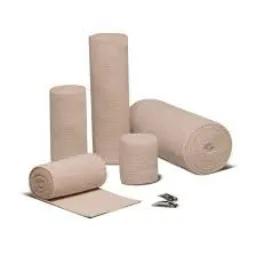
Reinforced elastic bandages are woven or knitted medical bandages designed to provide stable support, controlled compression and secure dressing fixation. Compared with ordinary gauze bandages, they use elastic yarns, reinforced fibers or blended structures to improve tensile strength, rebound performance and conformability around joints and irregular body contours. The product is widely used in wound care, orthopedic support, sports injury management, rehabilitation and post-operative protection. Its core function is not only to hold dressings in place, but also to reduce swelling, support soft tissue, limit excessive movement and improve patient comfort during recovery. Product performance is usually evaluated by elasticity, extensibility, compression retention, breathability, skin friendliness, washing durability, edge stability and ease of application. In market research scope, reinforced elastic bandages include reusable and disposable medical-grade elastic support bandages sold to hospitals, clinics, pharmacies, first-aid suppliers, sports medicine channels and home healthcare users for clinical and consumer care settings globally.
Global Reinforced Elastic Bandage Market Size (US$ Million), 2021-2032
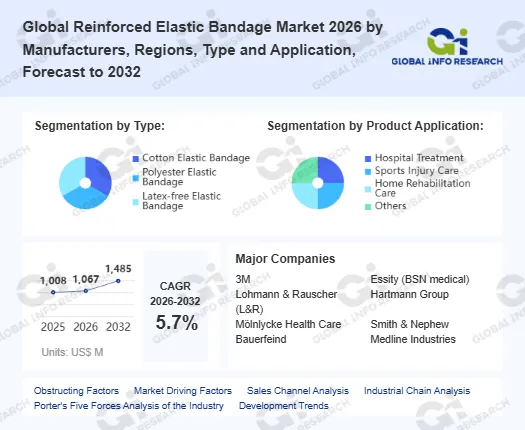
According to the latest report "Global Reinforced Elastic Bandage Market 2026 by Manufacturers, Regions, Type and Application, Forecast to 2032"published by GIR (Global Info Research), the global Reinforced Elastic Bandage market was valued at approximately USD 1008 million in 2025 and is projected to reach USD 1067 million in 2026. With a CAGR of 5.7% during the forecast period from 2026 to 2032, the market is expected to further expand to approximately USD 1485 million by 2032. This growth is driven by increasing market demand, evolving industry trends, and expanding application opportunities worldwide.
Figure00001. Global Reinforced Elastic Bandage Top 10 Players Ranking and Market Share
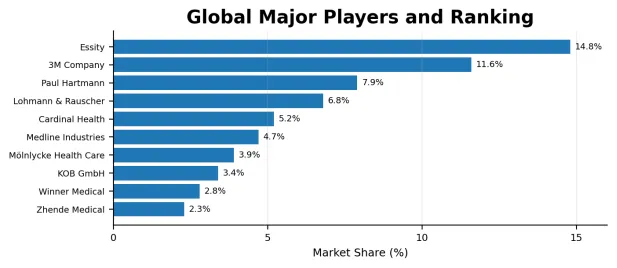
In 2026, the global top 10 players revenue share was approximately 63.4%.
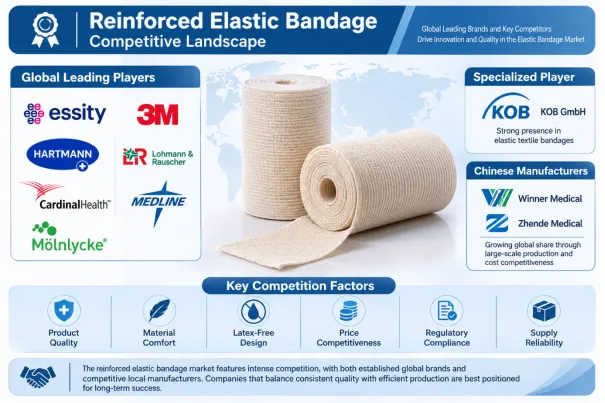
Competitive Landscape
The reinforced elastic bandage market is led by established global medical consumables and wound care companies, including Essity, 3M, Paul Hartmann, Lohmann & Rauscher, Cardinal Health, Medline Industries and Mölnlycke Health Care. These companies benefit from broad hospital channels, trusted clinical brands, mature quality systems and diversified product portfolios covering wound care, compression therapy and orthopedic support. KOB GmbH maintains a strong position in elastic textile bandages, while Chinese manufacturers such as Winner Medical and Zhende Medical are gaining share through large-scale production, cost competitiveness, OEM supply capabilities and expanding international distribution. Competition is mainly concentrated around product consistency, material comfort, latex-free design, packaging formats, sterilization options, tender pricing and supply reliability. Because reinforced elastic bandages are relatively standardized consumables, brand reputation and channel access are important differentiators, but procurement decisions also depend heavily on price, compliance documentation and stable delivery capacity. Long-term competitiveness depends on balancing quality assurance with efficient mass production.
Main Type
Main types of reinforced elastic bandages can be segmented by material structure, fixation method and usage scenario. By structure, the market includes woven elastic bandages, knitted elastic bandages and reinforced composite elastic bandages. Woven products usually provide stronger support and better compression control, while knitted products are softer, more breathable and easier to conform to body contours. By fixation method, products include clip-fixed bandages, self-closure bandages, cohesive elastic bandages and adhesive elastic bandages. Cohesive and self-closure formats are increasingly preferred in sports medicine and outpatient use because they reduce the need for separate fasteners and improve application convenience. By usage scenario, the market can be divided into medical compression bandages, orthopedic support bandages, first-aid bandages and sports protection bandages. Hospitals and rehabilitation institutions often prefer products with stable compression and regulatory documentation, while retail and homecare channels also emphasize comfort, ease of use, package convenience, affordability and simple daily handling.
Regional Perspective
From a regional perspective, North America and Europe remain high-value markets for reinforced elastic bandages because healthcare institutions have mature procurement systems, strict quality requirements and strong demand for branded wound care and orthopedic consumables. The United States has large hospital, outpatient, sports medicine and retail pharmacy channels, while Europe benefits from aging populations, rehabilitation demand and established medical textile suppliers. Asia-Pacific is the fastest-growing region, supported by rising healthcare expenditure, broader insurance coverage, hospital capacity expansion and stronger domestic production in China and India. China is both an important manufacturing base and a growing end market, with local companies improving product quality and overseas certification. Japan and South Korea maintain stable demand through advanced healthcare systems and aging demographics. Emerging markets in Latin America, the Middle East and Southeast Asia are more price-sensitive, but their demand continues to expand with basic healthcare access and trauma care infrastructure development steadily.
Industry Chain
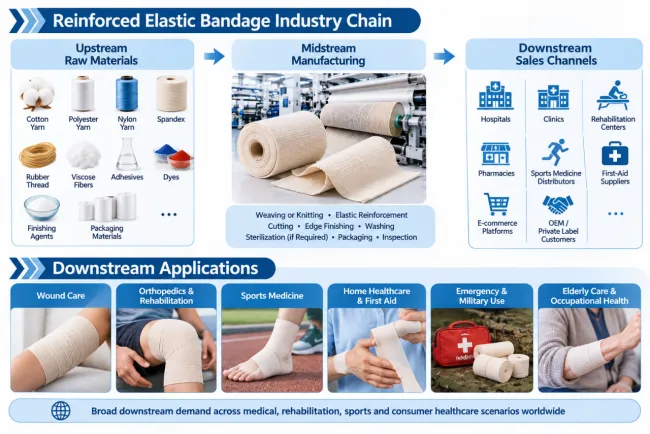
The reinforced elastic bandage industry chain begins with upstream textile and chemical materials, including cotton yarn, polyester yarn, nylon yarn, spandex, rubber thread, viscose fibers, adhesives, dyes, finishing agents and packaging materials. Material quality directly affects elasticity, compression retention, skin comfort, durability and regulatory compliance. Midstream manufacturers are responsible for weaving or knitting, elastic reinforcement, cutting, edge finishing, washing, sterilization if required, packaging, inspection and quality management. Some large companies operate integrated production systems, while others combine in-house design and brand management with outsourced manufacturing. Downstream sales channels include hospitals, clinics, rehabilitation centers, pharmacies, sports medicine distributors, first-aid suppliers, e-commerce platforms and OEM/private-label customers. The value chain is relatively mature, but differentiation is created through medical certification, automated textile processing, consistent compression performance, reliable global supply, brand reputation and access to institutional procurement networks. Strong supplier control helps ensure stable quality, cost control, export compliance and delivery reliability for buyers.
Downstream Applications
Downstream applications of reinforced elastic bandages are broad and closely linked to wound care, orthopedics, rehabilitation and sports medicine. In hospitals and clinics, they are used for dressing fixation, post-operative support, edema control, limb wrapping and temporary immobilization after minor injuries. Orthopedic departments and rehabilitation centers use them to provide joint support and soft-tissue compression for sprains, strains, tendon injuries and recovery after casting or surgery. Sports medicine is another important application area, where reinforced elastic bandages are used for ankle, knee, wrist and elbow support during training or competition. Retail pharmacies and home healthcare channels also generate stable demand because consumers use these bandages for first aid, chronic swelling, mild injuries and daily protection. Emergency kits, military medical supplies, elderly care facilities and occupational health programs further expand the application base. Demand is therefore supported by both professional medical use and recurring consumer healthcare needs worldwide across major regions.
Reinforced Elastic Bandage Report Chapter Summary:
Chapter 1: Reinforced Elastic Bandage Industry Definition and Market Overview
This chapter clearly defines the product definition, characteristics, and industry statistical scope of Reinforced Elastic Bandage, systematically introduces its mainstream product classifications and key application areas, and presents the overall size and future outlook of the global market.
Chapter 2: In-depth Analysis of Core Reinforced Elastic Bandage Companies (2021-2025)
This chapter focuses on the main players in the Reinforced Elastic Bandage market. For each representative company, it not only introduces its basic overview, main business, and product portfolio, but also highlights its core operating data in the Reinforced Elastic Bandage field, including sales volume, sales revenue, pricing strategies, and the latest development trends of the company from 2021 to 2025.
Chapter 3: Global Competitive Landscape Analysis (2021-2025)
This chapter examines the global Reinforced Elastic Bandage competitive landscape from a macro perspective. By comparing the Reinforced Elastic Bandage sales volume, pricing, revenue, and market share of major companies from 2021 to 2025, it quantitatively analyzes market concentration and interprets the competitive strategies and market position evolution of core manufacturers.
Chapter 4: Reinforced Elastic Bandage Major Regional Market Size and Prospects (2021-2032)
This chapter conducts a regional-level analysis of the global Reinforced Elastic Bandage core markets. It will present historical data on the Reinforced Elastic Bandage market size (sales volume and revenue from 2021-2025) in major regions such as North America, Europe, and Asia Pacific, and provide market outlook forecasts for 2026-2032.
Chapter 5: Reinforced Elastic Bandage Product Type Segmentation Market Forecast (2021-2032)
This chapter delves into the Reinforced Elastic Bandage product structure. It will segment the Reinforced Elastic Bandage market by different types (such as Cotton Elastic Bandage、Polyester Elastic Bandage、Latex-free Elastic Bandage, etc.), and analyze in detail the historical market size of each segmented product category from 2021 to 2025 and the future growth trends from 2026 to 2032.
Chapter 6: Reinforced Elastic Bandage Application Field Segmentation Market Forecast (2021-2032)
This chapter delves into the downstream application demand for Reinforced Elastic Bandage. The market will be segmented by different application areas (such as Hospital Treatment、Sports Injury Care、Home Rehabilitation Care、Others, etc.), presenting the historical market size for each area from 2021-2025 and future demand forecasts from 2026-2032.
Chapters 7-11: In-depth Analysis of Global Regional Markets (2021-2032)
This section is the core module of the Reinforced Elastic Bandage report, providing an in-depth country/regional analysis across five major regions: North America, Europe, Asia Pacific, South America, and the Middle East & Africa. The chapter structure for each region is consistent:
Segmentation by Country/Region: Analysis of the market size and forecasts for major countries within the region from 2021-2032.
Segmentation by Product Type: Presentation of the market structure and development forecasts for different product types within the region from 2021-2032.
Segmentation by Application Area: Analysis of market demand and prospects for different application areas within the region from 2021-2032.
Chapter 12: Global Reinforced Elastic Bandage Market Dynamics, Challenges, and Trends
This chapter aims to analyze the key internal and external factors affecting the development of the Reinforced Elastic Bandage market. It systematically reviews the core drivers of Reinforced Elastic Bandage market growth, the main obstacles and challenges faced, and assesses future product, technology, and market development trends.
Chapter 13: Reinforced Elastic Bandage Industry Chain Structure Analysis
This chapter analyzes the entire industry chain ecosystem of the Reinforced Elastic Bandage industry. From upstream raw material supply to midstream production and manufacturing, and then to downstream end-use applications, it analyzes the current status, cost structure, and collaborative relationships of each link.
Chapter 14: Sales Channel Model Research
This chapter focuses on the distribution channels of Reinforced Elastic Bandage products. It analyzes the market share, advantages and disadvantages, and typical cases of mainstream sales channels, and explores the innovation and development trends of channel models.
Chapter 15: Research Conclusions and Strategic Recommendations
As a summary of the report, this chapter will distill the core findings and conclusions of the entire report and, based on a comprehensive understanding of the Reinforced Elastic Bandage market, provide actionable strategic development recommendations for industry participants and potential entrants.
For more information, please refer to "Global Reinforced Elastic Bandage Market 2026 by Manufacturers, Regions, Type and Application, Forecast to 2032". This report analyzes the supply and demand situation, development status, and changes in the industry, focusing on the development status of the industry, how to face the development challenges of the industry, industry development suggestions, industry competitiveness, and industry investment analysis and trend forecasts. The report also summarizes the overall development dynamics of the industry, including the impact of the latest US tariffs on the global supply chain, the supply relationship analysis of the industrial chain, and provides reference suggestions and specific solutions for the industry in terms of products.
Previous News:
L2 Ethernet Switches Market 2026: A 5.0% CAGR Points to a USD 2,962 Million Opportunity by 2032 as Industrial Automation and PoE Access Demand Accelerate
Next News:
Drum Floor Sander Rental Market 2026: A 2.9% CAGR Points to a USD 547 Million Opportunity by 2032 as Aging Building Stock and Hardwood Refinishing Demand Sustain Rental Adoption
The copyright of this article belongs to Global Info Research. Without the written authorization of our company, no organization or individual may reprint, quote, copy, adapt or use it for commercial purposes in any way. When authorized to use, the original source must be indicated as "Global Info Research" and the complete copyright information must be retained.
- We Provide Professional, Accurate Market Analysis to Help You Stay Ahead of Your Competition.Speak to our analyst >>

Our Clients
What We Can Provide?
With better results and higher quality products,Our professional reports can achieve four things:

Insight into the industry market information

Analyze market development needs

Prospects for future development

Develop industry investment strategy
- Digging deeper into global industry information and providing market strategies.Contact Us >>
- We Provide Professional, Accurate Market Analysis to Help You Stay Ahead of Your Competition.Speak to our analyst >>
Our Clients
What We Can Provide?
With better results and higher quality products,Our professional reports can achieve four things:
Insight into the industry market information
Analyze market development needs
Prospects for future development
Develop industry investment strategy
- Digging deeper into global industry information and providing market strategies.Contact Us >>