
2026 Permalloy Foil Outlook: 8.1% CAGR Forecast as Ultra-Thin Foil, Stable Annealing and Magnetic Shielding Upgrades Push the Market Toward USD 527 Million by 2032
Published Date: Friday,20 Nov,2026



Permalloy Foil is typically based on nickel-iron alloy systems, including Ni80Fe20, 1J79, 1J85, Mu-metal type alloys and Mo/Cu-modified grades. Its core value lies not in structural strength, but in high initial permeability, high maximum permeability, low coercivity, low remanence, strong magnetic shielding performance and high processing precision. Compared with conventional Fe-Ni strips, silicon steel, amorphous/nanocrystalline ribbons, stainless steel foil and electroplated nickel layers, Permalloy Foil is more suitable for space-constrained systems, high magnetic sensitivity, low-frequency magnetic shielding and thin-form-factor applications.
From 2021 to 2025, market growth was mainly driven by consumer electronics, industrial sensors, precision instruments, medical devices and automotive electronics. From 2026 to 2032, the market is expected to maintain steady growth, but the growth will increasingly depend on high-end application qualification, thinner foil capability, stable supply of ultra-thin foil, magnetic performance consistency after annealing and shorter customer validation cycles. This market should be understood as a professional segment of “high-precision soft magnetic functional materials plus customer-specific qualification,” rather than a bulk metal materials market.
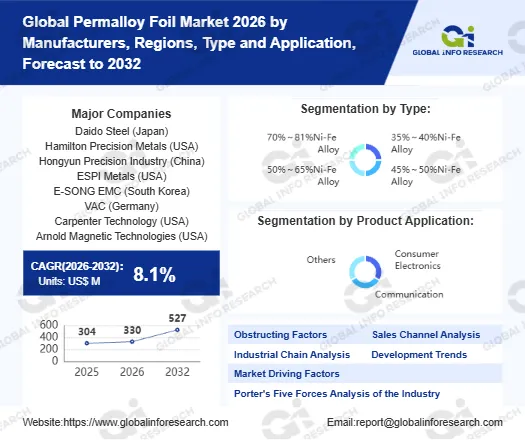
According to the latest report "Global Permalloy Foil Market 2026 by Manufacturers, Regions, Type and Application, Forecast to 2032" published by GIR (Global Info Research), the global Permalloy Foil market was valued at approximately USD 304 million in 2025 and is projected to reach USD 330 million in 2026. With a CAGR of 8.1% during the forecast period from 2026 to 2032, the market is expected to further expand to approximately USD 527 million by 2032. This growth is driven by increasing market demand, evolving industry trends, and expanding application opportunities worldwide.
Product Structure: Ultra-Thin Gauge, Tight Tolerance and Heat Treatment State Define Product Value
Permalloy Foil can be segmented by thickness, alloy grade, magnetic performance grade, delivery form and processing state. Thickness is the most intuitive segmentation approach, including ultra-thin foil, thin foil, medium-thickness foil and precision strip. Ultra-thin foil is typically used in miniature sensors, MEMS magnetic components, flexible magnetic shielding sheets and precision electronic components, while medium-thickness foil is used in magnetic shielding cans, transformer shielding layers, relays, magnetic core laminations and industrial instruments.
In terms of alloy grades, high-nickel Permalloy remains the core platform. Ni80Fe20 type materials emphasize high permeability and low coercivity, while Mo/Cu-modified grades are often used in higher shielding performance, lower hysteresis loss or stronger stability requirements. Delivery states may include cold-rolled, soft, half-hard, annealed, slit coils, sheets, etched parts, stamped parts and laminated structures. For downstream customers, purchasing value is not determined by thickness alone, but by thickness tolerance, surface quality, flatness, edge burr control, post-annealing magnetic performance, batch consistency and forming compatibility.
Applications: Magnetic Shielding Forms the Base, while Sensors and High-Reliability Electronics Open Incremental Growth
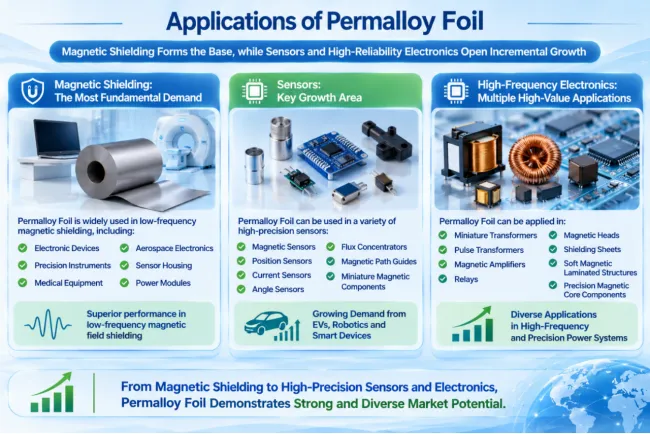
Magnetic shielding remains the most fundamental and stable demand source for Permalloy Foil. Applications include low-frequency magnetic shielding in electronic devices, shielding for precision instruments, magnetic interference control in medical equipment, aerospace electronics shielding, sensor housing shielding and localized shielding in power modules. Unlike conventional conductive shielding materials that mainly address high-frequency electromagnetic interference, Permalloy Foil has stronger value in low-frequency magnetic field shielding, high-sensitivity magnetic field protection and weak-signal stability.
Sensors represent a key mid- to long-term growth area. Permalloy Foil can be used in magnetic sensors, position sensors, current sensors, angle sensors, flux concentrators, magnetic path guides and miniature magnetic components. With the development of vehicle electrification, industrial automation, robotics, smart meters and medical monitoring equipment, demand for high-precision magnetic signal acquisition and anti-interference capability is expected to strengthen the material value of Permalloy Foil.
In high-frequency electronics and precision power systems, Permalloy Foil can be used in miniature transformers, pulse transformers, magnetic amplifiers, relays, magnetic heads, shielding sheets, soft magnetic laminated structures and precision magnetic core components. Future growth will not come from one single large-volume application, but from multiple high-value application niches.
Competitive Landscape: Barriers Lie in Melting, Cold Rolling, Annealing and Magnetic Consistency, Not Distribution Channels
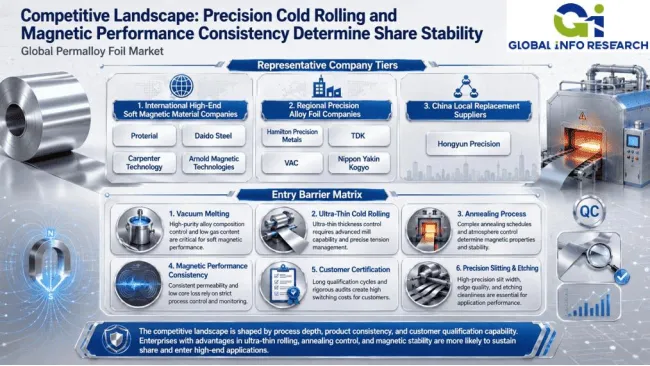
The Permalloy Foil market usually features a layered competitive structure consisting of a small group of high-end material companies, regional precision foil producers and customized processors. International suppliers tend to have advantages in high-purity melting, precision cold rolling, ultra-thin foil stability, heat treatment technology and qualification for aerospace, medical and high-reliability electronics. Chinese suppliers are improving in customized processing, cost response, delivery speed and local electronics supply chain support.
The main barriers are not distribution channels, but material formulation, vacuum melting, inclusion control, cold rolling deformation paths, annealing atmosphere, magnetic performance recovery, ultra-thin foil flatness, slitting edge quality and customer qualification cycles. For products used in weak magnetic measurement, precision sensors and aerospace electronics, suppliers must prove long-term batch consistency rather than only sample-level capability.
Regional Landscape: Asia Pacific Contributes the Largest Incremental Demand, while Europe, North America and Japan Maintain High-End Materials and Qualification Platforms
Asia Pacific is expected to contribute the largest incremental demand for Permalloy Foil, driven by electronics manufacturing, automotive electronics, industrial automation, sensors and communication equipment in China, Japan, South Korea and Southeast Asia. China’s demand is supported by consumer electronics, industrial control, EV electronics, smart meters and sensor supply chain upgrading. Japan and South Korea have strong foundations in precision electronics, materials engineering, sensors and high-reliability components.
Europe emphasizes high-end industry, automotive electronics, medical equipment, aerospace and precision instruments, with strict requirements for material qualification, traceability and magnetic performance stability. North America is closely linked to aerospace, defense electronics, medical instruments, scientific equipment and high-end industrial sensors. Although its volume may not be the largest, unit price and customization requirements are typically high.
Opportunities and Challenges: Electromagnetic System Upgrades Are Clear, but Cost, Qualification and Substitute Materials Limit Scaling Speed
Future opportunities first come from magnetic shielding upgrades. As devices become smaller, power density increases and sensor sensitivity improves, conventional conductive shielding materials cannot fully solve low-frequency magnetic interference. High-permeability Permalloy Foil will become more valuable. Second, automotive electronics, robotics, industrial automation and smart meters will drive demand for magnetic sensors, current sensors and miniature electromagnetic components. Third, medical equipment, aerospace and scientific instruments require low-noise and highly stable magnetic environments, supporting the continued adoption of high-end Permalloy Foil.
Constraints mainly come from cost and substitute routes. Permalloy Foil has high nickel content, making its price sensitive to nickel price fluctuations. Ultra-thin cold rolling and heat treatment are complex, and yield plus batch consistency directly affect cost. Meanwhile, silicon steel, amorphous alloys, nanocrystalline alloys, ferrites, soft magnetic composites, copper/aluminum conductive shielding and structural optimization solutions may coexist or substitute in different applications. For new entrants, the key difficulty is not producing metal foil, but producing functional soft magnetic foil that consistently meets magnetic performance, dimensional tolerance, surface quality and customer qualification requirements.

Opportunities:
Upgrading magnetic shielding requirements.
Growth in automotive electronics and sensors.
High-end demand from medical, aerospace and scientific instruments.
Ultra-thin and customized processing lifts ASP.
Localization and regional supply chain security.
Challenges:
Nickel price fluctuations.
High yield requirements in ultra-thin rolling and annealing.
Long customer qualification cycles.
Long-term coexistence of substitute materials.
Difficult batch consistency validation in high-end applications.
Conclusion: From Magnetic Shielding Functional Material to a Key Material for High-Reliability Electromagnetic Systems
The global Permalloy Foil market is evolving from a material used in traditional magnetic shielding and precision electromagnetic components toward applications in high-sensitivity sensors, automotive electronics, medical and scientific equipment, aerospace and high-reliability industrial electronics. Its growth is not based on broad substitution of common metal foils, but on magnetic performance, thickness tolerance, annealing process, processing precision, customer qualification and terminal system performance upgrades.
In the short term, magnetic shielding, precision transformers, relays and traditional industrial instruments remain stable demand sources. In the medium term, ultra-thin foil, sensor flux concentration materials, automotive electronics and medical equipment adoption should be monitored. In the long term, market value will depend on material indispensability in high-reliability electromagnetic systems, cost control and batch consistency breakthroughs. Suppliers with high-purity melting, precision cold rolling, stable annealing, ultra-thin foil processing and deep customer collaboration capabilities are more likely to capture future incremental value.
Permalloy Foil Report Chapter Summary:
Chapter 1: Permalloy Foil Industry Definition and Market Overview
This chapter clearly defines the product definition, characteristics, and industry statistical scope of Permalloy Foil, systematically introduces its mainstream product classifications and key application areas, and presents the overall size and future outlook of the global market.
Chapter 2: In-depth Analysis of Core Permalloy Foil Companies (2021-2025)
This chapter focuses on the main players in the Permalloy Foil market. For each representative company, it not only introduces its basic overview, main business, and product portfolio, but also highlights its core operating data in the Permalloy Foil field, including sales volume, sales revenue, pricing strategies, and the latest development trends of the company from 2021 to 2025.
Chapter 3: Global Competitive Landscape Analysis (2021-2025)
This chapter examines the global Permalloy Foil competitive landscape from a macro perspective. By comparing the Permalloy Foil sales volume, pricing, revenue, and market share of major companies from 2021 to 2025, it quantitatively analyzes market concentration and interprets the competitive strategies and market position evolution of core manufacturers.
Chapter 4: Permalloy Foil Major Regional Market Size and Prospects (2021-2032)
This chapter conducts a regional-level analysis of the global Permalloy Foil core markets. It will present historical data on the Permalloy Foil market size (sales volume and revenue from 2021-2025) in major regions such as North America, Europe, and Asia Pacific, and provide market outlook forecasts for 2026-2032.
Chapter 5: Permalloy Foil Product Type Segmentation Market Forecast (2021-2032)
This chapter delves into the Permalloy Foil product structure. It will segment the Permalloy Foil market by different types (such as 35%~40%Ni-Fe Alloy、45%~50%Ni-Fe Alloy、50%~65%Ni-Fe Alloy、70%~81%Ni-Fe Alloy, etc.), and analyze in detail the historical market size of each segmented product category from 2021 to 2025 and the future growth trends from 2026 to 2032.
Chapter 6: Permalloy Foil Application Field Segmentation Market Forecast (2021-2032)
This chapter delves into the downstream application demand for Permalloy Foil. The market will be segmented by different application areas (such as Consumer Electronics、Communication、Others, etc.), presenting the historical market size for each area from 2021-2025 and future demand forecasts from 2026-2032.
Chapters 7-11: In-depth Analysis of Global Regional Markets (2021-2032)
This section is the core module of the Permalloy Foil report, providing an in-depth country/regional analysis across five major regions: North America, Europe, Asia Pacific, South America, and the Middle East & Africa. The chapter structure for each region is consistent:
Segmentation by Country/Region: Analysis of the market size and forecasts for major countries within the region from 2021-2032.
Segmentation by Product Type: Presentation of the market structure and development forecasts for different product types within the region from 2021-2032.
Segmentation by Application Area: Analysis of market demand and prospects for different application areas within the region from 2021-2032.
Chapter 12: Global Permalloy Foil Market Dynamics, Challenges, and Trends
This chapter aims to analyze the key internal and external factors affecting the development of the Permalloy Foil market. It systematically reviews the core drivers of Permalloy Foil market growth, the main obstacles and challenges faced, and assesses future product, technology, and market development trends.
Chapter 13: Permalloy Foil Industry Chain Structure Analysis
This chapter analyzes the entire industry chain ecosystem of the Permalloy Foil industry. From upstream raw material supply to midstream production and manufacturing, and then to downstream end-use applications, it analyzes the current status, cost structure, and collaborative relationships of each link.
Chapter 14: Sales Channel Model Research
This chapter focuses on the distribution channels of Permalloy Foil products. It analyzes the market share, advantages and disadvantages, and typical cases of mainstream sales channels, and explores the innovation and development trends of channel models.
Chapter 15: Research Conclusions and Strategic Recommendations
As a summary of the report, this chapter will distill the core findings and conclusions of the entire report and, based on a comprehensive understanding of the Permalloy Foil market, provide actionable strategic development recommendations for industry participants and potential entrants.
For more information, please refer to "Global Permalloy Foil Market 2026 by Manufacturers, Regions, Type and Application, Forecast to 2032". This report analyzes the supply and demand situation, development status, and changes in the industry, focusing on the development status of the industry, how to face the development challenges of the industry, industry development suggestions, industry competitiveness, and industry investment analysis and trend forecasts. The report also summarizes the overall development dynamics of the industry, including the impact of the latest US tariffs on the global supply chain, the supply relationship analysis of the industrial chain, and provides reference suggestions and specific solutions for the industry in terms of products.
Previous News:
Rice Grading Machine Market 2026: A 3.8% CAGR Points to a USD 978 Million Opportunity by 2032 as Rice Mills Modernize and Export Quality Standards Tighten
Next News:
Global Vapor Deposition Silicon Carbon Material Market Is Projected to Reach USD 2,188 Million by 2032, Expanding at a 10.4% CAGR During the 2026–2032 Forecast Period
The copyright of this article belongs to Global Info Research. Without the written authorization of our company, no organization or individual may reprint, quote, copy, adapt or use it for commercial purposes in any way. When authorized to use, the original source must be indicated as "Global Info Research" and the complete copyright information must be retained.
- We Provide Professional, Accurate Market Analysis to Help You Stay Ahead of Your Competition.Speak to our analyst >>

Our Clients
What We Can Provide?
With better results and higher quality products,Our professional reports can achieve four things:

Insight into the industry market information

Analyze market development needs

Prospects for future development

Develop industry investment strategy
- Digging deeper into global industry information and providing market strategies.Contact Us >>
- We Provide Professional, Accurate Market Analysis to Help You Stay Ahead of Your Competition.Speak to our analyst >>
Our Clients
What We Can Provide?
With better results and higher quality products,Our professional reports can achieve four things:
Insight into the industry market information
Analyze market development needs
Prospects for future development
Develop industry investment strategy
- Digging deeper into global industry information and providing market strategies.Contact Us >>