
Non-ferrous Metal Recycling Solutions Market 2026: An 8.0% CAGR Points to a USD 88,271 Million Opportunity by 2032 as Carbon Goals and Green Metal Demand Accelerate
Published Date: Friday,20 Nov,2026


 Non-ferrous Metal Recycling Solutions
1. Non-ferrous Metal Recycling Solutions Market Summary
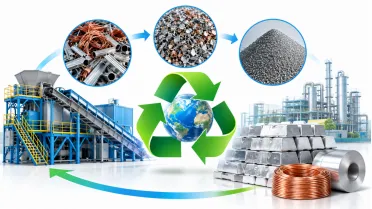
Non-ferrous metal recycling solutions refer to comprehensive technologies and services that minimize resource waste and reduce environmental pollution through the recycling, processing, and reuse of scrap non-ferrous metals. These solutions involve multiple stages, including the collection, sorting, smelting, refining, and reprocessing of scrap metals, aiming to transform waste metal materials into reusable raw materials, thereby achieving a circular economy and sustainable development. With increasingly scarce resources and stringent environmental policies, non-ferrous metal recycling has become a vital industry globally, playing a crucial role, particularly in sectors such as electronic waste, automotive, construction, and packaging.
Global Non-ferrous Metal Recycling Solutions Market Revenue Growth Rate, 2021-2032
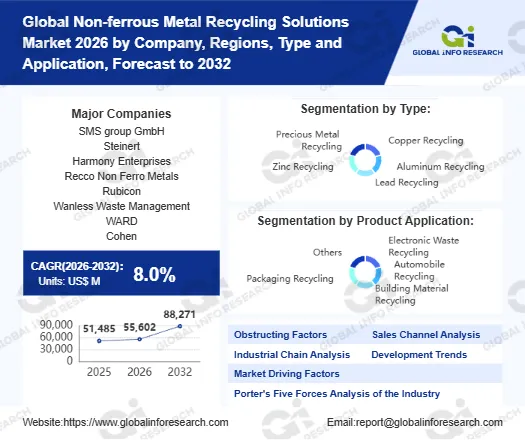
According to the latest report "Global Non-ferrous Metal Recycling Solutions Market 2026 by Manufacturers, Regions, Type and Application, Forecast to 2032" published by GIR (Global Info Research), the global Non-ferrous Metal Recycling Solutions market was valued at approximately USD 51485 million in 2025 and is projected to reach USD 55602 million in 2026. With a CAGR of 8.0% during the forecast period from 2026 to 2032, the market is expected to further expand to approximately USD 88271 million by 2032. This growth is driven by increasing market demand, evolving industry trends, and expanding application opportunities worldwide.
2 Introduction of Major Manufacturers of Non-ferrous Metal Recycling Solutions
|
Serial Number |
Company |
|
1 |
SMS group GmbH |
|
2 |
Steinert |
|
3 |
Harmony Enterprises |
|
4 |
Recco Non Ferro Metals |
|
5 |
Rubicon |
|
6 |
Wanless Waste Management |
|
7 |
WARD |
|
8 |
Cohen |
|
9 |
Jansen Recycling Group |
|
10 |
JLM Metal Recycling & Auto Parts |
|
11 |
Moffatt Scrap Iron & Metal |
|
12 |
GLR Advanced Recycling |
|
13 |
Ferrous Processing & Trading |
|
14 |
Fortum |
According to a survey by Global Info Research's Leading Enterprise Research Center, global Non-ferrous Metal Recycling Solutions manufacturers include SMS group GmbH, Steinert, Harmony Enterprises, Recco Non Ferro Metals, Rubicon, etc. By 2025, the top five global manufacturers will hold approximately 26% of the market share.
Introduction to Key Companies
Company 1
|
Description |
|
|
Company Introduction |
SMS group GmbH is a leading global industrial engineering company specializing in metal processing equipment and technology solutions, with particularly strong capabilities in the steel and non-ferrous metals industries. Through innovative technologies and equipment, the company provides efficient production and processing systems to global clients, helping them optimize production processes and improve product quality. SMS group's solutions cover multiple areas from metallurgy to automation, committed to driving sustainable development and green production. The company boasts a strong global service network, ensuring client success in various markets. |
|
Product Introduction |
SMS group GmbH offers advanced non-ferrous metal recycling solutions, dedicated to improving recycling efficiency and quality. Its technologies include efficient smelting, sorting, and refining processes that maximize recovery rates and reduce environmental impact. The company employs innovative equipment and intelligent technologies to ensure the efficient extraction and reuse of non-ferrous metals. SMS group's recycling systems are suitable for various non-ferrous metals, including aluminum and copper, helping companies achieve resource recycling, reduce production costs, and comply with increasingly stringent environmental standards. |
Company 2
|
Description |
|
|
Company Introduction |
Steinert is a leading global company specializing in material sorting and recycling technologies, providing innovative solutions for non-ferrous metal recycling, waste treatment, and mineral sorting. The company utilizes advanced magnetic separation, X-ray sorting, and spectroscopy technologies to provide efficient and precise sorting and recycling equipment for clients across various industries. Steinert's products are widely used in the mining, recycling, and waste management sectors, helping clients improve resource utilization and optimize production processes. The company is committed to promoting sustainable development and developing environmentally friendly and energy-saving technological solutions. |
|
Product Introduction |
Steiner's non-ferrous metal recycling solutions utilize advanced material sorting technologies to help clients efficiently recycle non-ferrous metals. Through technologies such as magnetic separation, X-ray sorting, and laser sorting, Steinert's equipment can accurately extract precious metals such as copper, aluminum, and nickel from waste. These solutions not only improve recycling efficiency but also ensure the extraction of high-quality metals, meeting stringent environmental requirements. Steinert's systems help clients reduce waste disposal costs and achieve resource recycling, thereby promoting a green economy and sustainable development. |
Company 3
|
Description |
|
|
Company Introduction |
Harmony Enterprises is a company specializing in providing waste treatment and recycling equipment, committed to innovation and sustainable development. The company provides clients with a diverse range of waste compression and recycling solutions, with particular expertise in non-ferrous metal recycling and waste management. Harmony Enterprises helps businesses achieve efficient waste recycling, reduce operating costs, and improve resource utilization through its advanced technologies. The company serves a wide range of industries, including waste treatment, recycling, waste management, and environmental protection, driving global circular economy and environmental protection goals. |
|
Product Introduction |
Harmony Enterprises' non-ferrous metal recycling solutions offer efficient waste compression and sorting technologies to help businesses recover precious metals such as aluminum, copper, and steel. Through its innovative waste compression and recycling equipment, Harmony helps customers reduce waste volume and increase metal recovery rates. Its product designs prioritize energy efficiency and environmental protection, ensuring minimal environmental impact during processing. Through intelligent and automated technologies, Harmony Enterprises' solutions make non-ferrous metal recycling more efficient, economical, and environmentally compliant, helping businesses achieve their sustainability goals. |
3 Non-ferrous Metal Recycling Solutions Industry Chain Analysis
|
Industry Chain |
Description |
|
Upstream |
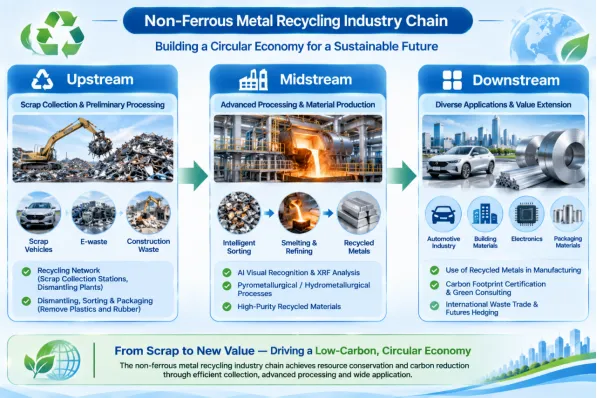
The upstream of the non-ferrous metal recycling industry chain mainly includes a scrap metal recycling network, dismantling and sorting enterprises, and the collection of social and industrial waste. The recycling network encompasses scrap recycling stations, auto dismantling plants, electronic waste processing companies, and building demolition companies, responsible for collecting waste containing non-ferrous metals such as copper, aluminum, lead, and zinc from scrapped vehicles, waste electronic products, construction waste, and industrial scrap. The upstream segment also involves preliminary manual or mechanical dismantling, sorting, and packaging to remove impurities such as plastics and rubber, providing raw materials for downstream processing. The coverage density, sorting accuracy, and logistics efficiency of the recycling network directly determine the raw material supply capacity of the entire industry chain and are the starting point for industry operation. |
|
Midstream |
The midstream of the industry chain is the core processing stage of metal recycling, including intelligent sorting, pyrometallurgical or hydrometallurgical processes, refining and purification, and the production of recycled materials. Modern sorting plants employ advanced technologies such as AI visual recognition, X-ray fluorescence spectroscopy, and eddy current separation to accurately separate mixed waste into different categories of pure metal components. Smelting enterprises transform waste metals into standard products such as recycled copper, recycled aluminum, and recycled lead through processes like smelting and electrolysis. Some high-end production lines can also produce high-quality materials such as aerospace-grade recycled aluminum alloys and electronic-grade recycled copper. The technological level of the midstream segment determines the metal recovery rate, product purity, and energy consumption and environmental protection indicators, making it the core of value creation in the industrial chain. |
|
Downstream |
The downstream of the industrial chain covers various application scenarios for recycled metals and a service system derived from the circular economy. Major users include processing companies in industries such as automobile manufacturing, building materials, electronics, and packaging materials, which use recycled copper and aluminum to produce end products such as parts, profiles, and cables. Driven by dual carbon targets, more and more brands are committing to using green recycled materials, and the downstream market is shifting from price-oriented to low-carbon value-oriented. Furthermore, the downstream has extended to professional services such as recycled metal carbon footprint certification, green supply chain consulting, international waste trade, and futures hedging, forming a complete circular economy industrial ecosystem. |
4 Non-ferrous Metal Recycling Solutions Industry Development Trends, Opportunities, Obstacles and Industry Barriers
Development Trends:
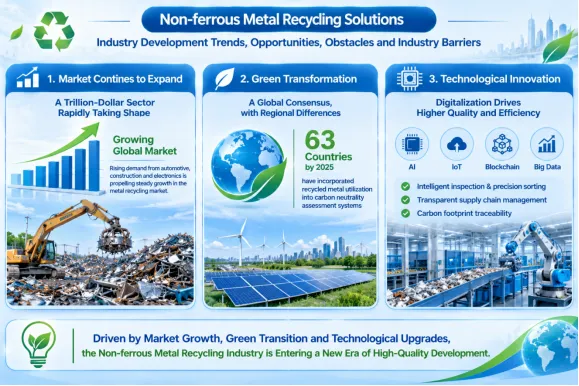
1. The market continues to expand, with a trillion-dollar sector rapidly taking shape. The global metal recycling market is experiencing steady growth. This expansion is mainly due to increasing awareness of the depletion of metal reserves and the continued rise in demand for recycled metals from end-use industries such as automotive, construction, and electronics. Recycling, as a process of dual importance to industry and the environment, is evolving from a peripheral supplement to a mainstream supply model.
2. Green transformation has become a global consensus, with significant regional differences in development paths. Against the backdrop of global carbon reduction, recycled metals have become a key resource for the steel and non-ferrous metals industries. By 2025, 63 countries worldwide had incorporated recycled metal utilization into their carbon neutrality assessment systems. However, there are significant differences between developing and developed countries in terms of resource endowment, policy systems, and technological capabilities. Resource-sufficient countries are actively investing in new technologies, while resource-importing countries face import dependence and the risk of overcapacity. Regional differentiation is reshaping the global industrial landscape.
3. Technological innovation and digitalization are empowering industries to improve quality and efficiency. Intelligent inspection, standardized quality control, and low-carbon process innovation have become common choices for the industry to address challenges. The integration of technologies such as artificial intelligence, machine learning, the Internet of Things, and blockchain is optimizing recycling processes, improving compliance, enhancing inventory management, and increasing decision-making accuracy. Digital tools are driving supply chain transparency, providing strong support for carbon footprint traceability and green certification, and the industry is undergoing a comprehensive upgrade from traditional manual sorting to intelligent precision recycling.
Development Opportunities:
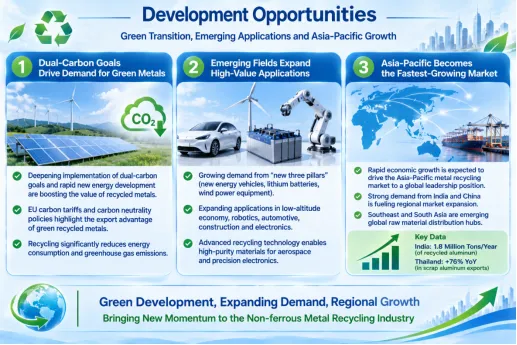
1. Dual-carbon goals drive essential demand for green metals. Driven by the deepening implementation of dual-carbon goals and the rapid development of the new energy industry, the resource security value and low-carbon emission reduction attributes of recycled metals are becoming increasingly prominent. The implementation of EU carbon tariffs and carbon neutrality policies in various countries makes green recycled metals a significant advantage in export trade. Recycling can significantly reduce energy consumption, greenhouse gas emissions, and minimize the extraction of new resources, making it a more sustainable option.
2. Emerging fields expand high-value applications. The application scenarios for recycled metals in emerging fields such as the "new three pillars" (new energy equipment, lithium batteries, and wind power equipment), the low-altitude economy, and robotics are constantly expanding. Strong demand for recycled metals from industries such as automotive, construction, electronics, and packaging confirms their cost-effectiveness and superior performance. Advances in recycling technology have improved the purity of these materials, enabling recycled metals to directly enter high-end manufacturing fields such as aerospace and precision electronics, driving the industry's transformation from simple "quantity increase" to high-quality "quality improvement."
3. Asia Pacific becomes the fastest-growing emerging market. Due to accelerating economic growth, the Asia Pacific region is expected to become the world's largest and fastest-growing metal recycling market. The increasing demand for metals from emerging countries such as India and China is strongly boosting market development in the region. Southeast Asia and South Asia, leveraging their geographical advantages, have become emerging global raw material distribution markets. India imports an average of 1.8 million tons of recycled aluminum raw materials annually, while Thailand's scrap aluminum exports have surged by 76% year-on-year.
Hindering Factors:
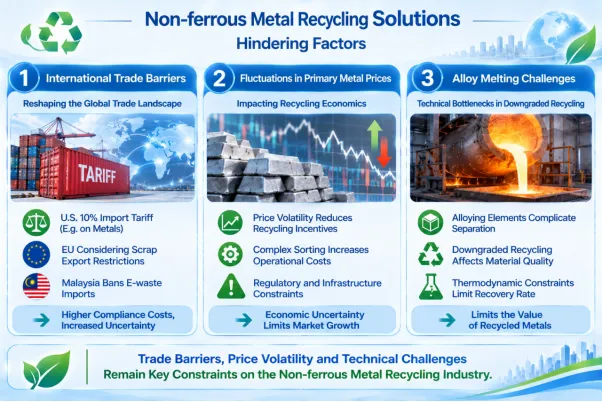
1. International trade barriers are reshaping the global trade landscape. The global recycled metals market is experiencing unprecedented regulatory volatility in 2026. The US has implemented a 10% comprehensive import tariff, the EU is considering restricting scrap exports, and Malaysia has imposed an absolute ban on e-waste imports. These policies are reshaping traditional scrap trade flows, leading to increased compliance costs, blocked arbitrage opportunities, and a highly uncertain international trade environment for market participants. Traditional aluminum scrap trade flows are being completely reshaped.
2. Fluctuations in primary metal prices impact recycling economics. One of the main limiting factors affecting the global recycled metals market is the volatility of raw material metal prices, which leads to fluctuations in recycling operations. When primary metal market prices fall, the economic incentive for recycling decreases, forcing recyclers to reduce processing volumes or lower profit margins. The complex sorting and processing of mixed metals further increases operational difficulty and costs, and regulatory barriers and insufficient recycling infrastructure in some regions exacerbate these challenges.
3. Alloy melting leads to technical bottlenecks in downgraded recycling. While chemically stable metals such as copper can be recycled without loss of quality, steel and aluminum are often alloyed with elements that are difficult to separate, leading to downgraded recycling and quality degradation. Aluminum recycling faces alloy-related limitations, requiring precise separation by alloy type to maintain material quality. Without fine sorting, recycled output is often downgraded, limiting its usability and market value. These thermodynamic and technological constraints are compounded by other structural limitations.
Barriers:
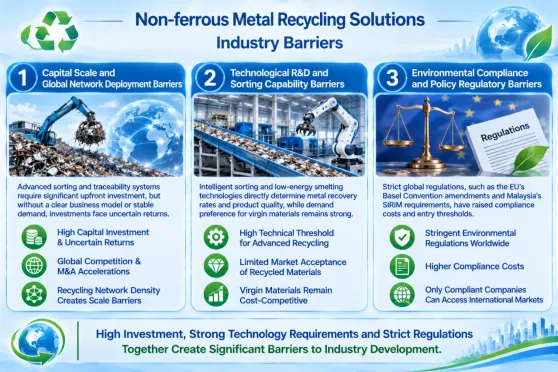
1. Capital Scale and Global Network Deployment Barriers: Advanced sorting and traceability systems require upfront investment, but in the absence of a clear business model, stable demand, or effective incentives, these investments struggle to yield reasonable returns. In uncertain markets, companies are reluctant to shift resources away from established production methods. International giants are accelerating mergers and acquisitions to compete for high-quality raw material resources, leading to a restructuring of the global recycled metal raw material trade landscape. The density of the recycling network directly impacts raw material acquisition capabilities, creating natural capital and scale barriers.
2. Technological R&D and Sorting Capability Barriers: The application level of technologies such as intelligent sorting and low-energy smelting directly determines metal recovery rates and product quality stability. Even if secondary processes are technically feasible, demand structures often still reinforce the use of virgin materials. The application of recycled materials is limited by insufficient buyer interest, high dismantling costs, and unstable supply quality. Virgin materials are typically cheaper, of guaranteed quality, and supported by long-term procurement practices, limiting the market coverage of recycled alternatives.
3. Environmental Compliance and Policy Regulatory Barriers: Governments worldwide have implemented strict regulations to curb illegal mining and the exploitation of metal reserves. While these measures have positively impacted industry growth, they have also significantly raised compliance thresholds. The EU's Basel Convention amendments have imposed strict controls on the trade of electronic waste resources, and Malaysia has extremely stringent requirements for the SIRIM purity of imported waste. High compliance costs exclude non-compliant companies, and only those with robust environmental systems and compliance capabilities can establish themselves in the international market.
Non-ferrous Metal Recycling Solutions Report Chapter Summary:
Chapter 1: Non-ferrous Metal Recycling Solutions Industry Definition and Market Overview
This chapter clearly defines the product definition, characteristics, and industry statistical scope of Non-ferrous Metal Recycling Solutions, systematically introduces its mainstream product classifications and key application areas, and presents the overall size and future outlook of the global market.
Chapter 2: In-depth Analysis of Core Non-ferrous Metal Recycling Solutions Companies (2021-2025)
This chapter focuses on the main players in the Non-ferrous Metal Recycling Solutions market. For each representative company, it not only introduces its basic overview, main business, and product portfolio, but also highlights its core operating data in the Non-ferrous Metal Recycling Solutions field, including sales volume, sales revenue, pricing strategies, and the latest development trends of the company from 2021 to 2025.
Chapter 3: Global Competitive Landscape Analysis (2021-2025)
This chapter examines the global Non-ferrous Metal Recycling Solutions competitive landscape from a macro perspective. By comparing the Non-ferrous Metal Recycling Solutions sales volume, pricing, revenue, and market share of major companies from 2021 to 2025, it quantitatively analyzes market concentration and interprets the competitive strategies and market position evolution of core manufacturers.
Chapter 4: Non-ferrous Metal Recycling Solutions Major Regional Market Size and Prospects (2021-2032)
This chapter conducts a regional-level analysis of the global Non-ferrous Metal Recycling Solutions core markets. It will present historical data on the Non-ferrous Metal Recycling Solutions market size (sales volume and revenue from 2021-2025) in major regions such as North America, Europe, and Asia Pacific, and provide market outlook forecasts for 2026-2032.
Chapter 5: Non-ferrous Metal Recycling Solutions Product Type Segmentation Market Forecast (2021-2032)
This chapter delves into the Non-ferrous Metal Recycling Solutions product structure. It will segment the Non-ferrous Metal Recycling Solutions market by different types (such as Copper Recycling、Aluminum Recycling、Lead Recycling、Zinc Recycling、Precious Metal Recycling, etc.), and analyze in detail the historical market size of each segmented product category from 2021 to 2025 and the future growth trends from 2026 to 2032.
Chapter 6: Non-ferrous Metal Recycling Solutions Application Field Segmentation Market Forecast (2021-2032)
This chapter delves into the downstream application demand for Non-ferrous Metal Recycling Solutions. The market will be segmented by different application areas (such as Electronic Waste Recycling、Automobile Recycling、Building Material Recycling、Packaging Recycling、Others, etc.), presenting the historical market size for each area from 2021-2025 and future demand forecasts from 2026-2032.
Chapters 7-11: In-depth Analysis of Global Regional Markets (2021-2032)
This section is the core module of the Non-ferrous Metal Recycling Solutions report, providing an in-depth country/regional analysis across five major regions: North America, Europe, Asia Pacific, South America, and the Middle East & Africa. The chapter structure for each region is consistent:
Segmentation by Country/Region: Analysis of the market size and forecasts for major countries within the region from 2021-2032.
Segmentation by Product Type: Presentation of the market structure and development forecasts for different product types within the region from 2021-2032.
Segmentation by Application Area: Analysis of market demand and prospects for different application areas within the region from 2021-2032.
Chapter 12: Global Non-ferrous Metal Recycling Solutions Market Dynamics, Challenges, and Trends
This chapter aims to analyze the key internal and external factors affecting the development of the Non-ferrous Metal Recycling Solutions market. It systematically reviews the core drivers of Non-ferrous Metal Recycling Solutions market growth, the main obstacles and challenges faced, and assesses future product, technology, and market development trends.
Chapter 13: Non-ferrous Metal Recycling Solutions Industry Chain Structure Analysis
This chapter analyzes the entire industry chain ecosystem of the Non-ferrous Metal Recycling Solutions industry. From upstream raw material supply to midstream production and manufacturing, and then to downstream end-use applications, it analyzes the current status, cost structure, and collaborative relationships of each link.
Chapter 14: Sales Channel Model Research
This chapter focuses on the distribution channels of Non-ferrous Metal Recycling Solutions products. It analyzes the market share, advantages and disadvantages, and typical cases of mainstream sales channels, and explores the innovation and development trends of channel models.
Chapter 15: Research Conclusions and Strategic Recommendations
As a summary of the report, this chapter will distill the core findings and conclusions of the entire report and, based on a comprehensive understanding of the Non-ferrous Metal Recycling Solutions market, provide actionable strategic development recommendations for industry participants and potential entrants.
For more information, please refer to "Global Non-ferrous Metal Recycling Solutions Market 2026 by Manufacturers, Regions, Type and Application, Forecast to 2032". This report analyzes the supply and demand situation, development status, and changes in the industry, focusing on the development status of the industry, how to face the development challenges of the industry, industry development suggestions, industry competitiveness, and industry investment analysis and trend forecasts. The report also summarizes the overall development dynamics of the industry, including the impact of the latest US tariffs on the global supply chain, the supply relationship analysis of the industrial chain, and provides reference suggestions and specific solutions for the industry in terms of products.
Previous News:
Global Vapor Deposition Silicon Carbon Material Market Is Projected to Reach USD 2,188 Million by 2032, Expanding at a 10.4% CAGR During the 2026–2032 Forecast Period
Next News:
The copyright of this article belongs to Global Info Research. Without the written authorization of our company, no organization or individual may reprint, quote, copy, adapt or use it for commercial purposes in any way. When authorized to use, the original source must be indicated as "Global Info Research" and the complete copyright information must be retained.
- We Provide Professional, Accurate Market Analysis to Help You Stay Ahead of Your Competition.Speak to our analyst >>

Our Clients
What We Can Provide?
With better results and higher quality products,Our professional reports can achieve four things:

Insight into the industry market information

Analyze market development needs

Prospects for future development

Develop industry investment strategy
- Digging deeper into global industry information and providing market strategies.Contact Us >>
- We Provide Professional, Accurate Market Analysis to Help You Stay Ahead of Your Competition.Speak to our analyst >>
Our Clients
What We Can Provide?
With better results and higher quality products,Our professional reports can achieve four things:
Insight into the industry market information
Analyze market development needs
Prospects for future development
Develop industry investment strategy
- Digging deeper into global industry information and providing market strategies.Contact Us >>