
Reciprocating R290 Compressor Market 2026: An 8.0% CAGR Points to a USD 1,068 Million Opportunity by 2032 as F-Gas Rules Accelerate the Shift Away From R404A and R134a
Published Date: Tuesday,24 Nov,2026


1. Reciprocating R290 Compressor Market Summary
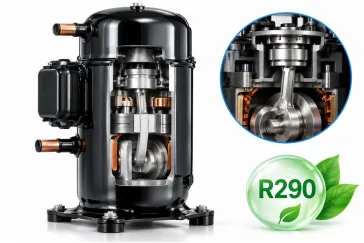
A reciprocating R290 compressor is a positive displacement refrigeration compressor that uses R290 (propane) as the refrigerant. It achieves gas intake, compression, and discharge through the periodic reciprocating motion of a piston within a cylinder. It is widely used in refrigerators, freezers, commercial cold chain equipment, air conditioning, and heat pump systems. These compressors typically employ a fully enclosed or semi-enclosed structure, using a crankshaft and connecting rod mechanism to drive the piston, compressing low-pressure refrigerant vapor, increasing its pressure and temperature, and then delivering it to the condenser to complete the refrigeration cycle. Due to R290's extremely low global warming potential (GWP≈3) and zero ozone depletion potential (ODP=0), reciprocating R290 compressors have become an important environmentally friendly technology route to replace high-GWP refrigerants such as R404A and R134a, and are gradually becoming more widespread in commercial refrigeration and home appliances.
Figure00001. Global Reciprocating R290 Compressor Market Revenue Growth Rate, 2021-2032
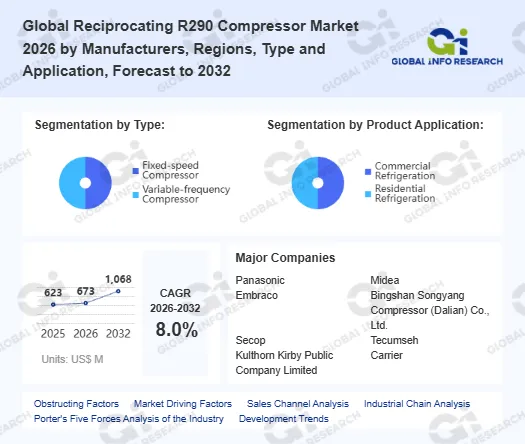
According to the latest report "Global Reciprocating R290 Compressor Market 2026 by Manufacturers, Regions, Type and Application, Forecast to 2032"published by GIR (Global Info Research), the global Reciprocating R290 Compressor market was valued at approximately USD 623 million in 2025 and is projected to reach USD 673 million in 2026. With a CAGR of 8.0% during the forecast period from 2026 to 2032, the market is expected to further expand to approximately USD 1068 million by 2032. This growth is driven by increasing market demand, evolving industry trends, and expanding application opportunities worldwide.
2 Introduction of Major Manufacturers of Reciprocating R290 Compressor
|
Serial Number |
Company |
|
1 |
Panasonic |
|
2 |
Midea |
|
3 |
Embraco |
|
4 |
Bingshan Songyang Compressor (Dalian) Co., Ltd. |
|
5 |
Secop |
|
6 |
Tecumseh |
|
7 |
Kulthorn Kirby Public Company Limited |
|
8 |
Carrier |
|
9 |
Bitzer |
|
10 |
Danfoss |
|
11 |
Frascold |
|
12 |
Samsung |
According to a survey by Global Info Research's Leading Enterprise Research Center, global Reciprocating R290 Compressor manufacturers include Panasonic, Midea, Embraco, Bingshan Songyang Compressor (Dalian) Co., Ltd., Secop, etc. By 2025, the top five global manufacturers will hold approximately 36% of the market share.
Introduction to Key Companies
Company 1
|
Description |
|
|
Company Introduction |
Panasonic is a large Japanese conglomerate specializing in electronics and home appliances, headquartered in Osaka. Its business encompasses home appliances, industrial equipment, energy solutions, and electronic components. In the refrigeration and HVAC sector, Panasonic possesses complete capabilities in compressors, motors, and system solutions, with products widely used in residential air conditioning, commercial refrigeration, and industrial equipment. The company has long focused on energy-saving and environmentally friendly technology development, possessing strong technological expertise in low-GWP refrigerant replacement and high-efficiency system design, making it one of the world's leading refrigeration system suppliers. |
Company 2
|
Description |
|
|
Company Introduction |
Midea Group is a leading Chinese global home appliance and HVAC company, headquartered in Foshan, Guangdong. Its business covers home appliances, HVAC, industrial automation, and intelligent manufacturing. In the refrigeration industry chain, Midea has built a complete capability from complete unit design and core components to system solutions, and has strengthened its global presence through acquisitions of companies such as Toshiba Home Appliances and KUKA Robotics. The company continuously invests in energy-saving and environmentally friendly refrigeration technologies and is one of the world's leading suppliers of air conditioning and cold chain equipment. |
Source: Third-party data, Global Info Research Research Team
Company 3
|
Description |
|
|
Company Introduction |
Embraco is a globally renowned manufacturer of refrigeration compressors, now part of the Japanese Nidec Group, headquartered in Brazil. It has long focused on the research and development and production of commercial and residential refrigeration compressors. The company holds a significant market share in the field of lightweight refrigeration compressors, and its products are widely used in equipment such as refrigerators, freezers, and beverage display cases. Embraco is renowned for its high energy efficiency, miniaturization, and low-noise technology, and is one of the world's leading suppliers of core components for cold chain equipment. |
3 Reciprocating R290 Compressor Industry Chain Analysis
|
Industry Chain |
Description |
|
Upstream |
The upstream of the global reciprocating R290 compressor industry mainly consists of a supply system of basic materials and key components, including motor materials, compressor housing steel, copper, aluminum, as well as lubricants, seals, and precision-machined parts. Core components include high-efficiency silicon steel sheets for the motor, low-leakage sealing systems, and explosion-proof electrical components adapted to the flammable properties of R290 (propane). Due to the flammability of R290, upstream materials must meet high safety standards, such as low-friction coatings, high-pressure resistant valve plate materials, and high-precision bearing systems. Simultaneously, refrigeration oils have extremely high compatibility requirements with R290. Major global upstream suppliers are concentrated in Japan, Germany, China, and the United States. Material performance directly determines the compressor's energy efficiency, safety, and lifespan, making it a fundamental link in the entire industry chain. |
|
Midstream |
The midstream is the core manufacturing stage of the reciprocating R290 compressor, including compressor design, precision machining, complete assembly, testing and verification, and performance optimization. Major global manufacturers, including Secop, Danfoss, and Embraco, have optimized reciprocating compressor structures to achieve low noise, high energy efficiency, and safe operation compatible with R290. This stage focuses on valve system design, piston movement precision control, and the efficiency of matching the motor and compression chamber, while also meeting EU F-gas regulations and IEC 60335-2-89 safety standards. High-pressure sealing tests, leak detection, and energy efficiency calibration are required during manufacturing to ensure stable operation in freezers, commercial refrigeration, and light-duty cold chain applications. Midstream companies typically hold core patents and are the technology and profit centers of the entire industry chain. |
|
Downstream |
Downstream applications primarily involve R290 reciprocating compressors in commercial refrigeration equipment, supermarket freezers, refrigerators, beverage display cases, small cold storage facilities, and some light-duty heat pump systems. Due to its low GWP, R290 is gradually replacing traditional refrigerants such as R404A and R134a, driven by global carbon neutrality and environmental regulations. Terminal equipment manufacturers such as Carrier, Haier, Midea, and Epta integrate compressors into complete systems and optimize the coefficient of performance (COP) through system design. Downstream market demand is significantly driven by policy, with Europe and China being the main growth regions, and North America gradually relaxing restrictions on R290 applications. Overall, downstream demand determines the rate of large-scale growth and replacement of R290 compressors, making it a key driving force for the green refrigeration transformation. |
4 Reciprocating R290 Compressor Industry Development Trends, Opportunities, Obstacles and Industry Barriers
Development Trends:
1. Low-carbon refrigeration replacement is accelerating as a major trend. The development of reciprocating R290 compressors globally is clearly driven by carbon neutrality policies, especially the accelerated implementation of the EU F-Gas regulations and the global HFC reduction agreement, leading to the gradual withdrawal of high-GWP refrigerants such as R404A and R134a from the market. R290, as a natural refrigerant, has extremely low global warming potential and excellent thermodynamic properties, driving its rapid penetration in the commercial refrigeration sector. Reciprocating compressors, due to their mature structure and lower cost, still occupy a significant share in the replacement path and are becoming an important direction for upgrading existing equipment.
2. High energy efficiency and variable frequency technology are becoming the direction of technological upgrades. The industry is evolving from traditional fixed-frequency reciprocating structures to high-efficiency variable frequency drive systems, achieving higher coefficient of performance (COP) by optimizing motor efficiency, valve design, and cylinder volume ratio. The natural thermodynamic advantages of R290 further amplify its energy-saving potential, making compressors perform better in light-duty cold chain equipment. Meanwhile, variable frequency control technology improves system partial load efficiency and reduces energy consumption fluctuations, giving OEMs a stronger competitive edge in the end-user market and driving product upgrades towards high-end products.
3. The global supply chain is evolving towards regionalization and localization. The reciprocating R290 compressor industry chain is gradually shifting from a globally centralized supply to a regional layout, with Europe, China, and Southeast Asia becoming major manufacturing bases. Because R290 involves flammability safety standards, different countries have different certification requirements, leading companies to favor a model combining local production and local certification. At the same time, geopolitical and supply chain security factors are also prompting OEMs and compressor manufacturers to establish closer regional partnerships, reducing the risks of intercontinental supply.
Development Opportunities:
1. Global environmental regulations present structural substitution opportunities. With the continuous strengthening of F-Gas regulations, the Kigali amendment, and carbon emission constraints in various countries, the market space for traditional HFC refrigerants is being continuously compressed. R290, as a natural working fluid, possesses inherent environmental advantages, providing a long-term replacement window for reciprocating R290 compressors in the commercial refrigeration sector. This policy-driven demand represents certain growth, independent of short-term economic cycles, and is the industry's core growth opportunity.
2. Continued growth in cold chain logistics and commercial refrigeration demand. The expansion of global food retail, cold chain logistics, and e-commerce instant delivery is driving a continuous increase in demand for small and medium-sized refrigeration equipment, such as freezers, refrigerators, and display cases. These are precisely the core application areas for reciprocating R290 compressors. As cold chain infrastructure improves in developing countries, the demand for new equipment combined with the replacement demand for existing equipment creates a dual growth curve, providing the industry with a long-term stable market space.
3. Expanding green energy and heat pump applications bring new scenarios. In addition to traditional refrigeration, R290 reciprocating compressors are gradually entering the fields of low-temperature heat pumps and residential heating systems, especially showing significant growth against the backdrop of Europe's energy transition. R290 exhibits excellent performance in high-efficiency heat pump systems, expanding its application from a single refrigeration component to a core component of multi-scenario energy equipment, further broadening its market potential and driving the industry's upgrade from "refrigeration equipment" to "energy system components."
Hindering Factors:
1. R290's flammability imposes strict safety limitations. As an A3-class flammable refrigerant, R290 must meet stringent safety regulations during application, including charge limits, explosion-proof design, and leakage control requirements. This directly limits its application in large commercial and centralized systems, while increasing the complexity of overall system design and certification costs, placing additional technical and compliance burdens on both compressor and system manufacturers.
2. Intense competition from alternative technologies. While R290 has significant environmental advantages, it still faces competition from CO2 (R744), R32, and new low-GWP refrigerants. CO2 offers greater safety advantages in large supermarket refrigeration systems, while R32 is more widely used in air conditioning, diverting R290's market share. The coexistence of different technologies leads to inconsistent market standards, weakening the centralized economies of scale effect of R290 reciprocating compressors.
3. High cost and system retrofit barriers. R290 systems require redesigning compressors, electrical controls, piping, and safety protection structures, making the overall cost higher than traditional HFC systems. Furthermore, end customers need to replace equipment or upgrade systems, which poses a high investment barrier for SMEs. In price-sensitive markets, this initial cost disadvantage slows down the replacement of R290 compressors.
Barriers:
1. Extremely high safety and certification barriers. R290 reciprocating compressors must pass multiple international safety certifications such as IEC, UL, and EN, while meeting explosion-proof, electrical isolation, and leakage control standards. Different countries have different restrictions on charge volume and usage scenarios, requiring companies to invest significant time and resources in certification. This high barrier makes it difficult for new entrants to quickly enter the market, forming a significant entry barrier.
2. Core compressor design and manufacturing technology barriers. Reciprocating compressors involve precision mechanical design, valve dynamics, motor efficiency optimization, and low-leakage structural design, while R290 operating conditions have even higher requirements for sealing and safety. Leading companies such as Secop and Danfoss have long-term technological accumulation and patent systems, making it difficult for new entrants to quickly catch up in terms of energy efficiency, noise, and reliability, forming a significant technological barrier.
3. Customer certification and supply chain binding barriers. The compressor industry has a very strong customer certification system, and OEMs typically require a multi-year verification period before introducing new suppliers. Once a supplier enters the supply chain, the replacement cost is extremely high. At the same time, leading companies have formed long-term partnerships with OEMs such as Midea, Haier, and Carrier, creating a stable supporting system that makes it difficult for new competitors to break through existing customer networks, thus forming a strong channel barrier.
Reciprocating R290 Compressor Report Chapter Summary:
Chapter 1: Reciprocating R290 Compressor Industry Definition and Market Overview
This chapter clearly defines the product definition, characteristics, and industry statistical scope of Reciprocating R290 Compressor, systematically introduces its mainstream product classifications and key application areas, and presents the overall size and future outlook of the global market.
Chapter 2: In-depth Analysis of Core Reciprocating R290 Compressor Companies (2021-2025)
This chapter focuses on the main players in the Reciprocating R290 Compressor market. For each representative company, it not only introduces its basic overview, main business, and product portfolio, but also highlights its core operating data in the Reciprocating R290 Compressor field, including sales volume, sales revenue, pricing strategies, and the latest development trends of the company from 2021 to 2025.
Chapter 3: Global Competitive Landscape Analysis (2021-2025)
This chapter examines the global Reciprocating R290 Compressor competitive landscape from a macro perspective. By comparing the Reciprocating R290 Compressor sales volume, pricing, revenue, and market share of major companies from 2021 to 2025, it quantitatively analyzes market concentration and interprets the competitive strategies and market position evolution of core manufacturers.
Chapter 4: Reciprocating R290 Compressor Major Regional Market Size and Prospects (2021-2032)
This chapter conducts a regional-level analysis of the global Reciprocating R290 Compressor core markets. It will present historical data on the Reciprocating R290 Compressor market size (sales volume and revenue from 2021-2025) in major regions such as North America, Europe, and Asia Pacific, and provide market outlook forecasts for 2026-2032.
Chapter 5: Reciprocating R290 Compressor Product Type Segmentation Market Forecast (2021-2032)
This chapter delves into the Reciprocating R290 Compressor product structure. It will segment the Reciprocating R290 Compressor market by different types (such as Fixed-speed Compressor、Variable-frequency Compressor, etc.), and analyze in detail the historical market size of each segmented product category from 2021 to 2025 and the future growth trends from 2026 to 2032.
Chapter 6: Reciprocating R290 Compressor Application Field Segmentation Market Forecast (2021-2032)
This chapter delves into the downstream application demand for Reciprocating R290 Compressor. The market will be segmented by different application areas (such as Commercial Refrigeration、Residential Refrigeration, etc.), presenting the historical market size for each area from 2021-2025 and future demand forecasts from 2026-2032.
Chapters 7-11: In-depth Analysis of Global Regional Markets (2021-2032)
This section is the core module of the Reciprocating R290 Compressor report, providing an in-depth country/regional analysis across five major regions: North America, Europe, Asia Pacific, South America, and the Middle East & Africa. The chapter structure for each region is consistent:
Segmentation by Country/Region: Analysis of the market size and forecasts for major countries within the region from 2021-2032.
Segmentation by Product Type: Presentation of the market structure and development forecasts for different product types within the region from 2021-2032.
Segmentation by Application Area: Analysis of market demand and prospects for different application areas within the region from 2021-2032.
Chapter 12: Global Reciprocating R290 Compressor Market Dynamics, Challenges, and Trends
This chapter aims to analyze the key internal and external factors affecting the development of the Reciprocating R290 Compressor market. It systematically reviews the core drivers of Reciprocating R290 Compressor market growth, the main obstacles and challenges faced, and assesses future product, technology, and market development trends.
Chapter 13: Reciprocating R290 Compressor Industry Chain Structure Analysis
This chapter analyzes the entire industry chain ecosystem of the Reciprocating R290 Compressor industry. From upstream raw material supply to midstream production and manufacturing, and then to downstream end-use applications, it analyzes the current status, cost structure, and collaborative relationships of each link.
Chapter 14: Sales Channel Model Research
This chapter focuses on the distribution channels of Reciprocating R290 Compressor products. It analyzes the market share, advantages and disadvantages, and typical cases of mainstream sales channels, and explores the innovation and development trends of channel models.
Chapter 15: Research Conclusions and Strategic Recommendations
As a summary of the report, this chapter will distill the core findings and conclusions of the entire report and, based on a comprehensive understanding of the Reciprocating R290 Compressor market, provide actionable strategic development recommendations for industry participants and potential entrants.
For more information, please refer to "Global Reciprocating R290 Compressor Market 2026 by Manufacturers, Regions, Type and Application, Forecast to 2032". This report analyzes the supply and demand situation, development status, and changes in the industry, focusing on the development status of the industry, how to face the development challenges of the industry, industry development suggestions, industry competitiveness, and industry investment analysis and trend forecasts. The report also summarizes the overall development dynamics of the industry, including the impact of the latest US tariffs on the global supply chain, the supply relationship analysis of the industrial chain, and provides reference suggestions and specific solutions for the industry in terms of products.
Previous News:
Cruise Ship Travel Services Market 2026: An 8.3% CAGR Points to a USD 97,968 Million Opportunity by 2032 as Premium and Themed Cruises Drive Higher Order Values
Next News:
Brake Pads Market 2026: A 2.4% CAGR Points to a USD 7,430 Million Opportunity by 2032 as Copper-Free Rules and EV-Specific Demand Reshape Product Mix
The copyright of this article belongs to Global Info Research. Without the written authorization of our company, no organization or individual may reprint, quote, copy, adapt or use it for commercial purposes in any way. When authorized to use, the original source must be indicated as "Global Info Research" and the complete copyright information must be retained.
- We Provide Professional, Accurate Market Analysis to Help You Stay Ahead of Your Competition.Speak to our analyst >>

Our Clients
What We Can Provide?
With better results and higher quality products,Our professional reports can achieve four things:

Insight into the industry market information

Analyze market development needs

Prospects for future development

Develop industry investment strategy
- Digging deeper into global industry information and providing market strategies.Contact Us >>
- We Provide Professional, Accurate Market Analysis to Help You Stay Ahead of Your Competition.Speak to our analyst >>
Our Clients
What We Can Provide?
With better results and higher quality products,Our professional reports can achieve four things:
Insight into the industry market information
Analyze market development needs
Prospects for future development
Develop industry investment strategy
- Digging deeper into global industry information and providing market strategies.Contact Us >>