
Brake Pads Market 2026: A 2.4% CAGR Points to a USD 7,430 Million Opportunity by 2032 as Copper-Free Rules and EV-Specific Demand Reshape Product Mix
Published Date: Tuesday,24 Nov,2026


Brake Pad Market Summary
Brake Pads are components of brake systems used in automotive and other applications. Brake pads are friction materials which bound to the surface that faces the brake rotor and take the brunt of the frictional force necessary to stop the car. In a disc brake system, the brake pedal activates a hydraulic line which squeezes the calipers against the rotors of the car's tires. Pads are positioned between the calipers and the rotors to absorb the energy and heat, and then provide enough grips to stop the car.
In this report, we only count brake pads, not brake shoes. The main difference between brake pads and brake shoes is: The brake shoes are a component of the drum brake system in a vehicle. They are made of a tough, heat-resistant material and are attached to the brake drum. Brake pads are a component of the disc brake system. They are the part that comes into contact with the brake rotor to slow or stop a vehicle.
Figure1. Global Automobile Brake Pad Market Size (US$ Million), 2026-2032
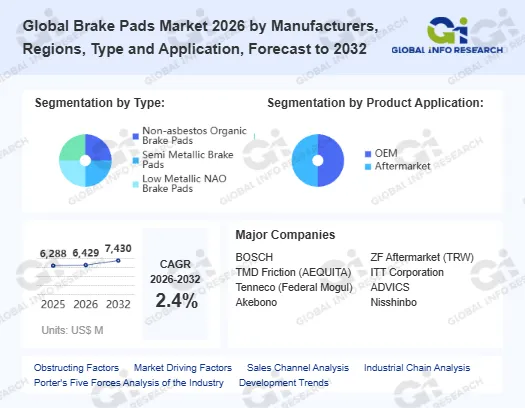
According to the latest "Global Brake Pads Market 2026 by Manufacturers, Regions, Type and Application, Forecast to 2032" research by GIR (Global Info Research), the global Brake Pads market was valued at USD 6288 million in 2025 and is expected to reach approximately USD 6429 million in 2026. The market is further projected to grow significantly to around USD 7430 million by 2032, registering a CAGR of 2.4% during the forecast period. This growth is driven by increasing market demand, technological advancements, and expanding application areas, highlighting strong growth potential and emerging opportunities for industry participants worldwide.
Figure2. Global Automobile Brake Pad Top 33 Players Ranking and Market Share (Ranking is based on the revenue of 2025, continually updated)
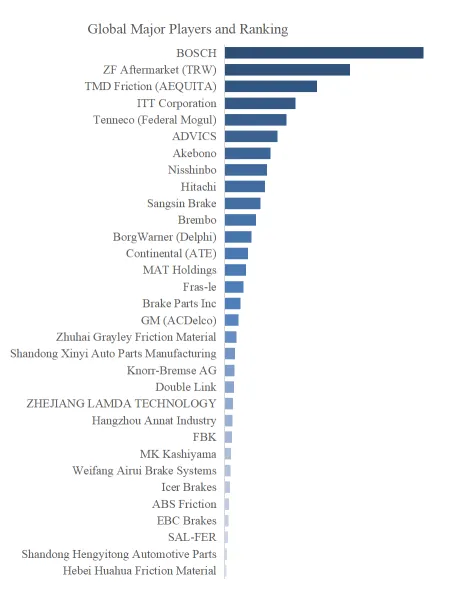
Table 1. Automobile Brake Pad Industry Chain Analysis
|
|
Item |
Description |
|
Upstream |
Raw Material Supply (Foundation of the Industry Chain) |
Friction Materials (60-80% of product cost) Backing Plates Auxiliary Materials |
|
Midstream |
Manufacturing & Processing (Core Value-Adding Link) |
The midstream segment involves converting raw materials into finished brake pads through standardized production processes. It is divided into original equipment (OE) production (supplied to automakers) and aftermarket (AM) production (supplied to repair/maintenance channels), with strict quality control requirements. |
|
Downstream |
Passenger Cars |
Lightweight, low-noise, and long-life pads are preferred (replacement cycle: 30,000-80,000 km). |
|
NEV-specific demand |
Brake pads for electric vehicles (EVs) require higher heat resistance (due to regenerative braking’s auxiliary effect) and lower dust emissions (aligning with NEV environmental positioning). |
|
|
Commercial Vehicles (Trucks, Buses) |
Demand high wear resistance and load-bearing capacity (replacement cycle: 10,000-30,000 km). Steel fiber-based pads are mainstream. |
|
|
Special Vehicles (Construction Vehicles, Racing Cars) |
Customized high-performance pads (e.g., carbon-ceramic pads for racing cars, with friction coefficient stable at 0.4-0.6). |
Table 2. Automobile Brake Pad Industry Policy Analysis
|
|
Policy |
Description |
|
1 |
EU |
ECE R90, REACH, Euro VI Performance testing (cold/high-speed/fade), heavy metal limits, low-dust Mandatory approval for replacement pads; pushes NAO/ceramic blends |
|
2 |
North America |
EPA Copper-Free Initiative, WA Better Brakes Law <0.5% Cu (2026); limits asbestos/Cr(VI)/Hg/Cd/Pb OEM/aftermarket rapid shift to low-copper/copper-free formulas |
|
3 |
China |
GB 5763-2018, NEV Development Plan Safety performance, green manufacturing, localization of key parts Accelerates domestic R&D of eco-friendly/lightweight pads |
|
4 |
Japan |
Emission Control Regulations Strict heavy metal cuts, nano/composite materials Drives high-performance, low-abrasion formulations |
Table 3. Automobile Brake Pad Industry Development Trends
|
|
Development Trends |
Description |
|
1 |
Material transition |
From semi-metallic/NAO to ceramic, low-copper/copper-free, and composite materials to cut dust, noise, and heavy metal emissions. |
|
2 |
EV/HEV specialization |
Heavier vehicle weight, regenerative braking (low steady wear but high emergency load) demand pads with high thermal stability, low NVH, and long service life. |
|
3 |
Smart & connected |
Wear sensors, temperature/pressure monitoring, and integration with ADAS/ brake-by-wire enable predictive maintenance and safety alerts. |
|
4 |
Channel mix |
Aftermarket remains a steady growth driver (fleet maintenance, consumer replacement); OEM focuses on high-performance and system-level integration. |
|
5 |
Lightweight & system integration |
Brake pads are designed alongside rotors, calipers, and regenerative systems to optimize overall braking efficiency and vehicle weight. |
Table 4. Automobile Brake Pad Industry Development Opportunities
|
|
Development Opportunities |
Description |
|
1 |
Eco-friendly formulations |
Copper-free, low-dust, and biodegradable friction materials gain regulatory and consumer preference; R&D into alternative fibers/resins is a high-margin path. |
|
2 |
EV/HEV niche |
Dedicated pads for passenger EVs, commercial EVs, and high-performance EVs (track/day use) offer premium pricing and long-term OEM partnerships. |
|
3 |
Smart brake pads |
Sensor integration, data analytics, and fleet maintenance platforms create recurring revenue from service and data subscriptions. |
|
4 |
Aftermarket expansion |
Emerging markets (India, Southeast Asia, Africa) have growing vehicle fleets; building local distribution, brand certification, and quick-fit networks drives volume. |
|
5 |
Commercial vehicle & fleet solutions |
Long-life, high-load pads for trucks, buses, and delivery fleets (with bulk supply contracts) ensure stable cash flow. |
|
6 |
System-level collaboration |
Partnering with brake system suppliers for brake-by-wire and autonomous vehicle braking systems to secure high-value OEM business. |
Table 5. Automobile Brake Pad Obstacles/Challenges to Industry Development
|
|
Obstacles/Challenges |
Description |
|
1 |
Regulatory burden |
Regional standards (ECE R90, US copper limits, China GB) require multi-market certification, R&D investment, and production line upgrades; non-compliance leads to market exclusion. |
|
2 |
Raw material volatility |
Steel, copper, resin, and friction additives have price fluctuations due to geopolitics and supply chain disruptions, squeezing margins. |
|
3 |
Regenerative braking impact |
In high EV adoption regions, reduced friction brake wear lowers replacement frequency, pressuring aftermarket volume; requires product differentiation and service diversification. |
|
4 |
Intense competition & pricing pressure |
A fragmented market with numerous regional and global players leads to price wars; small manufacturers struggle with R&D and certification costs. |
|
5 |
Counterfeit & low-quality products |
Aftermarket counterfeits pose safety risks, damage brand reputation, and undercut genuine product sales, especially in emerging markets. |
|
6 |
Supply chain & logistics |
Global logistics constraints, regional production localization requirements, and raw material shortages disrupt production and delivery schedules. |
Brake Pads Report Chapter Summary:
Chapter 1: Brake Pads Industry Definition and Market Overview
This chapter clearly defines the product definition, characteristics, and industry statistical scope of Brake Pads, systematically introduces its mainstream product classifications and key application areas, and presents the overall size and future outlook of the global market.
Chapter 2: In-depth Analysis of Core Brake Pads Companies (2021-2025)
This chapter focuses on the main players in the Brake Pads market. For each representative company, it not only introduces its basic overview, main business, and product portfolio, but also highlights its core operating data in the Brake Pads field, including sales volume, sales revenue, pricing strategies, and the latest development trends of the company from 2021 to 2025.
Chapter 3: Global Competitive Landscape Analysis (2021-2025)
This chapter examines the global Brake Pads competitive landscape from a macro perspective. By comparing the Brake Pads sales volume, pricing, revenue, and market share of major companies from 2021 to 2025, it quantitatively analyzes market concentration and interprets the competitive strategies and market position evolution of core manufacturers.
Chapter 4: Brake Pads Major Regional Market Size and Prospects (2021-2032)
This chapter conducts a regional-level analysis of the global Brake Pads core markets. It will present historical data on the Brake Pads market size (sales volume and revenue from 2021-2025) in major regions such as North America, Europe, and Asia Pacific, and provide market outlook forecasts for 2026-2032.
Chapter 5: Brake Pads Product Type Segmentation Market Forecast (2021-2032)
This chapter delves into the Brake Pads product structure. It will segment the Brake Pads market by different types (such as Non-asbestos Organic Brake Pads、Semi Metallic Brake Pads、Low Metallic NAO Brake Pads、Ceramic Brake Pads, etc.), and analyze in detail the historical market size of each segmented product category from 2021 to 2025 and the future growth trends from 2026 to 2032.
Chapter 6: Brake Pads Application Field Segmentation Market Forecast (2021-2032)
This chapter delves into the downstream application demand for Brake Pads. The market will be segmented by different application areas (such as OEM、Aftermarket, etc.), presenting the historical market size for each area from 2021-2025 and future demand forecasts from 2026-2032.
Chapters 7-11: In-depth Analysis of Global Regional Markets (2021-2032)
This section is the core module of the Brake Pads report, providing an in-depth country/regional analysis across five major regions: North America, Europe, Asia Pacific, South America, and the Middle East & Africa. The chapter structure for each region is consistent:
Segmentation by Country/Region: Analysis of the market size and forecasts for major countries within the region from 2021-2032.
Segmentation by Product Type: Presentation of the market structure and development forecasts for different product types within the region from 2021-2032.
Segmentation by Application Area: Analysis of market demand and prospects for different application areas within the region from 2021-2032.
Chapter 12: Global Brake Pads Market Dynamics, Challenges, and Trends
This chapter aims to analyze the key internal and external factors affecting the development of the Brake Pads market. It systematically reviews the core drivers of Brake Pads market growth, the main obstacles and challenges faced, and assesses future product, technology, and market development trends.
Chapter 13: Brake Pads Industry Chain Structure Analysis
This chapter analyzes the entire industry chain ecosystem of the Brake Pads industry. From upstream raw material supply to midstream production and manufacturing, and then to downstream end-use applications, it analyzes the current status, cost structure, and collaborative relationships of each link.
Chapter 14: Sales Channel Model Research
This chapter focuses on the distribution channels of Brake Pads products. It analyzes the market share, advantages and disadvantages, and typical cases of mainstream sales channels, and explores the innovation and development trends of channel models.
Chapter 15: Research Conclusions and Strategic Recommendations
As a summary of the report, this chapter will distill the core findings and conclusions of the entire report and, based on a comprehensive understanding of the Brake Pads market, provide actionable strategic development recommendations for industry participants and potential entrants.
For more information, please refer to "Global Brake Pads Market 2026 by Manufacturers, Regions, Type and Application, Forecast to 2032". This report analyzes the supply and demand situation, development status, and changes in the industry, focusing on the development status of the industry, how to face the development challenges of the industry, industry development suggestions, industry competitiveness, and industry investment analysis and trend forecasts. The report also summarizes the overall development dynamics of the industry, including the impact of the latest US tariffs on the global supply chain, the supply relationship analysis of the industrial chain, and provides reference suggestions and specific solutions for the industry in terms of products.
Previous News:
Reciprocating R290 Compressor Market 2026: An 8.0% CAGR Points to a USD 1,068 Million Opportunity by 2032 as F-Gas Rules Accelerate the Shift Away From R404A and R134a
Next News:
Disposable Stone Extraction Basket Market 2026: A 3.4% CAGR Points to a USD 407 Million Opportunity by 2032 as Ureteroscopy and Laser Lithotripsy Volumes Rise
The copyright of this article belongs to Global Info Research. Without the written authorization of our company, no organization or individual may reprint, quote, copy, adapt or use it for commercial purposes in any way. When authorized to use, the original source must be indicated as "Global Info Research" and the complete copyright information must be retained.
- We Provide Professional, Accurate Market Analysis to Help You Stay Ahead of Your Competition.Speak to our analyst >>

Our Clients
What We Can Provide?
With better results and higher quality products,Our professional reports can achieve four things:

Insight into the industry market information

Analyze market development needs

Prospects for future development

Develop industry investment strategy
- Digging deeper into global industry information and providing market strategies.Contact Us >>
- We Provide Professional, Accurate Market Analysis to Help You Stay Ahead of Your Competition.Speak to our analyst >>
Our Clients
What We Can Provide?
With better results and higher quality products,Our professional reports can achieve four things:
Insight into the industry market information
Analyze market development needs
Prospects for future development
Develop industry investment strategy
- Digging deeper into global industry information and providing market strategies.Contact Us >>