
Global 1.6T Silicon Photonics Optical Engine Market in Depth: USD 545 Million Scale, Full-Stack Competition, Industry Chain and the USD 1.795 Billion Strategic Opportunity by 2032.
Published Date: Friday,27 Nov,2026


 1.6T Silicon Photonics Optical Engines
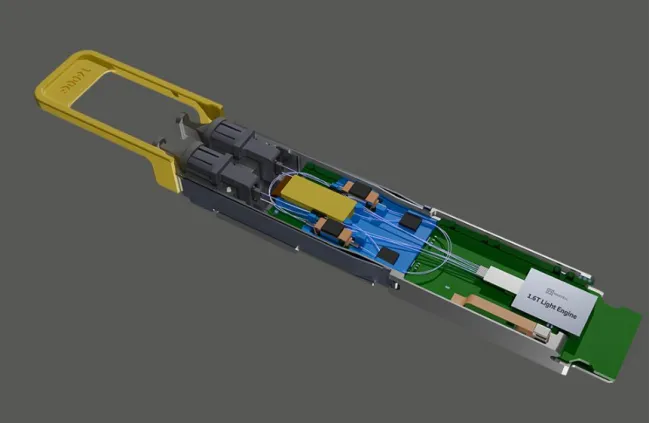
A 1.6T Silicon Photonics Optical Engine is a silicon-photonics integrated optical engine designed for 1.6Tbps-class opto-electrical conversion and short-reach high-speed interconnects. It usually integrates a SiPh PIC, modulators, photodetectors, optical coupling structures, driver/TIA/DSP electrical ICs, high-density packaging and testing processes. It can be used inside 1.6T pluggable optical modules, and can also serve NPO/CPO, board-mounted optical interconnects and Optical I/O architectures close to switch or accelerator chips.
1.1 Core judgment: growth depends on power efficiency of AI interconnects, not speed alone
The commercialization of 1.6T silicon photonic optical engines is not merely a rate upgrade from 800G to 1.6T. It is driven by the need for high-density, low-power, low-latency links in AI clusters. As switch-silicon bandwidth scales, copper reach and power face increasing constraints, making optical engines more critical either inside the module or closer to the package.
|
Dimension |
Conclusion |
Implication for the value chain |
|
Growth stage |
The global 1.6T Silicon Photonics Optical Engine market was about US$457 million in 2025; after 2026, AI data-center qualification and adoption will accelerate. |
Demand conversion depends on the move from 800G to 1.6T and the technical trade-off among LPO, CPO/NPO and pluggable routes. |
|
Product structure |
Pluggable optical engines remain the near-term mainstream, while NPO/CPO and board-mounted engines open long-term upside. |
SiPh PICs, optical coupling packaging, drivers/TIAs, low-power DSPs and thermal management become value-concentrated links. |
|
Application structure |
AI training/inference clusters are the largest application, with cloud data-center switch upgrades as a second growth curve. |
Procurement logic shifts from port speed alone to power per bit, latency, yield, supply resilience and maintainability. |
|
Regional pattern |
North American cloud companies drive demand, while Mainland China, Taiwan, China, Japan, South Korea and Southeast Asia scale manufacturing and packaging. |
Regional competition depends on terminal demand as well as wafer, packaging, testing and module manufacturing coordination. |
1.2 Market size and growth trend: US$470 million in 2025 as the public baseline, entering volume qualification
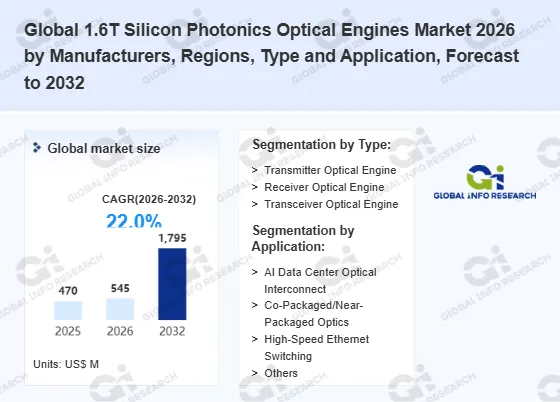
According to the latest report "Global 1.6T Silicon Photonics Optical Engines Market 2026 by Manufacturers, Regions, Type and Application, Forecast to 2032" published by GIR (Global Info Research), the global 1.6T Silicon Photonics Optical Engines market was valued at approximately USD 470 million in 2025 and is projected to reach USD 545 million in 2026. With a CAGR of 22.0% during the forecast period from 2026 to 2032, the market is expected to further expand to approximately USD 1795 million by 2032. This growth is driven by increasing market demand, evolving industry trends, and expanding application opportunities worldwide.
1.3 Competitive landscape and leading players: full-stack co-design becomes the dividing line
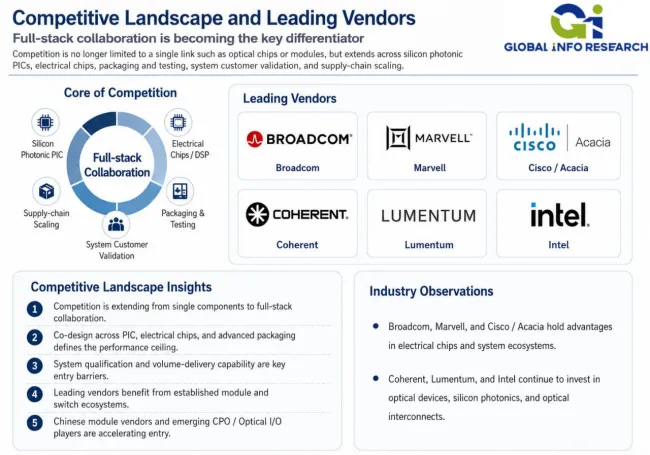
Competition is not limited to optical chips or optical modules alone. It spans SiPh PICs, electrical ICs, packaging and testing, system customer qualification and supply-chain scaling. Broadcom, Marvell, Cisco/Acacia, Coherent, Lumentum and Intel occupy important positions, while Chinese module suppliers and CPO/Optical I/O innovators are accelerating entry.
1.4 Product and application structure: pluggables first, CPO/NPO for long-term upside
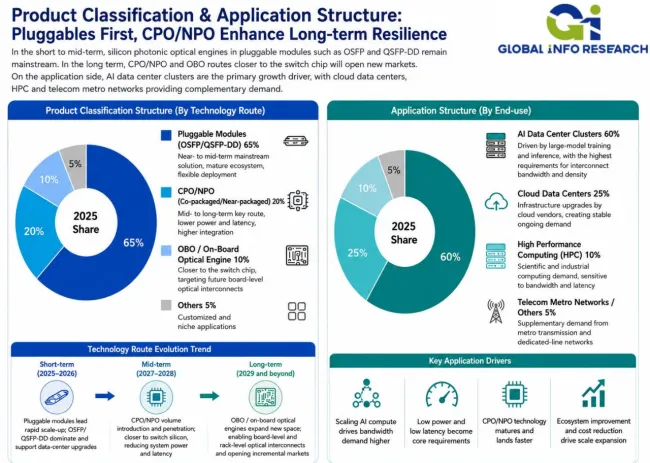
In the near term, OSFP and QSFP-DD pluggables remain the main form factor for silicon photonic optical engines. Over time, CPO/NPO and OBO routes closer to switch chips will open additional value. AI data-center clusters are the largest demand driver, while cloud data centers, HPC and telecom metro networks provide supplementary demand.
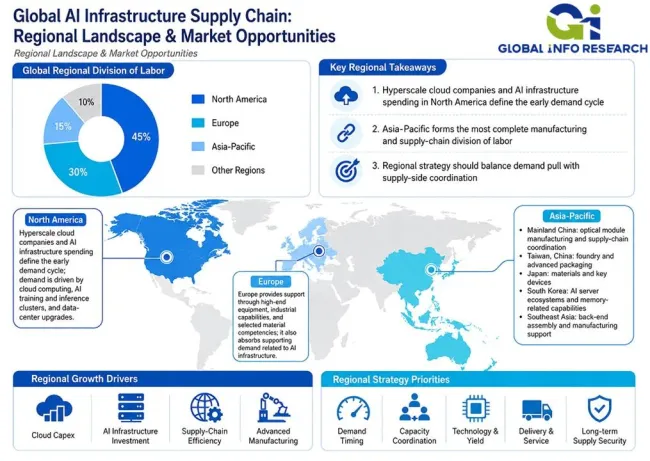
1.5 Regional landscape: North America drives demand, Asia scales the supply chain
Hyperscale cloud companies and AI infrastructure spending in North America define the early demand cycle. Mainland China, Taiwan, China, Japan, South Korea and Southeast Asia contribute through optical module manufacturing, foundry and advanced packaging, materials and devices, AI server ecosystems and back-end assembly.
Key market opportunities include:
AI computing power drives bandwidth upgrades, making 1.6T a definite requirement for the next generation.
The training of large AI models is fueling an explosive surge in internal data center traffic; as 800G technology increasingly hits bandwidth bottlenecks, 1.6T has emerged as the mainstream upgrade path for interconnecting switches and GPU clusters. This demand is being spearheaded by hyperscale cloud providers, ensuring high market certainty.
Silicon photonics and Co-Packaged Optics (CPO) are driving a shift up the value chain, positioning optical engines as a key source of incremental value.
Optical modules are evolving from pluggable form factors toward "optical engine + system-level integration." Silicon photonics offers advantages in high integration and low power consumption, while the accelerating adoption of CPO transforms the optical engine from a mere component into a core, platform-level element, significantly boosting its added value.
Supply chain restructuring creates opportunities for localization and specialized division of labor.
The global optical interconnect industry is undergoing restructuring, with silicon photonics design, advanced packaging, and optoelectronic co-design emerging as critical bottlenecks. China possesses advantages in packaging and manufacturing and is successfully entering the mid-stream of the 1.6T supply chain; however, there remains significant room for import substitution in high-end design and ecosystem development.
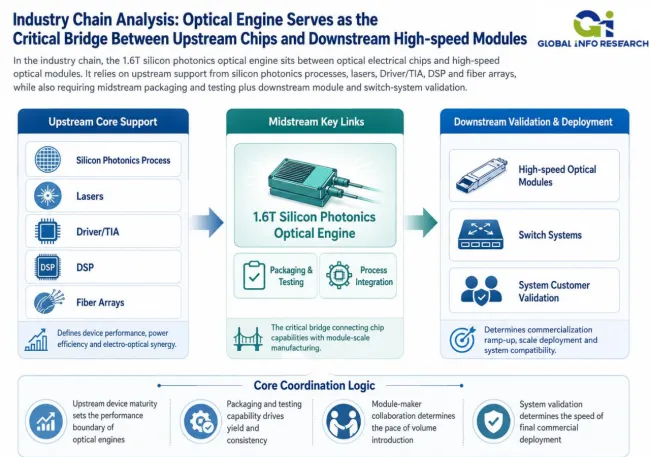
1.6 Industry-chain position: optical engine is the bridge between chips and high-speed modules
A 1.6T silicon photonic optical engine sits between optical/electrical chips and high-speed optical modules. It relies on SiPh processes, lasers, drivers/TIAs, DSPs and fiber arrays upstream, and requires packaging, testing and downstream module/switch system qualification.

1.7 Conclusion: the core variable is moving from “transmission works” to “low-power, manufacturable and repeatable”
Over the next few years, the key metrics will not be data rate alone, but power per bit, packaging yield, thermal stability, customer qualification cycles and supply continuity. If AI data-center customers can validate ROI across port density, energy consumption and system cost, the market will shift from sampling to scaled delivery.
1.6T Silicon Photonics Optical Engines Report Chapter Summary:
Chapter 1: 1.6T Silicon Photonics Optical Engines Industry Definition and Market Overview
This chapter clearly defines the product definition, characteristics, and industry statistical scope of 1.6T Silicon Photonics Optical Engines, systematically introduces its mainstream product classifications and key application areas, and presents the overall size and future outlook of the global market.
Chapter 2: In-depth Analysis of Core 1.6T Silicon Photonics Optical Engines Companies (2021-2025)
This chapter focuses on the main players in the 1.6T Silicon Photonics Optical Engines market. For each representative company, it not only introduces its basic overview, main business, and product portfolio, but also highlights its core operating data in the 1.6T Silicon Photonics Optical Engines field, including sales volume, sales revenue, pricing strategies, and the latest development trends of the company from 2021 to 2025.
Chapter 3: Global Competitive Landscape Analysis (2021-2025)
This chapter examines the global 1.6T Silicon Photonics Optical Engines competitive landscape from a macro perspective. By comparing the 1.6T Silicon Photonics Optical Engines sales volume, pricing, revenue, and market share of major companies from 2021 to 2025, it quantitatively analyzes market concentration and interprets the competitive strategies and market position evolution of core manufacturers.
Chapter 4: 1.6T Silicon Photonics Optical Engines Major Regional Market Size and Prospects (2021-2032)
This chapter conducts a regional-level analysis of the global 1.6T Silicon Photonics Optical Engines core markets. It will present historical data on the 1.6T Silicon Photonics Optical Engines market size (sales volume and revenue from 2021-2025) in major regions such as North America, Europe, and Asia Pacific, and provide market outlook forecasts for 2026-2032.
Chapter 5: 1.6T Silicon Photonics Optical Engines Product Type Segmentation Market Forecast (2021-2032)
This chapter delves into the 1.6T Silicon Photonics Optical Engines product structure. It will segment the 1.6T Silicon Photonics Optical Engines market by different types (such as Transmitter Optical Engine、Receiver Optical Engine、Transceiver Optical Engine, etc.), and analyze in detail the historical market size of each segmented product category from 2021 to 2025 and the future growth trends from 2026 to 2032.
Chapter 6: 1.6T Silicon Photonics Optical Engines Application Field Segmentation Market Forecast (2021-2032)
This chapter delves into the downstream application demand for 1.6T Silicon Photonics Optical Engines. The market will be segmented by different application areas (such as AI Data Center Optical Interconnect、Co-Packaged/Near-Packaged Optics、High-Speed Ethernet Switching、Others, etc.), presenting the historical market size for each area from 2021-2025 and future demand forecasts from 2026-2032.
Chapters 7-11: In-depth Analysis of Global Regional Markets (2021-2032)
This section is the core module of the 1.6T Silicon Photonics Optical Engines report, providing an in-depth country/regional analysis across five major regions: North America, Europe, Asia Pacific, South America, and the Middle East & Africa. The chapter structure for each region is consistent:
Segmentation by Country/Region: Analysis of the market size and forecasts for major countries within the region from 2021-2032.
Segmentation by Product Type: Presentation of the market structure and development forecasts for different product types within the region from 2021-2032.
Segmentation by Application Area: Analysis of market demand and prospects for different application areas within the region from 2021-2032.
Chapter 12: Global 1.6T Silicon Photonics Optical Engines Market Dynamics, Challenges, and Trends
This chapter aims to analyze the key internal and external factors affecting the development of the 1.6T Silicon Photonics Optical Engines market. It systematically reviews the core drivers of 1.6T Silicon Photonics Optical Engines market growth, the main obstacles and challenges faced, and assesses future product, technology, and market development trends.
Chapter 13: 1.6T Silicon Photonics Optical Engines Industry Chain Structure Analysis
This chapter analyzes the entire industry chain ecosystem of the 1.6T Silicon Photonics Optical Engines industry. From upstream raw material supply to midstream production and manufacturing, and then to downstream end-use applications, it analyzes the current status, cost structure, and collaborative relationships of each link.
Chapter 14: Sales Channel Model Research
This chapter focuses on the distribution channels of 1.6T Silicon Photonics Optical Engines products. It analyzes the market share, advantages and disadvantages, and typical cases of mainstream sales channels, and explores the innovation and development trends of channel models.
Chapter 15: Research Conclusions and Strategic Recommendations
As a summary of the report, this chapter will distill the core findings and conclusions of the entire report and, based on a comprehensive understanding of the 1.6T Silicon Photonics Optical Engines market, provide actionable strategic development recommendations for industry participants and potential entrants.
For more information, please refer to "Global 1.6T Silicon Photonics Optical Engines Market 2026 by Manufacturers, Regions, Type and Application, Forecast to 2032". This report analyzes the supply and demand situation, development status, and changes in the industry, focusing on the development status of the industry, how to face the development challenges of the industry, industry development suggestions, industry competitiveness, and industry investment analysis and trend forecasts. The report also summarizes the overall development dynamics of the industry, including the impact of the latest US tariffs on the global supply chain, the supply relationship analysis of the industrial chain, and provides reference suggestions and specific solutions for the industry in terms of products.
Previous News:
Global AI Fetal Ultrasound View Detection Software Market at USD 388 Million in 2026, Reaching USD 933 Million by 2032, CAGR 15.8%, Driven by Congenital Defect Screening Demand.
Next News:
Global Connected Gas Detection Device Market at USD 632 Million in 2026, Reaching USD 852 Million by 2032, CAGR 5.1%, Driven by Real-Time Monitoring Demand in High-Risk Industries.
The copyright of this article belongs to Global Info Research. Without the written authorization of our company, no organization or individual may reprint, quote, copy, adapt or use it for commercial purposes in any way. When authorized to use, the original source must be indicated as "Global Info Research" and the complete copyright information must be retained.
- We Provide Professional, Accurate Market Analysis to Help You Stay Ahead of Your Competition.Speak to our analyst >>

Our Clients
What We Can Provide?
With better results and higher quality products,Our professional reports can achieve four things:

Insight into the industry market information

Analyze market development needs

Prospects for future development

Develop industry investment strategy
- Digging deeper into global industry information and providing market strategies.Contact Us >>
- We Provide Professional, Accurate Market Analysis to Help You Stay Ahead of Your Competition.Speak to our analyst >>
Our Clients
What We Can Provide?
With better results and higher quality products,Our professional reports can achieve four things:
Insight into the industry market information
Analyze market development needs
Prospects for future development
Develop industry investment strategy
- Digging deeper into global industry information and providing market strategies.Contact Us >>