
Global Connected Gas Detection Device Market at USD 632 Million in 2026, Reaching USD 852 Million by 2032, CAGR 5.1%, Driven by Real-Time Monitoring Demand in High-Risk Industries.
Published Date: Friday,27 Nov,2026


 Connected Gas Detection Device
 Market Summary
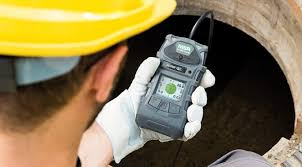
A Connected Gas Detection Device is an intelligent device capable of real-time monitoring the concentration of specific gases in the environment and transmitting data to a monitoring center via a network connection, enabling remote monitoring, early warning, and management. It integrates high-precision gas sensors, data acquisition modules, communication modules, and intelligent analysis software. Petrochemical, mining, laboratory safety, environmental protection, and public safety sectors, Connected Gas Detection Devices have become the core terminal of the "industrial IoT safety perception layer." Their technological evolution focuses on improving sensor sensitivity and selectivity, multi-gas composite detection, low power consumption with long battery life, edge computing and cloud-platform collaboration, as well as enhanced explosion-proof and extreme environment adaptability.
This growth is underpinned by three core factors: the rigid demand for real-time gas monitoring and accident prevention in high-risk industries such as petrochemicals and mining, stricter environmental regulations requiring online monitoring of industrial emissions like nitrogen oxides, and the promotion of large-scale deployment of wireless gas detection devices driven by industrial IoT and 5G infrastructure development. However, the impact of global trade landscape changes in 2025 on the supply chain of core components such as sensor chips, wireless communication modules, and batteries, coupled with differentiated demands for explosion-proof ratings, detection accuracy, communication protocols, and data compliance across different application scenarios, is profoundly shaping the product structure and competitive landscape of the global Connected Gas Detection Device market. The global market presents a pattern of "Europe and the US leading in technology, China rising in manufacturing, and Asia-Pacific driving demand." Asia-Pacific region (especially China), relying on the world's largest manufacturing and energy consumption markets, continuous government investment in safety production and environmental supervision, and rapid technological catch-up by local companies, has become the core engine of global market growth, releasing significant incremental space particularly in municipal pipelines, commercial premises, and household applications.
Global Connected Gas Detection Device Market Size (US$ Million)
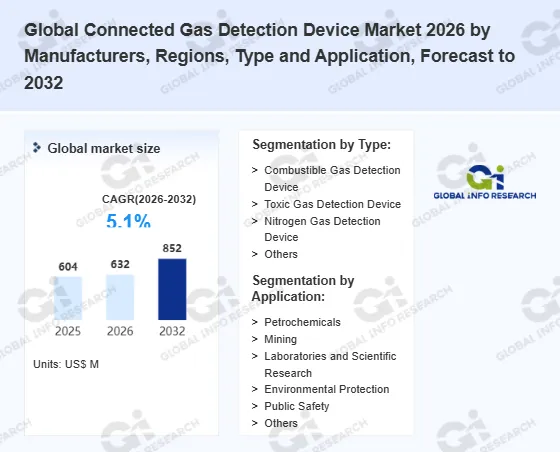
According to the latest report “Global Connected Gas Detection Device Market 2026 by Manufacturers, Regions, Type and Application, Forecast to 2032” published by GIR (Global Info Research), the global Connected Gas Detection Device market was valued at approximately USD 604 million in 2025 and is projected to reach USD 632 million in 2026. With a CAGR of 5.1% during the forecast period from 2026 to 2032, the market is expected to further expand to approximately USD 852 million by 2032. This growth is driven by increasing market demand, evolving industry trends, and expanding application opportunities worldwide.
Technology Characteristics & Product Classification
The core technological value of Connected Gas Detection Devices lies in transforming "manual inspection after a leak" into "real-time warning and remote linkage before a leak," thereby compressing accident response time from minutes to seconds. Key technological trends include: 1. Intelligent sensors and multi-gas compositing, with a single device integrating multiple sensing principles to simultaneously detect combustible, toxic, oxygen, and other gases, using internal algorithms for cross-interference compensation; 2. Low power consumption and long battery life design, using low-power communication protocols (e.g., NB-IoT, LoRaWAN) and intelligent sleep/wake mechanisms to achieve 3-5 year battery life for battery-powered devices, significantly reducing deployment and maintenance costs; 3. Edge computing and cloud-edge collaboration, with devices possessing preliminary data processing and alarm determination capabilities, uploading only critical events or abnormal data, reducing invalid data uploads and extending battery life, while cloud platforms use AI models to analyze concentration trends and predict leak risks.
By Type:
Combustible Gas Detection Device: Used to detect concentrations of combustible gases such as methane, propane, hydrogen, and acetylene, primarily based on catalytic combustion or infrared absorption principles. This type is a rigid necessity in industrial safety, widely used in petrochemicals, natural gas stations, coal mines, and commercial kitchens. In connected mode, the device can upload concentration values and alarm status in real-time to fire control rooms or safety supervision platforms. Estimated average price: 200−800 USD/unit.
Toxic Gas Detection Device: Used to detect toxic gases such as carbon monoxide, hydrogen sulfide, ammonia, and chlorine, primarily based on electrochemical sensors. Widely used in petrochemical plant areas, wastewater treatment plants, underground pipelines, and laboratories. Connected toxic gas detectors are seeing rapidly growing demand in metallurgy, papermaking, refrigeration, and other industries. Estimated average price: 300−1,000 USD/unit.
Nitrogen Gas Detection Device: Used to detect nitrogen oxides (NOx), primarily based on electrochemical or photoionization principles. Applied in environmental emission monitoring, boiler flue gas treatment, diesel engine exhaust detection, and laboratory ventilation control. With the tightening of global NOx emission standards (e.g., US EPA, EU Industrial Emissions Directive), demand in power generation, cement, steel, and vehicle emission testing is continuously rising. Estimated average price: 400−1,200 USD/unit.
Others (oxygen, volatile organic compounds, carbon dioxide, etc.): Account for a certain combined share.
By Application:
Petrochemicals: The largest application segment for Connected Gas Detection Devices, accounting for approximately 30%, covering oil & gas extraction, refining, storage & transportation, and gas stations, with the highest requirements for explosion-proof ratings (Ex d/Ex ib), corrosion resistance, and system integration.
Mining (coal, metal, and non-metal mines): Approximately 20%, with mandatory requirements for continuous monitoring of methane, carbon monoxide, and other gases, demanding dust resistance, vibration resistance, and intrinsically safe explosion-proof characteristics.
Environmental Protection: Approximately 15%, focusing on urban air quality grid monitoring, fugitive emission monitoring in industrial parks, and emergency monitoring, emphasizing solar power, field durability, and data upload stability.
Public Safety (fire rescue, underground pipelines, large event security): Approximately 15%, with significant demand for portable, fast response connected detection devices.
Laboratories and Scientific Research: Approximately 10%, emphasizing high precision, low detection limits, and data traceability.
Others (food cold chain, agricultural greenhouses, tunnel construction, etc.): Approximately 10%.
Actual Procurement & Application Characteristics
The procurement process for Connected Gas Detection Devices involves industrial enterprises (EHS departments, instrument workshops), engineering general contractors, fire engineering companies, and government regulatory departments. In large petrochemical or mining projects, devices are typically included in tender unifieds for safety instrumented systems, with technical specifications strictly defining explosion-proof ratings, ingress protection ratings (IP66/67), communication protocols (e.g., Modbus, OPC UA, MQTT), sensor ranges and accuracy, and platform data interface specifications. In medium-sized commercial and municipal projects, integrated procurement of "device + platform service" is common, emphasizing platform functionality (real-time dashboards, historical trends, multi-level alarm push) and inspection/maintenance services.
In terms of procurement structure, multinational corporations and high-end applications tend to purchase branded products with international explosion-proof certifications and SIL2/3 safety integrity level certifications. Domestic small and medium-sized industrial enterprises focus more on cost-effectiveness, ease of installation, and compatibility with existing supervision platforms. In public safety and environmental protection, government projects typically use public tenders with mandatory requirements for data upload capability to superior regulatory platforms.
Tariff Policies & Supply Chain Restructuring
Changes in the global trade landscape in 2025 are having structural impacts on the Connected Gas Detection Device market:
1. Supply Chain Risks for Gas Sensor Chips and Wireless Modules Become Evident. The supply of high-precision electrochemical sensors, infrared sources and detectors, and low-power wireless SoC chips is highly concentrated among a few European, American, and Japanese companies. Trade policy fluctuations may lead to extended delivery times and increased costs, forcing domestic companies to accelerate R&D and substitution of domestic sensors and establish diversified procurement channels. In recent years, domestic electrochemical sensors have gradually approached imported levels in performance (accuracy, lifespan), with significantly increased substitution rates in the mid-to-low-end market.
2. Regional Barriers in Explosion-Proof Certification Affect Market Access. Differences exist in certification systems for explosion-proof electrical products across countries (e.g., China CCC Ex, EU ATEX, international IECEx, North America UL/CSA). Product exports require multiple certifications, increasing compliance costs and market access timelines. Some large multinational procurement projects require both IECEx and target market local certifications.
3. Communication Frequency Bands and Data Localization Requirements Increase Delivery Complexity. Cellular communication (shifting from 2G/3G phase-out to 4G/5G/NB-IoT) used by Connected Gas Detection Devices must adapt to different carrier frequency bands. Some countries require device data to be stored on domestic servers, imposing localization requirements on cloud platform deployment strategies for multinational suppliers.
4. Environmental Regulations Drive Demand Growth for Nitrogen Oxide Detectors. With the upgrading of industrial emission standards globally, demand for continuous online monitoring systems for nitrogen oxides is increasing, driving market expansion for corresponding connected detection devices, particularly in power generation, cement, steel, and marine emission monitoring.
Market Participant Competitive Landscape Analysis
Global participants in the Connected Gas Detection Device market exhibit a distinct multi-level competitive landscape of "international sensor and safety giants leading, Chinese specialized manufacturers catching up, and regional brands deeply involved."
The upstream core focuses on gas-sensitive materials (electrodes, electrolytes, infrared sources, PID lamps), MEMS sensor chips, and low-power wireless communication chips. Core technology barriers are high, with global supply concentrated among a few European, American, and Japanese companies. Chinese companies are gradually achieving breakthroughs in electrochemical sensors and infrared detectors.
The midstream market presents a pattern of "European/American multinational safety groups + Chinese manufacturing enterprises + specialized gas detection brands" coexisting. International leading companies include: Dräger (Germany, global leader in gas detection and safety protection, covering portable and fixed connected detectors, known for high reliability across medical/industrial sectors), MSA Safety (USA, industrial safety equipment giant, leading market share in petrochemical and fire protection), Industrial Scientific (USA, part of Fortive group, focusing on gas detection and connected safety solutions, its iNet platform is an industry benchmark), Blackline Safety (Canada, known for integrated "hardware + cellular IoT + cloud platform" model, focusing on personnel area gas safety monitoring), Teledyne (USA, its gas and flame detection division provides high-end optical gas detectors), GfG (Germany, specializing in portable and fixed gas detection systems), RKI Instruments (USA, fixed and portable gas detector manufacturer), GDS Corp (USA, focusing on industrial gas detection system integration), Armstrong Monitoring (Canada, fixed gas detection system supplier), Sensitron Srl (Italy, specializing in gas detection for explosive environments), Macurco Inc (USA, providing commercial and industrial gas detection solutions), and Invest Electronics Ltd (focusing on gas detection and alarm systems). These companies have built deep barriers in sensor technology, explosion-proof certifications, industry application experience, and global service networks.
Chinese local companies are rapidly rising. Hanwei Electronics Group is a leading Chinese enterprise in gas sensors and gas detection instruments, covering semiconductor, electrochemical, infrared, and other sensing principles. Its Connected Gas Detection Devices are widely used in smart gas, smart environmental protection, industrial safety, and other fields, and it is actively expanding overseas markets.
Downstream end demand is primarily composed of petrochemical enterprises, mining groups, environmental monitoring stations, fire rescue teams, large industrial parks, and municipal pipeline network operators. Petrochemicals and mining constitute the core market with equal weight on existing and incremental demand; environmental protection and public safety contribute to incremental market expansion.
Future Development Outlook
In the future, Connected Gas Detection Devices will continue to evolve around three main themes: industrial safety intelligence, urban lifeline projects, and digital environmental supervision.
In the industrial safety field, with the advancement of the "Industrial Internet + Safety Production" action plan for hazardous chemical enterprises, petrochemical and chemical industrial parks will build full-coverage wireless gas detection networks, deeply integrating with personnel positioning, video surveillance, and emergency command systems to achieve intelligent leak source tracing and dynamic evacuation route planning.
In the urban lifeline project field, demand for wireless gas detection devices in enclosed spaces such as urban gas pipelines, underground utility tunnels, and drainage culverts is growing rapidly. Devices need low power consumption, high ingress protection (IP68), explosion-proof capability, and the ability to connect with urban safety operation monitoring platforms.
In the environmental protection and public safety field, gridded air quality monitoring and mobile emergency monitoring will drive the deployment of solar-powered, miniaturized, portable Connected Gas Detection Devices. In large event security and fire rescue, gas detection payloads mounted on drones or robots will provide real-time risk criteria for on-site command.
In the technology convergence direction, the combination of gas detection and digital twin technology will enable visual simulation of leak dispersion ranges; edge AI will be used for feature extraction of sensor signals and early weak leak identification; and device lifecycle management platforms will evolve from "data aggregation" to "health diagnosis + predictive maintenance + decision support."
Overall, the Connected Gas Detection Device industry remains in a phase of parallel technological iteration and scenario deepening. With the continuous improvement of global industrial safety standards, the digital upgrading of environmental supervision, and the improvement of IoT infrastructure, the industry's long-term growth is highly certain. It is expected to gradually upgrade from "safety compliance equipment" to "intelligent perception infrastructure for industrial and environmental safety."
Connected Gas Detection Device Report Chapter Summary:
Chapter 1: Connected Gas Detection Device Industry Definition and Market Overview
This chapter clearly defines the product definition, characteristics, and industry statistical scope of Connected Gas Detection Device, systematically introduces its mainstream product classifications and key application areas, and presents the overall size and future outlook of the global market.
Chapter 2: In-depth Analysis of Core Connected Gas Detection Device Companies (2021-2025)
This chapter focuses on the main players in the Connected Gas Detection Device market. For each representative company, it not only introduces its basic overview, main business, and product portfolio, but also highlights its core operating data in the Connected Gas Detection Device field, including sales volume, sales revenue, pricing strategies, and the latest development trends of the company from 2021 to 2025.
Chapter 3: Global Competitive Landscape Analysis (2021-2025)
This chapter examines the global Connected Gas Detection Device competitive landscape from a macro perspective. By comparing the Connected Gas Detection Device sales volume, pricing, revenue, and market share of major companies from 2021 to 2025, it quantitatively analyzes market concentration and interprets the competitive strategies and market position evolution of core manufacturers.
Chapter 4: Connected Gas Detection Device Major Regional Market Size and Prospects (2021-2032)
This chapter conducts a regional-level analysis of the global Connected Gas Detection Device core markets. It will present historical data on the Connected Gas Detection Device market size (sales volume and revenue from 2021-2025) in major regions such as North America, Europe, and Asia Pacific, and provide market outlook forecasts for 2026-2032.
Chapter 5: Connected Gas Detection Device Product Type Segmentation Market Forecast (2021-2032)
This chapter delves into the Connected Gas Detection Device product structure. It will segment the Connected Gas Detection Device market by different types (such as Combustible Gas Detection Device、Toxic Gas Detection Device、Nitrogen Gas Detection Device、Others, etc.), and analyze in detail the historical market size of each segmented product category from 2021 to 2025 and the future growth trends from 2026 to 2032.
Chapter 6: Connected Gas Detection Device Application Field Segmentation Market Forecast (2021-2032)
This chapter delves into the downstream application demand for Connected Gas Detection Device. The market will be segmented by different application areas (such as Petrochemicals、Mining、Laboratories and Scientific Research、Environmental Protection、Public Safety、Others, etc.), presenting the historical market size for each area from 2021-2025 and future demand forecasts from 2026-2032.
Chapters 7-11: In-depth Analysis of Global Regional Markets (2021-2032)
This section is the core module of the Connected Gas Detection Device report, providing an in-depth country/regional analysis across five major regions: North America, Europe, Asia Pacific, South America, and the Middle East & Africa. The chapter structure for each region is consistent:
Segmentation by Country/Region: Analysis of the market size and forecasts for major countries within the region from 2021-2032.
Segmentation by Product Type: Presentation of the market structure and development forecasts for different product types within the region from 2021-2032.
Segmentation by Application Area: Analysis of market demand and prospects for different application areas within the region from 2021-2032.
Chapter 12: Global Connected Gas Detection Device Market Dynamics, Challenges, and Trends
This chapter aims to analyze the key internal and external factors affecting the development of the Connected Gas Detection Device market. It systematically reviews the core drivers of Connected Gas Detection Device market growth, the main obstacles and challenges faced, and assesses future product, technology, and market development trends.
Chapter 13: Connected Gas Detection Device Industry Chain Structure Analysis
This chapter analyzes the entire industry chain ecosystem of the Connected Gas Detection Device industry. From upstream raw material supply to midstream production and manufacturing, and then to downstream end-use applications, it analyzes the current status, cost structure, and collaborative relationships of each link.
Chapter 14: Sales Channel Model Research
This chapter focuses on the distribution channels of Connected Gas Detection Device products. It analyzes the market share, advantages and disadvantages, and typical cases of mainstream sales channels, and explores the innovation and development trends of channel models.
Chapter 15: Research Conclusions and Strategic Recommendations
As a summary of the report, this chapter will distill the core findings and conclusions of the entire report and, based on a comprehensive understanding of the Connected Gas Detection Device market, provide actionable strategic development recommendations for industry participants and potential entrants.
For more information, please refer to "Global Connected Gas Detection Device Market 2026 by Manufacturers, Regions, Type and Application, Forecast to 2032". This report analyzes the supply and demand situation, development status, and changes in the industry, focusing on the development status of the industry, how to face the development challenges of the industry, industry development suggestions, industry competitiveness, and industry investment analysis and trend forecasts. The report also summarizes the overall development dynamics of the industry, including the impact of the latest US tariffs on the global supply chain, the supply relationship analysis of the industrial chain, and provides reference suggestions and specific solutions for the industry in terms of products.
Previous News:
Global 1.6T Silicon Photonics Optical Engine Market in Depth: USD 545 Million Scale, Full-Stack Competition, Industry Chain and the USD 1.795 Billion Strategic Opportunity by 2032.
Next News:
Environmental Solvent Upgrades toward Electronic-Grade Products: 1-Methoxy-2-Propanol at CAGR 4.5% to USD 1.659 Billion by 2032, Led by ≥99% High-Purity Grades.
The copyright of this article belongs to Global Info Research. Without the written authorization of our company, no organization or individual may reprint, quote, copy, adapt or use it for commercial purposes in any way. When authorized to use, the original source must be indicated as "Global Info Research" and the complete copyright information must be retained.
- We Provide Professional, Accurate Market Analysis to Help You Stay Ahead of Your Competition.Speak to our analyst >>

Our Clients
What We Can Provide?
With better results and higher quality products,Our professional reports can achieve four things:

Insight into the industry market information

Analyze market development needs

Prospects for future development

Develop industry investment strategy
- Digging deeper into global industry information and providing market strategies.Contact Us >>
- We Provide Professional, Accurate Market Analysis to Help You Stay Ahead of Your Competition.Speak to our analyst >>
Our Clients
What We Can Provide?
With better results and higher quality products,Our professional reports can achieve four things:
Insight into the industry market information
Analyze market development needs
Prospects for future development
Develop industry investment strategy
- Digging deeper into global industry information and providing market strategies.Contact Us >>